

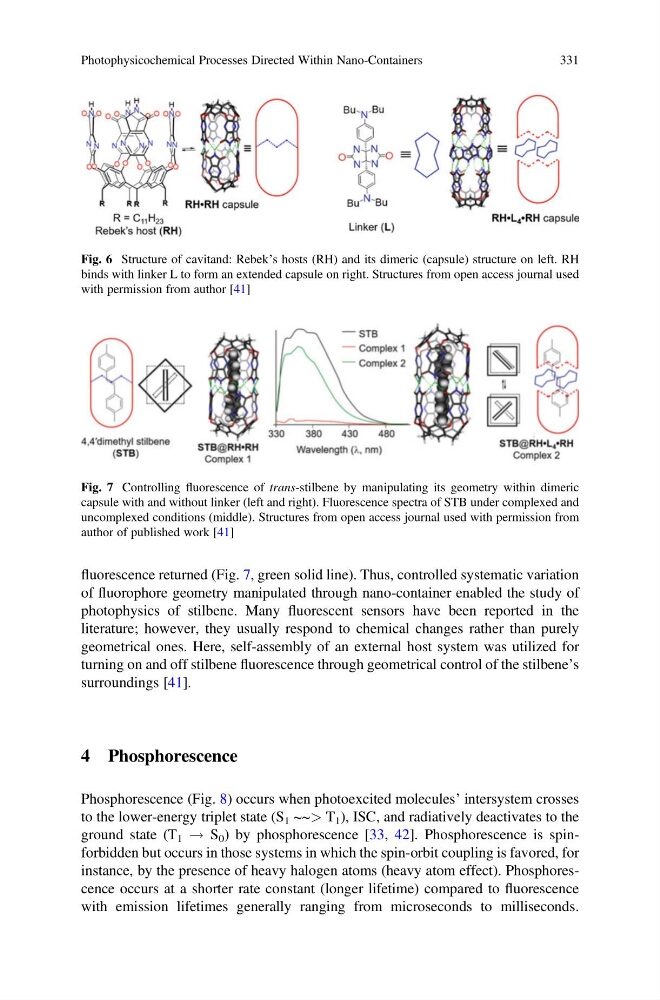
fluorescence returned (Fig. 7, green solid line). Thus, controlled systematic variation
of fluorophore geometry manipulated through nano-container enabled the study of
photophysics of stilbene. Many fluorescent sensors have been reported in the
literature; however, they usually respond to chemical changes rather than purely
geometrical ones. Here, self-assembly of an external host system was utilized for
turning on and off stilbene fluorescence through geometrical control of the stilbene’s
surroundings [41].
4 Phosphorescence
Phosphorescence (Fig. 8) occurs when photoexcited molecules’ intersystem crosses
to the lower-energy triplet state (S 1 ~~> T 1 ), ISC, and radiatively deactivates to the
ground state (T 1 ! S 0 ) by phosphorescence [33, 42]. Phosphorescence is spinforbidden but occurs in those systems in which the spin-orbit coupling is favored, for
instance, by the presence of heavy halogen atoms (heavy atom effect). Phosphorescence occurs at a shorter rate constant (longer lifetime) compared to fluorescence
with emission lifetimes generally ranging from microseconds to milliseconds.
Fig. 6 Structure of cavitand: Rebek’s hosts (RH) and its dimeric (capsule) structure on left. RH
binds with linker L to form an extended capsule on right. Structures from open access journal used
with permission from author [41]
Fig. 7 Controlling fluorescence of trans-stilbene by manipulating its geometry within dimeric
capsule with and without linker (left and right). Fluorescence spectra of STB under complexed and
uncomplexed conditions (middle). Structures from open access journal used with permission from
author of published work [41]
Photophysicochemical Processes Directed Within Nano-Containers
331
of fluorophore geometry manipulated through nano-container enabled the study of
photophysics of stilbene. Many fluorescent sensors have been reported in the
literature; however, they usually respond to chemical changes rather than purely
geometrical ones. Here, self-assembly of an external host system was utilized for
turning on and off stilbene fluorescence through geometrical control of the stilbene’s
surroundings [41].
4 Phosphorescence
Phosphorescence (Fig. 8) occurs when photoexcited molecules’ intersystem crosses
to the lower-energy triplet state (S 1 ~~> T 1 ), ISC, and radiatively deactivates to the
ground state (T 1 ! S 0 ) by phosphorescence [33, 42]. Phosphorescence is spinforbidden but occurs in those systems in which the spin-orbit coupling is favored, for
instance, by the presence of heavy halogen atoms (heavy atom effect). Phosphorescence occurs at a shorter rate constant (longer lifetime) compared to fluorescence
with emission lifetimes generally ranging from microseconds to milliseconds.
Fig. 6 Structure of cavitand: Rebek’s hosts (RH) and its dimeric (capsule) structure on left. RH
binds with linker L to form an extended capsule on right. Structures from open access journal used
with permission from author [41]
Fig. 7 Controlling fluorescence of trans-stilbene by manipulating its geometry within dimeric
capsule with and without linker (left and right). Fluorescence spectra of STB under complexed and
uncomplexed conditions (middle). Structures from open access journal used with permission from
author of published work [41]
Photophysicochemical Processes Directed Within Nano-Containers
331