

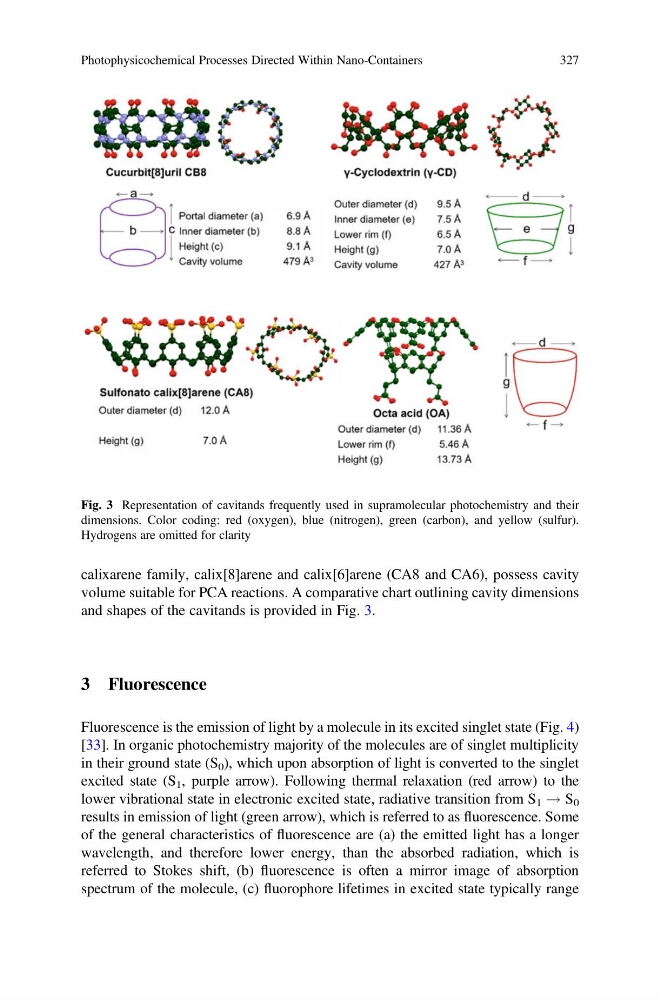
calixarene family, calix[8]arene and calix[6]arene (CA8 and CA6), possess cavity
volume suitable for PCA reactions. A comparative chart outlining cavity dimensions
and shapes of the cavitands is provided in Fig. 3.
3 Fluorescence
Fluorescence is the emission of light by a molecule in its excited singlet state (Fig. 4)
[33]. In organic photochemistry majority of the molecules are of singlet multiplicity
in their ground state (S 0 ), which upon absorption of light is converted to the singlet
excited state (S 1 , purple arrow). Following thermal relaxation (red arrow) to the
lower vibrational state in electronic excited state, radiative transition from S 1 ! S 0
results in emission of light (green arrow), which is referred to as fluorescence. Some
of the general characteristics of fluorescence are (a) the emitted light has a longer
wavelength, and therefore lower energy, than the absorbed radiation, which is
referred to Stokes shift, (b) fluorescence is often a mirror image of absorption
spectrum of the molecule, (c) fluorophore lifetimes in excited state typically range
Fig. 3 Representation of cavitands frequently used in supramolecular photochemistry and their
dimensions. Color coding: red (oxygen), blue (nitrogen), green (carbon), and yellow (sulfur).
Hydrogens are omitted for clarity
Photophysicochemical Processes Directed Within Nano-Containers
327
volume suitable for PCA reactions. A comparative chart outlining cavity dimensions
and shapes of the cavitands is provided in Fig. 3.
3 Fluorescence
Fluorescence is the emission of light by a molecule in its excited singlet state (Fig. 4)
[33]. In organic photochemistry majority of the molecules are of singlet multiplicity
in their ground state (S 0 ), which upon absorption of light is converted to the singlet
excited state (S 1 , purple arrow). Following thermal relaxation (red arrow) to the
lower vibrational state in electronic excited state, radiative transition from S 1 ! S 0
results in emission of light (green arrow), which is referred to as fluorescence. Some
of the general characteristics of fluorescence are (a) the emitted light has a longer
wavelength, and therefore lower energy, than the absorbed radiation, which is
referred to Stokes shift, (b) fluorescence is often a mirror image of absorption
spectrum of the molecule, (c) fluorophore lifetimes in excited state typically range
Fig. 3 Representation of cavitands frequently used in supramolecular photochemistry and their
dimensions. Color coding: red (oxygen), blue (nitrogen), green (carbon), and yellow (sulfur).
Hydrogens are omitted for clarity
Photophysicochemical Processes Directed Within Nano-Containers
327