

between pico- to hundreds of nanoseconds, and (d) the quantum yield of fluorescence (Φ f ) is independent of wavelength of excitation. Fluorescence has many
practical applications, including bio- and material imaging, medicine, sensing,
labeling, and optical devices.
Efficiency of fluorescence is increased by reducing the efficiency of other competing pathways such as intersystem crossing (ISC, S 1 ! T 1 ), energy transfer (ET),
non-radiative relaxation, or other competing processes such as photochemical
change. Supramolecular strategies for enhancing fluorescence should, therefore,
involve the use of weak interactions to thwart the competing pathways. Cavitands
have been employed to enhance fluorescence by increasing rigidity of fluorophores
to prevent S 1 ! S O IC (which requires conformational freedom), thwarting
autoquenching by reducing aggregation, and promoting energy transfer of previously excited chromophore.
One such representative approach to observing fluorescence through energy
transfer between aromatic hydrocarbons and squaraines (SQ) was demonstrated by
Mako et al. [34]. Energy transfer between excited anthracene and ground-state
squaraine to exhibit its near-infrared emission, after UV excitation, was achieved
through supramolecular association. This energy transfer occurs inside the
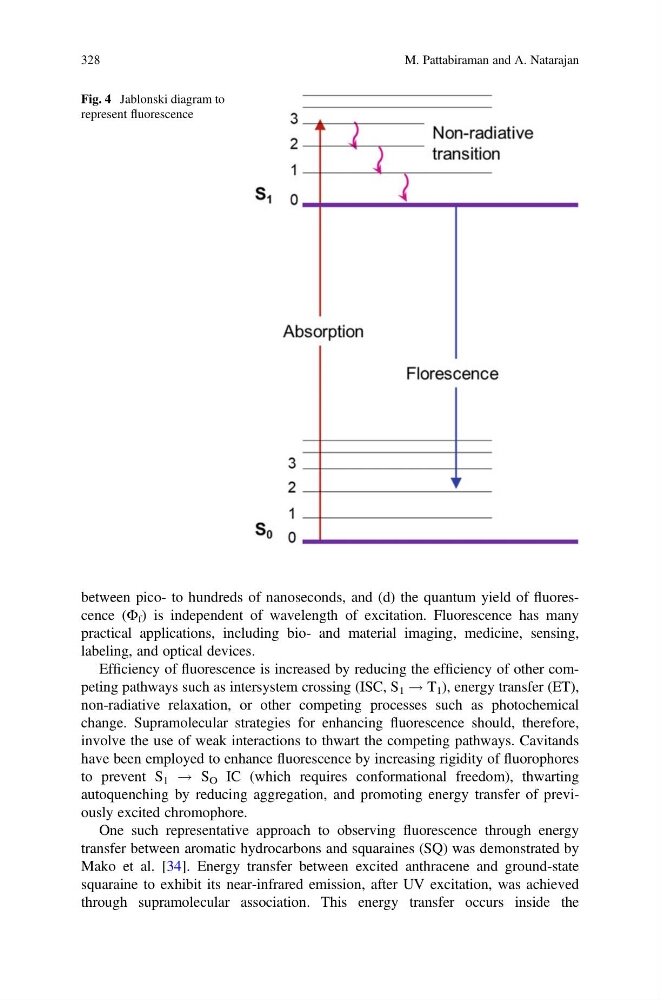
Fig. 4 Jablonski diagram to
represent fluorescence
328
M. Pattabiraman and A. Natarajan
practical applications, including bio- and material imaging, medicine, sensing,
labeling, and optical devices.
Efficiency of fluorescence is increased by reducing the efficiency of other competing pathways such as intersystem crossing (ISC, S 1 ! T 1 ), energy transfer (ET),
non-radiative relaxation, or other competing processes such as photochemical
change. Supramolecular strategies for enhancing fluorescence should, therefore,
involve the use of weak interactions to thwart the competing pathways. Cavitands
have been employed to enhance fluorescence by increasing rigidity of fluorophores
to prevent S 1 ! S O IC (which requires conformational freedom), thwarting
autoquenching by reducing aggregation, and promoting energy transfer of previously excited chromophore.
One such representative approach to observing fluorescence through energy
transfer between aromatic hydrocarbons and squaraines (SQ) was demonstrated by
Mako et al. [34]. Energy transfer between excited anthracene and ground-state
squaraine to exhibit its near-infrared emission, after UV excitation, was achieved
through supramolecular association. This energy transfer occurs inside the
Fig. 4 Jablonski diagram to
represent fluorescence
328
M. Pattabiraman and A. Natarajan