

Several hosts are available for supramolecular chemists currently, though a few
macrocycles have been employed more frequently than others. Cyclodextrins (CDs)
and cucurbiturils (CBs) are arguably the most commonly utilized organic hosts due
to their supramolecular versatility, easy synthetic accessibility, and aqueous amenability. Calixarenes (CAs) are the next most commonly utilized host, though to a
much lower extent than the former. Each family of aforementioned macrocycles
possesses oligomers that are of comparable dimensions to each other, due to which
they affect similar photochemical outcome in many instances. At the same time,
differences in their chemical functionalities, therefore different modes of interactions, have led to markedly different photochemistry as well. Octa acid (OA) is a
relatively newly synthesized host with unique host characteristics, which has given
rise to previously unobserved inclusion dynamics and therefore supramolecular
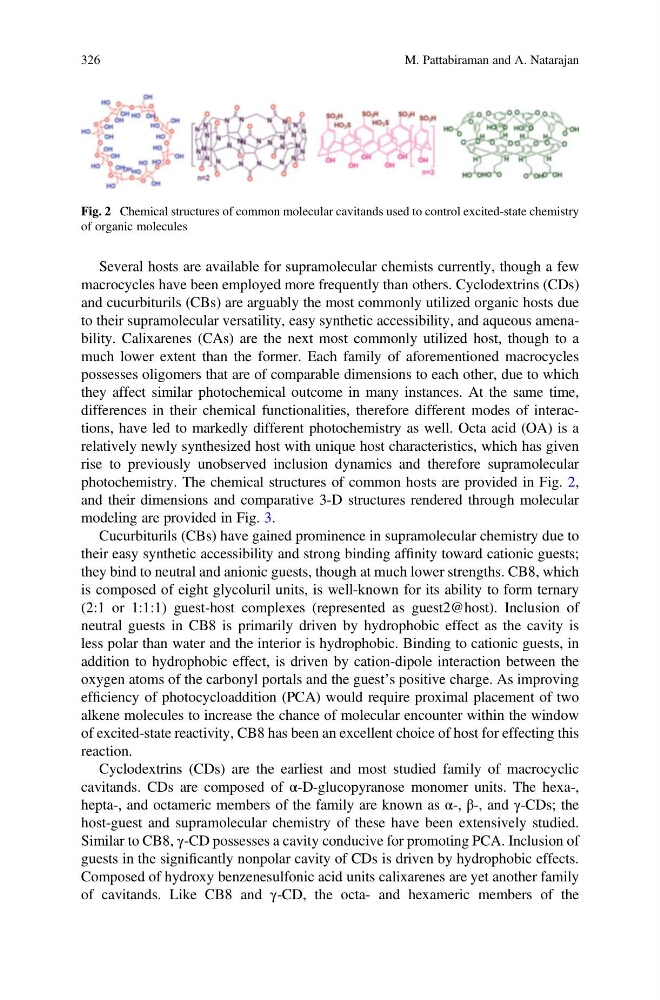
photochemistry. The chemical structures of common hosts are provided in Fig. 2,
and their dimensions and comparative 3-D structures rendered through molecular
modeling are provided in Fig. 3.
Cucurbiturils (CBs) have gained prominence in supramolecular chemistry due to
their easy synthetic accessibility and strong binding affinity toward cationic guests;
they bind to neutral and anionic guests, though at much lower strengths. CB8, which
is composed of eight glycoluril units, is well-known for its ability to form ternary
(2:1 or 1:1:1) guest-host complexes (represented as guest2@host). Inclusion of
neutral guests in CB8 is primarily driven by hydrophobic effect as the cavity is
less polar than water and the interior is hydrophobic. Binding to cationic guests, in
addition to hydrophobic effect, is driven by cation-dipole interaction between the
oxygen atoms of the carbonyl portals and the guest’s positive charge. As improving
efficiency of photocycloaddition (PCA) would require proximal placement of two
alkene molecules to increase the chance of molecular encounter within the window
of excited-state reactivity, CB8 has been an excellent choice of host for effecting this
reaction.
Cyclodextrins (CDs) are the earliest and most studied family of macrocyclic
cavitands. CDs are composed of α-D-glucopyranose monomer units. The hexa-,
hepta-, and octameric members of the family are known as α-, β-, and γ-CDs; the
host-guest and supramolecular chemistry of these have been extensively studied.
Similar to CB8, γ-CD possesses a cavity conducive for promoting PCA. Inclusion of
guests in the significantly nonpolar cavity of CDs is driven by hydrophobic effects.
Composed of hydroxy benzenesulfonic acid units calixarenes are yet another family
of cavitands. Like CB8 and γ-CD, the octa- and hexameric members of the
Fig. 2 Chemical structures of common molecular cavitands used to control excited-state chemistry
of organic molecules
326
M. Pattabiraman and A. Natarajan
macrocycles have been employed more frequently than others. Cyclodextrins (CDs)
and cucurbiturils (CBs) are arguably the most commonly utilized organic hosts due
to their supramolecular versatility, easy synthetic accessibility, and aqueous amenability. Calixarenes (CAs) are the next most commonly utilized host, though to a
much lower extent than the former. Each family of aforementioned macrocycles
possesses oligomers that are of comparable dimensions to each other, due to which
they affect similar photochemical outcome in many instances. At the same time,
differences in their chemical functionalities, therefore different modes of interactions, have led to markedly different photochemistry as well. Octa acid (OA) is a
relatively newly synthesized host with unique host characteristics, which has given
rise to previously unobserved inclusion dynamics and therefore supramolecular
photochemistry. The chemical structures of common hosts are provided in Fig. 2,
and their dimensions and comparative 3-D structures rendered through molecular
modeling are provided in Fig. 3.
Cucurbiturils (CBs) have gained prominence in supramolecular chemistry due to
their easy synthetic accessibility and strong binding affinity toward cationic guests;
they bind to neutral and anionic guests, though at much lower strengths. CB8, which
is composed of eight glycoluril units, is well-known for its ability to form ternary
(2:1 or 1:1:1) guest-host complexes (represented as guest2@host). Inclusion of
neutral guests in CB8 is primarily driven by hydrophobic effect as the cavity is
less polar than water and the interior is hydrophobic. Binding to cationic guests, in
addition to hydrophobic effect, is driven by cation-dipole interaction between the
oxygen atoms of the carbonyl portals and the guest’s positive charge. As improving
efficiency of photocycloaddition (PCA) would require proximal placement of two
alkene molecules to increase the chance of molecular encounter within the window
of excited-state reactivity, CB8 has been an excellent choice of host for effecting this
reaction.
Cyclodextrins (CDs) are the earliest and most studied family of macrocyclic
cavitands. CDs are composed of α-D-glucopyranose monomer units. The hexa-,
hepta-, and octameric members of the family are known as α-, β-, and γ-CDs; the
host-guest and supramolecular chemistry of these have been extensively studied.
Similar to CB8, γ-CD possesses a cavity conducive for promoting PCA. Inclusion of
guests in the significantly nonpolar cavity of CDs is driven by hydrophobic effects.
Composed of hydroxy benzenesulfonic acid units calixarenes are yet another family
of cavitands. Like CB8 and γ-CD, the octa- and hexameric members of the
Fig. 2 Chemical structures of common molecular cavitands used to control excited-state chemistry
of organic molecules
326
M. Pattabiraman and A. Natarajan