

metal organic frameworks [29] have enabled exploration of otherwise unexplored
aspects of excited-state processes. The range of photoreactions explored within
cavitands is wide, and their utility in understanding fundamental aspects of photochemistry is profound. Comparison of photophysicochemical events of free and
encapsulated molecules has provided innate understanding about the electronic
properties of excited states; such efforts have also benefited the supramolecular
community as the interpretation of observed deviation from photochemistry of
nascent chromophores providing insight into the nature of supramolecular interactions that drive that change. On the applied side, host-guest interactions have
provided the niche required for realizing photochemical technologies [30–
32]. This chapter will present a conceptual overview of the fundamental science
underlying the latest advancement in the field of supramolecular chemistry.
2 Host-Guest Chemistry and Nano-Containers
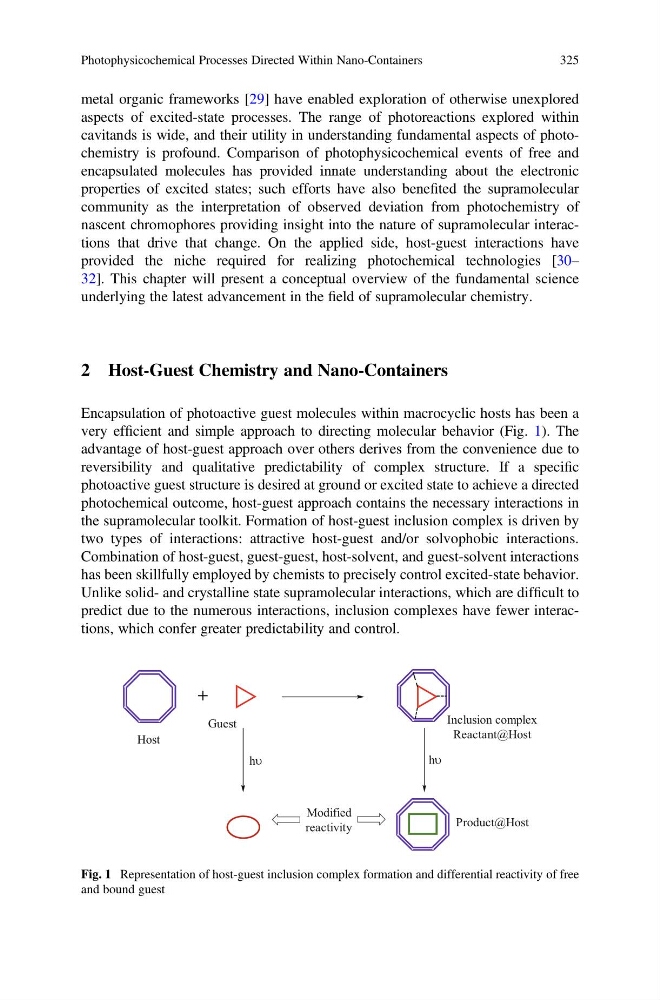
Encapsulation of photoactive guest molecules within macrocyclic hosts has been a
very efficient and simple approach to directing molecular behavior (Fig. 1). The
advantage of host-guest approach over others derives from the convenience due to
reversibility and qualitative predictability of complex structure. If a specific
photoactive guest structure is desired at ground or excited state to achieve a directed
photochemical outcome, host-guest approach contains the necessary interactions in
the supramolecular toolkit. Formation of host-guest inclusion complex is driven by
two types of interactions: attractive host-guest and/or solvophobic interactions.
Combination of host-guest, guest-guest, host-solvent, and guest-solvent interactions
has been skillfully employed by chemists to precisely control excited-state behavior.
Unlike solid- and crystalline state supramolecular interactions, which are difficult to
predict due to the numerous interactions, inclusion complexes have fewer interactions, which confer greater predictability and control.
Host
Guest
Inclusion complex
Reactant@Host
h
h
Modified
reactivity
Product@Host
Fig. 1 Representation of host-guest inclusion complex formation and differential reactivity of free
and bound guest
Photophysicochemical Processes Directed Within Nano-Containers
325
aspects of excited-state processes. The range of photoreactions explored within
cavitands is wide, and their utility in understanding fundamental aspects of photochemistry is profound. Comparison of photophysicochemical events of free and
encapsulated molecules has provided innate understanding about the electronic
properties of excited states; such efforts have also benefited the supramolecular
community as the interpretation of observed deviation from photochemistry of
nascent chromophores providing insight into the nature of supramolecular interactions that drive that change. On the applied side, host-guest interactions have
provided the niche required for realizing photochemical technologies [30–
32]. This chapter will present a conceptual overview of the fundamental science
underlying the latest advancement in the field of supramolecular chemistry.
2 Host-Guest Chemistry and Nano-Containers
Encapsulation of photoactive guest molecules within macrocyclic hosts has been a
very efficient and simple approach to directing molecular behavior (Fig. 1). The
advantage of host-guest approach over others derives from the convenience due to
reversibility and qualitative predictability of complex structure. If a specific
photoactive guest structure is desired at ground or excited state to achieve a directed
photochemical outcome, host-guest approach contains the necessary interactions in
the supramolecular toolkit. Formation of host-guest inclusion complex is driven by
two types of interactions: attractive host-guest and/or solvophobic interactions.
Combination of host-guest, guest-guest, host-solvent, and guest-solvent interactions
has been skillfully employed by chemists to precisely control excited-state behavior.
Unlike solid- and crystalline state supramolecular interactions, which are difficult to
predict due to the numerous interactions, inclusion complexes have fewer interactions, which confer greater predictability and control.
Host
Guest
Inclusion complex
Reactant@Host
h
h
Modified
reactivity
Product@Host
Fig. 1 Representation of host-guest inclusion complex formation and differential reactivity of free
and bound guest
Photophysicochemical Processes Directed Within Nano-Containers
325