

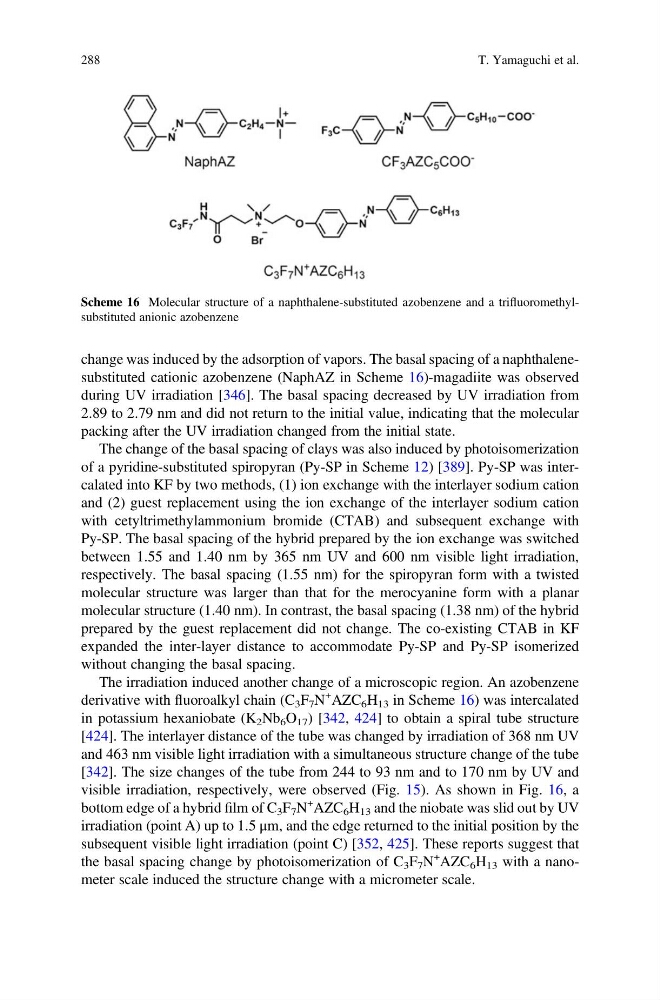
change was induced by the adsorption of vapors. The basal spacing of a naphthalenesubstituted cationic azobenzene (NaphAZ in Scheme 16)-magadiite was observed
during UV irradiation [346]. The basal spacing decreased by UV irradiation from
2.89 to 2.79 nm and did not return to the initial value, indicating that the molecular
packing after the UV irradiation changed from the initial state.
The change of the basal spacing of clays was also induced by photoisomerization
of a pyridine-substituted spiropyran (Py-SP in Scheme 12) [389]. Py-SP was intercalated into KF by two methods, (1) ion exchange with the interlayer sodium cation
and (2) guest replacement using the ion exchange of the interlayer sodium cation
with cetyltrimethylammonium bromide (CTAB) and subsequent exchange with
Py-SP. The basal spacing of the hybrid prepared by the ion exchange was switched
between 1.55 and 1.40 nm by 365 nm UV and 600 nm visible light irradiation,
respectively. The basal spacing (1.55 nm) for the spiropyran form with a twisted
molecular structure was larger than that for the merocyanine form with a planar
molecular structure (1.40 nm). In contrast, the basal spacing (1.38 nm) of the hybrid
prepared by the guest replacement did not change. The co-existing CTAB in KF
expanded the inter-layer distance to accommodate Py-SP and Py-SP isomerized
without changing the basal spacing.
The irradiation induced another change of a microscopic region. An azobenzene
derivative with fluoroalkyl chain (C 3 F 7 N
+ AZC 6 H 13 in Scheme 16) was intercalated
in potassium hexaniobate (K 2 Nb 6 O 17 ) [342, 424] to obtain a spiral tube structure
[424]. The interlayer distance of the tube was changed by irradiation of 368 nm UV
and 463 nm visible light irradiation with a simultaneous structure change of the tube
[342]. The size changes of the tube from 244 to 93 nm and to 170 nm by UV and
visible irradiation, respectively, were observed (Fig. 15). As shown in Fig. 16, a
bottom edge of a hybrid film of C 3 F 7 N
+
AZC 6 H 13 and the niobate was slid out by UV
irradiation (point A) up to 1.5 μm, and the edge returned to the initial position by the
subsequent visible light irradiation (point C) [352, 425]. These reports suggest that
the basal spacing change by photoisomerization of C 3 F 7 N
+
AZC 6 H 13 with a nanometer scale induced the structure change with a micrometer scale.
Scheme 16 Molecular structure of a naphthalene-substituted azobenzene and a trifluoromethylsubstituted anionic azobenzene
288
T. Yamaguchi et al.
during UV irradiation [346]. The basal spacing decreased by UV irradiation from
2.89 to 2.79 nm and did not return to the initial value, indicating that the molecular
packing after the UV irradiation changed from the initial state.
The change of the basal spacing of clays was also induced by photoisomerization
of a pyridine-substituted spiropyran (Py-SP in Scheme 12) [389]. Py-SP was intercalated into KF by two methods, (1) ion exchange with the interlayer sodium cation
and (2) guest replacement using the ion exchange of the interlayer sodium cation
with cetyltrimethylammonium bromide (CTAB) and subsequent exchange with
Py-SP. The basal spacing of the hybrid prepared by the ion exchange was switched
between 1.55 and 1.40 nm by 365 nm UV and 600 nm visible light irradiation,
respectively. The basal spacing (1.55 nm) for the spiropyran form with a twisted
molecular structure was larger than that for the merocyanine form with a planar
molecular structure (1.40 nm). In contrast, the basal spacing (1.38 nm) of the hybrid
prepared by the guest replacement did not change. The co-existing CTAB in KF
expanded the inter-layer distance to accommodate Py-SP and Py-SP isomerized
without changing the basal spacing.
The irradiation induced another change of a microscopic region. An azobenzene
derivative with fluoroalkyl chain (C 3 F 7 N
+ AZC 6 H 13 in Scheme 16) was intercalated
in potassium hexaniobate (K 2 Nb 6 O 17 ) [342, 424] to obtain a spiral tube structure
[424]. The interlayer distance of the tube was changed by irradiation of 368 nm UV
and 463 nm visible light irradiation with a simultaneous structure change of the tube
[342]. The size changes of the tube from 244 to 93 nm and to 170 nm by UV and
visible irradiation, respectively, were observed (Fig. 15). As shown in Fig. 16, a
bottom edge of a hybrid film of C 3 F 7 N
+
AZC 6 H 13 and the niobate was slid out by UV
irradiation (point A) up to 1.5 μm, and the edge returned to the initial position by the
subsequent visible light irradiation (point C) [352, 425]. These reports suggest that
the basal spacing change by photoisomerization of C 3 F 7 N
+
AZC 6 H 13 with a nanometer scale induced the structure change with a micrometer scale.
Scheme 16 Molecular structure of a naphthalene-substituted azobenzene and a trifluoromethylsubstituted anionic azobenzene
288
T. Yamaguchi et al.