

5.3 Uses of Photochemical Reactions as Trigger
for Photoinduced Phenomena
5.3.1 Photoinduced Change in the Basal Spacing
The change in the basal spacing by photoirradiation is the first example of photoinduced structural change in intercalation compounds [334]. Azobenzene (AZ) shows
reversible photoisomerization between a rod-like-shaped trans-isomer and a bending
structured cis-isomer (Scheme 8), and a molecular size of a long axis was switched
between 1.21 nm for the trans-isomer and 0.74 nm for the cis-isomer. AZ was
intercalated into n-dodecylammonium exchanged KF by mechanical mixing without
a solvent [334]. The basal spacing of the organically modified KF increased from 1.8
to 3.0 nm by the intercalation of AZ. The basal spacing of the hybrid increased from
3.0 to 3.1 nm by UV irradiation, which is the first example of photoinduced change
in the basal spacing.
It was reported that the basal spacing of magadiite intercalated with
AZC 2 N
+
C 2 OH (Table 3) changed from 2.69 to 2.75 nm under UV irradiation and
retuned to 2.69 nm by visible irradiation [165, 186], while those of KF intercalated
C 8 AZC 10 N
+ and C 12 AZC 5 N
+ (Table 3) did not change by the isomerization of the
cationic azobenzenes in the interlayer space [161]. Basal spacings of the montmorillonite with a cation exchange capacity of 143 meq/100 g intercalated aminoAZ
and 4,4
0 -diaminoazobenzene were simulated [423]. The simulated basal spacings
with the trans-isomers of aminoAZ and 4,4
0 -diaminoazobenzene were 2.0 and
2.1 nm, and those with the cis-isomers were 1.8 nm. The simulation did not match
the experimental observations, suggesting that the photoswitching of the basal
spacing was not explained simply by the isomerization of azobenzene.
To state the point, more recently, it was reported that the basal spacing of
AZC 2 N
+
C 2 OH-magadiite under humidity of 5% was negligibly small [346], while
the change between 2.69 and 2.75 nm was observed when the reaction was
conducted under ambient condition [165, 186]. It suggests that the basal spacing
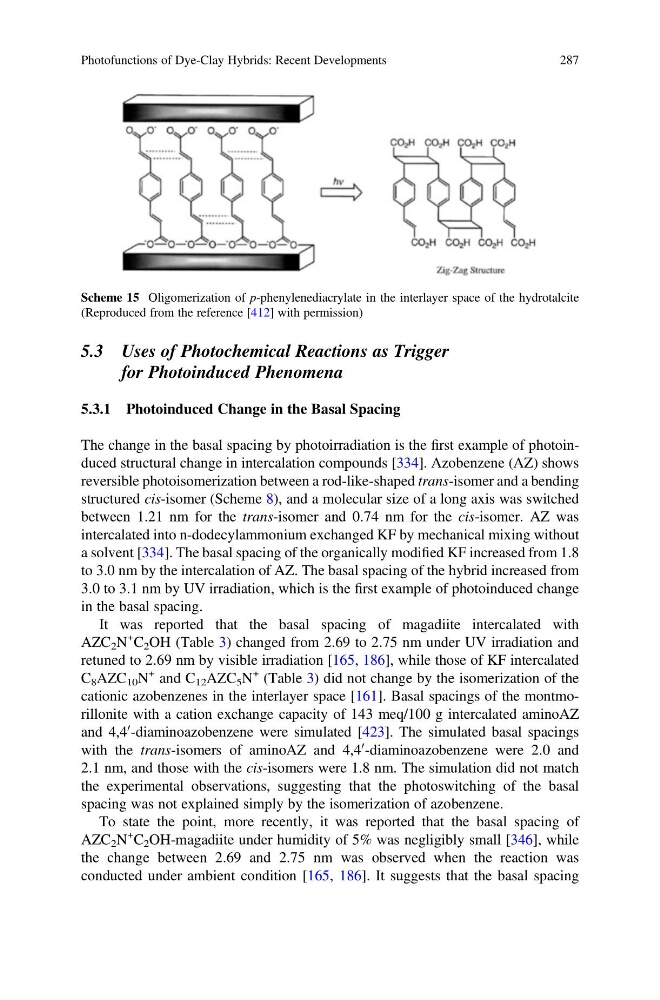
Scheme 15 Oligomerization of p-phenylenediacrylate in the interlayer space of the hydrotalcite
(Reproduced from the reference [412] with permission)
Photofunctions of Dye-Clay Hybrids: Recent Developments
287
for Photoinduced Phenomena
5.3.1 Photoinduced Change in the Basal Spacing
The change in the basal spacing by photoirradiation is the first example of photoinduced structural change in intercalation compounds [334]. Azobenzene (AZ) shows
reversible photoisomerization between a rod-like-shaped trans-isomer and a bending
structured cis-isomer (Scheme 8), and a molecular size of a long axis was switched
between 1.21 nm for the trans-isomer and 0.74 nm for the cis-isomer. AZ was
intercalated into n-dodecylammonium exchanged KF by mechanical mixing without
a solvent [334]. The basal spacing of the organically modified KF increased from 1.8
to 3.0 nm by the intercalation of AZ. The basal spacing of the hybrid increased from
3.0 to 3.1 nm by UV irradiation, which is the first example of photoinduced change
in the basal spacing.
It was reported that the basal spacing of magadiite intercalated with
AZC 2 N
+
C 2 OH (Table 3) changed from 2.69 to 2.75 nm under UV irradiation and
retuned to 2.69 nm by visible irradiation [165, 186], while those of KF intercalated
C 8 AZC 10 N
+ and C 12 AZC 5 N
+ (Table 3) did not change by the isomerization of the
cationic azobenzenes in the interlayer space [161]. Basal spacings of the montmorillonite with a cation exchange capacity of 143 meq/100 g intercalated aminoAZ
and 4,4
0 -diaminoazobenzene were simulated [423]. The simulated basal spacings
with the trans-isomers of aminoAZ and 4,4
0 -diaminoazobenzene were 2.0 and
2.1 nm, and those with the cis-isomers were 1.8 nm. The simulation did not match
the experimental observations, suggesting that the photoswitching of the basal
spacing was not explained simply by the isomerization of azobenzene.
To state the point, more recently, it was reported that the basal spacing of
AZC 2 N
+
C 2 OH-magadiite under humidity of 5% was negligibly small [346], while
the change between 2.69 and 2.75 nm was observed when the reaction was
conducted under ambient condition [165, 186]. It suggests that the basal spacing
Scheme 15 Oligomerization of p-phenylenediacrylate in the interlayer space of the hydrotalcite
(Reproduced from the reference [412] with permission)
Photofunctions of Dye-Clay Hybrids: Recent Developments
287