

accentuated when comparing it with the result of the following procedure. FMOCAPTES, bearing the bulky triethoxysilyl group, was used instead of FMOC-APMS
in the surface modification reaction of ZL under otherwise the same conditions,
leading to about the same total amount of –NH 2 groups at the ZL surface, as revealed
by the ninhydrin test. The spatial distribution of the amino group was again tested,
by reacting the samples with ATTO610-NHS. The confocal fluorescence microscopy images of these samples are shown in Fig. 8b. The difference between the
results obtained with the monomethoxysilane APMS and the triethoxysilane APTES
is striking. The overall fluorescence intensity of single crystals of both samples is
about the same, since the same number of amino groups is available, but the
distribution of the amino groups on the ZL surface is completely different: while
FMOC-APMS is observed only at the base of the crystals, FMOC-APTES is
observed to be present over the whole surface. The only way to explain this is by
assuming that the smaller –Si(CH 3 ) 2 -OH can enter the channels where it is stabilized, while the more bulky triethoxysilyl cannot. We should add that alternative
reagents based on silanol and silylether functional groups for channel modification
have been reported [91]. The reaction shown in Fig. 7d is another way of using the –
Si(CH 3 ) 2 -OH group for anchoring a molecule at the channel entrance [89]. Amino
functionalization of the whole surface was, e.g., used for decorating the ZL with
cyclodextrin [92].
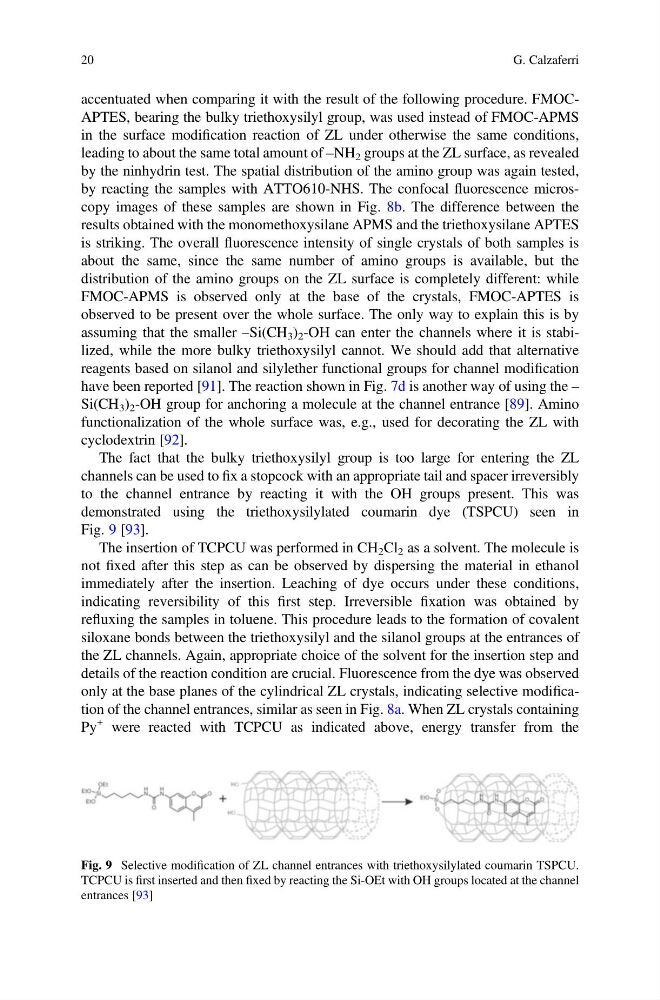
The fact that the bulky triethoxysilyl group is too large for entering the ZL
channels can be used to fix a stopcock with an appropriate tail and spacer irreversibly
to the channel entrance by reacting it with the OH groups present. This was
demonstrated using the triethoxysilylated coumarin dye (TSPCU) seen in
Fig. 9 [93].
The insertion of TCPCU was performed in CH 2 Cl 2 as a solvent. The molecule is
not fixed after this step as can be observed by dispersing the material in ethanol
immediately after the insertion. Leaching of dye occurs under these conditions,
indicating reversibility of this first step. Irreversible fixation was obtained by
refluxing the samples in toluene. This procedure leads to the formation of covalent
siloxane bonds between the triethoxysilyl and the silanol groups at the entrances of
the ZL channels. Again, appropriate choice of the solvent for the insertion step and
details of the reaction condition are crucial. Fluorescence from the dye was observed
only at the base planes of the cylindrical ZL crystals, indicating selective modification of the channel entrances, similar as seen in Fig. 8a. When ZL crystals containing
Py
+ were reacted with TCPCU as indicated above, energy transfer from the
Fig. 9 Selective modification of ZL channel entrances with triethoxysilylated coumarin TSPCU.
TCPCU is first inserted and then fixed by reacting the Si-OEt with OH groups located at the channel
entrances [93]
20
G. Calzaferri
in the surface modification reaction of ZL under otherwise the same conditions,
leading to about the same total amount of –NH 2 groups at the ZL surface, as revealed
by the ninhydrin test. The spatial distribution of the amino group was again tested,
by reacting the samples with ATTO610-NHS. The confocal fluorescence microscopy images of these samples are shown in Fig. 8b. The difference between the
results obtained with the monomethoxysilane APMS and the triethoxysilane APTES
is striking. The overall fluorescence intensity of single crystals of both samples is
about the same, since the same number of amino groups is available, but the
distribution of the amino groups on the ZL surface is completely different: while
FMOC-APMS is observed only at the base of the crystals, FMOC-APTES is
observed to be present over the whole surface. The only way to explain this is by
assuming that the smaller –Si(CH 3 ) 2 -OH can enter the channels where it is stabilized, while the more bulky triethoxysilyl cannot. We should add that alternative
reagents based on silanol and silylether functional groups for channel modification
have been reported [91]. The reaction shown in Fig. 7d is another way of using the –
Si(CH 3 ) 2 -OH group for anchoring a molecule at the channel entrance [89]. Amino
functionalization of the whole surface was, e.g., used for decorating the ZL with
cyclodextrin [92].
The fact that the bulky triethoxysilyl group is too large for entering the ZL
channels can be used to fix a stopcock with an appropriate tail and spacer irreversibly
to the channel entrance by reacting it with the OH groups present. This was
demonstrated using the triethoxysilylated coumarin dye (TSPCU) seen in
Fig. 9 [93].
The insertion of TCPCU was performed in CH 2 Cl 2 as a solvent. The molecule is
not fixed after this step as can be observed by dispersing the material in ethanol
immediately after the insertion. Leaching of dye occurs under these conditions,
indicating reversibility of this first step. Irreversible fixation was obtained by
refluxing the samples in toluene. This procedure leads to the formation of covalent
siloxane bonds between the triethoxysilyl and the silanol groups at the entrances of
the ZL channels. Again, appropriate choice of the solvent for the insertion step and
details of the reaction condition are crucial. Fluorescence from the dye was observed
only at the base planes of the cylindrical ZL crystals, indicating selective modification of the channel entrances, similar as seen in Fig. 8a. When ZL crystals containing
Py
+ were reacted with TCPCU as indicated above, energy transfer from the
Fig. 9 Selective modification of ZL channel entrances with triethoxysilylated coumarin TSPCU.
TCPCU is first inserted and then fixed by reacting the Si-OEt with OH groups located at the channel
entrances [93]
20
G. Calzaferri