

coumarin to Py
+ was observed [93]. An interesting extension regarding the versatility of the stopcock principle is achieved by transforming the amino group into
carboxyester functionalization as indicated in Fig. 7c using a reaction reported in
[94]. The carboxyester functionalization extends the number of chemicals that can be
attached to the crystals, for example, DNA [88]. Proof of principle was reported by
reacting the so-prepared carboxyester-functionalized ZL with Texas Red hydrazide
(TRH, Table 4) and by performing confocal fluorescence microscopy analysis. The
results are similar to those seen in Fig. 8a. Energy transfer from donor molecules
located inside of the channels to the Texas Red at the channel entrances was
observed in samples loaded with Py
+
, which in this case acts as a donor, before
modifying the channel entrances [95]. The possibility to selectively modify the base
was combining with micro contact printing (mCP) technique. A stepwise procedure
allowed modifying the two bases of the ZL crystals selectively with different
functionalities [96]. Stopcocks can be very useful for sealing the channels. While
stopcocks such as AETES, CPTES (Table 4), and similar may be sufficient for fixing
spacious guest from leaving the channels, larger labels and spacers are needed for
keeping small guests inside or to prevent penetration of small molecules such as
oxygen. Stopcocks bearing imidazolium as label such as Melmi
+ Sil, Bulmi
+
Sil
(Table 4), and similar have been shown to be very useful for such purposes
[77, 97–99]. Our understanding of stopcocks as closure molecules was much
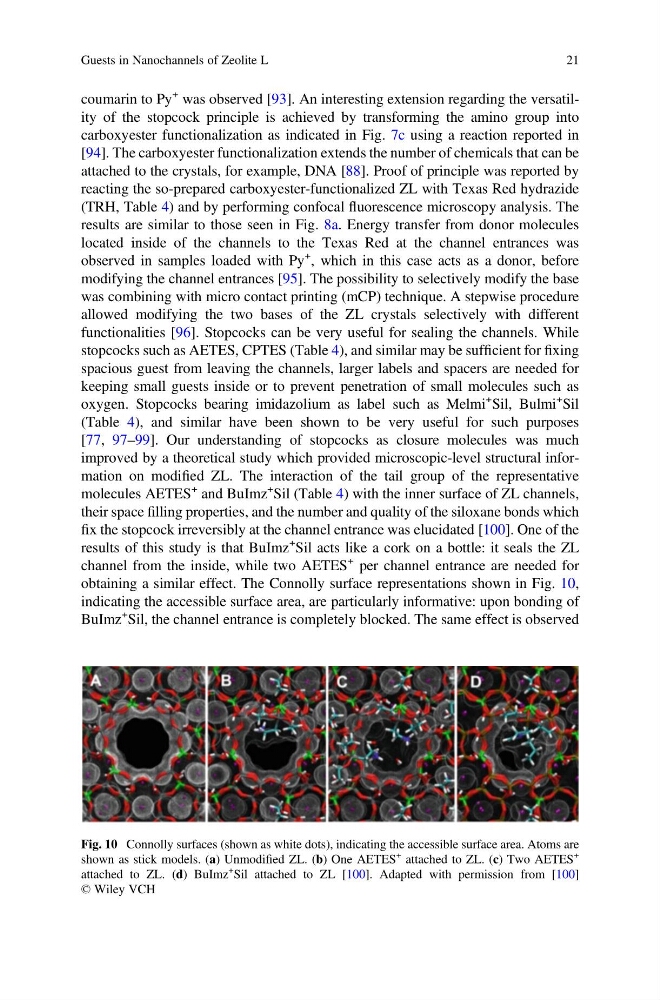
improved by a theoretical study which provided microscopic-level structural information on modified ZL. The interaction of the tail group of the representative
molecules AETES
+ and BuImz
+ Sil (Table 4) with the inner surface of ZL channels,
their space filling properties, and the number and quality of the siloxane bonds which
fix the stopcock irreversibly at the channel entrance was elucidated [100]. One of the
results of this study is that BuImz
+
Sil acts like a cork on a bottle: it seals the ZL
channel from the inside, while two AETES
+ per channel entrance are needed for
obtaining a similar effect. The Connolly surface representations shown in Fig. 10,
indicating the accessible surface area, are particularly informative: upon bonding of
BuImz
+
Sil, the channel entrance is completely blocked. The same effect is observed
Fig. 10 Connolly surfaces (shown as white dots), indicating the accessible surface area. Atoms are
shown as stick models. (a) Unmodified ZL. (b) One AETES
+ attached to ZL. (c) Two AETES
+
attached to ZL. (d) BuImz
+ Sil attached to ZL [100]. Adapted with permission from [100]
© Wiley VCH
Guests in Nanochannels of Zeolite L
21
+ was observed [93]. An interesting extension regarding the versatility of the stopcock principle is achieved by transforming the amino group into
carboxyester functionalization as indicated in Fig. 7c using a reaction reported in
[94]. The carboxyester functionalization extends the number of chemicals that can be
attached to the crystals, for example, DNA [88]. Proof of principle was reported by
reacting the so-prepared carboxyester-functionalized ZL with Texas Red hydrazide
(TRH, Table 4) and by performing confocal fluorescence microscopy analysis. The
results are similar to those seen in Fig. 8a. Energy transfer from donor molecules
located inside of the channels to the Texas Red at the channel entrances was
observed in samples loaded with Py
+
, which in this case acts as a donor, before
modifying the channel entrances [95]. The possibility to selectively modify the base
was combining with micro contact printing (mCP) technique. A stepwise procedure
allowed modifying the two bases of the ZL crystals selectively with different
functionalities [96]. Stopcocks can be very useful for sealing the channels. While
stopcocks such as AETES, CPTES (Table 4), and similar may be sufficient for fixing
spacious guest from leaving the channels, larger labels and spacers are needed for
keeping small guests inside or to prevent penetration of small molecules such as
oxygen. Stopcocks bearing imidazolium as label such as Melmi
+ Sil, Bulmi
+
Sil
(Table 4), and similar have been shown to be very useful for such purposes
[77, 97–99]. Our understanding of stopcocks as closure molecules was much
improved by a theoretical study which provided microscopic-level structural information on modified ZL. The interaction of the tail group of the representative
molecules AETES
+ and BuImz
+ Sil (Table 4) with the inner surface of ZL channels,
their space filling properties, and the number and quality of the siloxane bonds which
fix the stopcock irreversibly at the channel entrance was elucidated [100]. One of the
results of this study is that BuImz
+
Sil acts like a cork on a bottle: it seals the ZL
channel from the inside, while two AETES
+ per channel entrance are needed for
obtaining a similar effect. The Connolly surface representations shown in Fig. 10,
indicating the accessible surface area, are particularly informative: upon bonding of
BuImz
+
Sil, the channel entrance is completely blocked. The same effect is observed
Fig. 10 Connolly surfaces (shown as white dots), indicating the accessible surface area. Atoms are
shown as stick models. (a) Unmodified ZL. (b) One AETES
+ attached to ZL. (c) Two AETES
+
attached to ZL. (d) BuImz
+ Sil attached to ZL [100]. Adapted with permission from [100]
© Wiley VCH
Guests in Nanochannels of Zeolite L
21