

It is interesting that the –Si(CH 3 ) 2 -OH group can act as convenient label, which
seems to be hold inside the channels by binding to the potassium cations, similarly as
the carbonyl groups. This was used for modifying the channel entrances with amino
groups as exemplified in Fig. 7b. Again, key to success is to use the right reaction
conditions. The anchored amino group that can be reacted to incorporate other
functional groups is seen in Fig. 7c. FMOC-APMS was used in the first successful
demonstration of this principle [87]. (There is a printing mistake in the formula 1 of
the FMOC-APMS, reported in [87]; an O atom is missing.) The number of resulting
amino groups linked to the ZL after performing the reaction shown in Fig. 7b was
determined by a quantitative ninhydrin colorimetric reaction [90] and compared to
the calculated number of channel entrances. The spatial distribution was analyzed by
adding the strongly luminescent amino-reactive ATTO610-NHS (Table 4). The
N-hydroxysuccinimidyl ester (NHS) group of this molecule is well known to react
selectively with primary amino groups in high yield, giving an amide bond. The
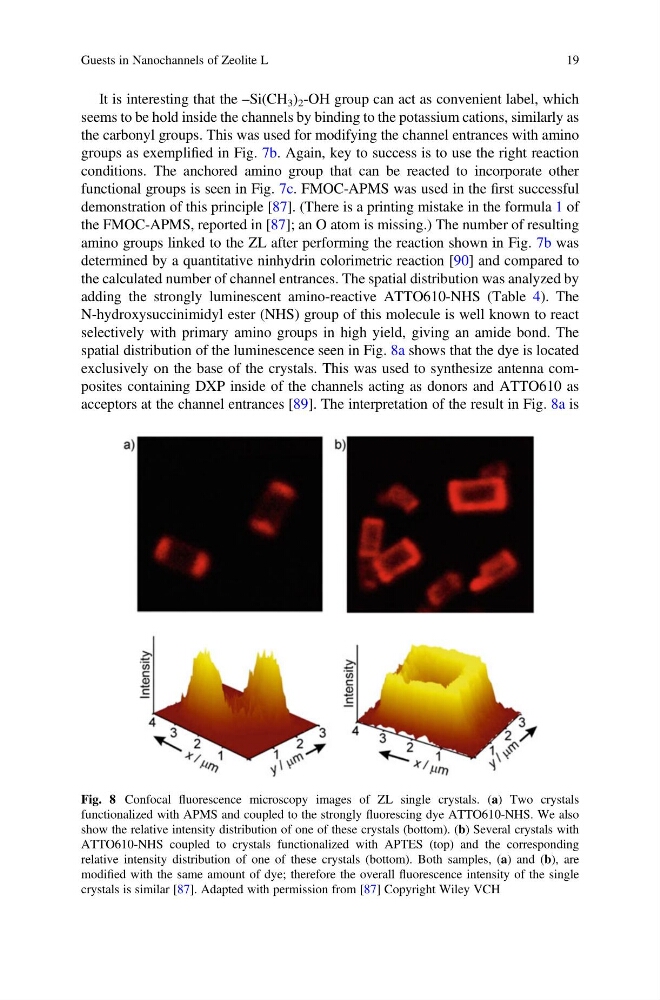
spatial distribution of the luminescence seen in Fig. 8a shows that the dye is located
exclusively on the base of the crystals. This was used to synthesize antenna composites containing DXP inside of the channels acting as donors and ATTO610 as
acceptors at the channel entrances [89]. The interpretation of the result in Fig. 8a is
Fig. 8 Confocal fluorescence microscopy images of ZL single crystals. (a) Two crystals
functionalized with APMS and coupled to the strongly fluorescing dye ATTO610-NHS. We also
show the relative intensity distribution of one of these crystals (bottom). (b) Several crystals with
ATTO610-NHS coupled to crystals functionalized with APTES (top) and the corresponding
relative intensity distribution of one of these crystals (bottom). Both samples, (a) and (b), are
modified with the same amount of dye; therefore the overall fluorescence intensity of the single
crystals is similar [87]. Adapted with permission from [87] Copyright Wiley VCH
Guests in Nanochannels of Zeolite L
19
seems to be hold inside the channels by binding to the potassium cations, similarly as
the carbonyl groups. This was used for modifying the channel entrances with amino
groups as exemplified in Fig. 7b. Again, key to success is to use the right reaction
conditions. The anchored amino group that can be reacted to incorporate other
functional groups is seen in Fig. 7c. FMOC-APMS was used in the first successful
demonstration of this principle [87]. (There is a printing mistake in the formula 1 of
the FMOC-APMS, reported in [87]; an O atom is missing.) The number of resulting
amino groups linked to the ZL after performing the reaction shown in Fig. 7b was
determined by a quantitative ninhydrin colorimetric reaction [90] and compared to
the calculated number of channel entrances. The spatial distribution was analyzed by
adding the strongly luminescent amino-reactive ATTO610-NHS (Table 4). The
N-hydroxysuccinimidyl ester (NHS) group of this molecule is well known to react
selectively with primary amino groups in high yield, giving an amide bond. The
spatial distribution of the luminescence seen in Fig. 8a shows that the dye is located
exclusively on the base of the crystals. This was used to synthesize antenna composites containing DXP inside of the channels acting as donors and ATTO610 as
acceptors at the channel entrances [89]. The interpretation of the result in Fig. 8a is
Fig. 8 Confocal fluorescence microscopy images of ZL single crystals. (a) Two crystals
functionalized with APMS and coupled to the strongly fluorescing dye ATTO610-NHS. We also
show the relative intensity distribution of one of these crystals (bottom). (b) Several crystals with
ATTO610-NHS coupled to crystals functionalized with APTES (top) and the corresponding
relative intensity distribution of one of these crystals (bottom). Both samples, (a) and (b), are
modified with the same amount of dye; therefore the overall fluorescence intensity of the single
crystals is similar [87]. Adapted with permission from [87] Copyright Wiley VCH
Guests in Nanochannels of Zeolite L
19