

HE by the UV irradiation [374], indicating that 6-NO 2 -MC adsorbed on HE by the
host-guest interactions.
Dihydropyrenes [375], Stenhouse salts [376, 377], and binaphthyl-bridged imidazole dimers [378, 379] showed negative photochromism (opposite behavior to
normal photochromism in non-polar environment; photodecoloration by visible
light and thermal coloration) (Scheme 11b). High conversion of the
photoisomerization of the negative photochromic compounds with respect to normal
photochromism is possible because of the absence of the visible light absorption by
the photochemically formed colorless isomer. In polar environments such as in
mesoporous silicas [380–383], zeolites [383–385], and LDHs [386, 387], MC
form is thermally more stable than SP form. These characteristics were utilized to
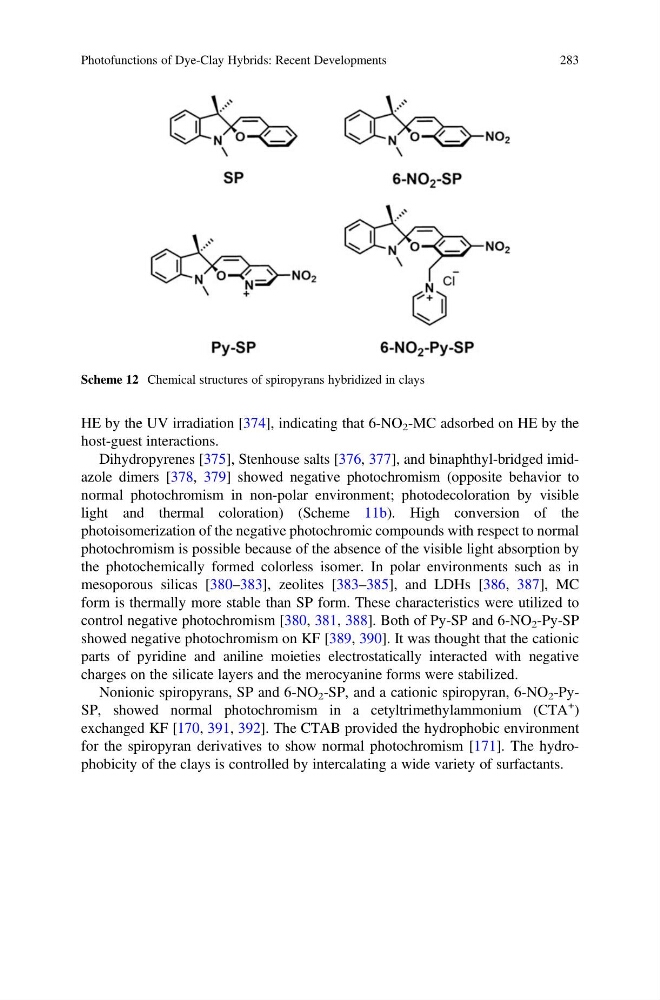
control negative photochromism [380, 381, 388]. Both of Py-SP and 6-NO 2 -Py-SP
showed negative photochromism on KF [389, 390]. It was thought that the cationic
parts of pyridine and aniline moieties electrostatically interacted with negative
charges on the silicate layers and the merocyanine forms were stabilized.
Nonionic spiropyrans, SP and 6-NO 2 -SP, and a cationic spiropyran, 6-NO 2 -PySP, showed normal photochromism in a cetyltrimethylammonium (CTA
+
)
exchanged KF [170, 391, 392]. The CTAB provided the hydrophobic environment
for the spiropyran derivatives to show normal photochromism [171]. The hydrophobicity of the clays is controlled by intercalating a wide variety of surfactants.
Scheme 12 Chemical structures of spiropyrans hybridized in clays
Photofunctions of Dye-Clay Hybrids: Recent Developments
283
host-guest interactions.
Dihydropyrenes [375], Stenhouse salts [376, 377], and binaphthyl-bridged imidazole dimers [378, 379] showed negative photochromism (opposite behavior to
normal photochromism in non-polar environment; photodecoloration by visible
light and thermal coloration) (Scheme 11b). High conversion of the
photoisomerization of the negative photochromic compounds with respect to normal
photochromism is possible because of the absence of the visible light absorption by
the photochemically formed colorless isomer. In polar environments such as in
mesoporous silicas [380–383], zeolites [383–385], and LDHs [386, 387], MC
form is thermally more stable than SP form. These characteristics were utilized to
control negative photochromism [380, 381, 388]. Both of Py-SP and 6-NO 2 -Py-SP
showed negative photochromism on KF [389, 390]. It was thought that the cationic
parts of pyridine and aniline moieties electrostatically interacted with negative
charges on the silicate layers and the merocyanine forms were stabilized.
Nonionic spiropyrans, SP and 6-NO 2 -SP, and a cationic spiropyran, 6-NO 2 -PySP, showed normal photochromism in a cetyltrimethylammonium (CTA
+
)
exchanged KF [170, 391, 392]. The CTAB provided the hydrophobic environment
for the spiropyran derivatives to show normal photochromism [171]. The hydrophobicity of the clays is controlled by intercalating a wide variety of surfactants.
Scheme 12 Chemical structures of spiropyrans hybridized in clays
Photofunctions of Dye-Clay Hybrids: Recent Developments
283