

5.2 Intermolecular Reactions
The intermolecular reactions in/on nanospaces have been used for (1) stereoselective
reaction and (2) trigger of photoinduced phenomena [393]. Intermolecular distance
and orientation of guests in layered materials have been utilized to control the
stereoselective reactions [394, 395].
5.2.1 Diels-Alder Reaction in Clay Interlayer
Diels-Alder reaction is known as a [4 + 2] cycloaddition between a π-conjugated
diene and an alkene to form a six-membered ring. A major reaction product is
predicted by Woodward-Hoffman rules, while some by-products are included in
the products [394, 395]. Because the kinetically stable product is the major product
of Diels-Alder reaction (endo rules), high temperatures are not recommended to
accelerate Diels-Alder reaction with keeping the reaction selectivity. The addition of
the catalyst, which does not affect the reaction selectivity, is proposed to increase the
rate constant for Diels-Alder reaction. Acceleration of the dimerization of
1,3-cyclohexadiene [396] and the cycloaddition between 2,3-dimethyl-1,3-butadiene and acrolein [397] in the presence of a montmorillonite (K10) with Fe(III) was
reported. A reaction yield of the dimerization of 1,3-cyclohexadiene increased to
49% even at 0
C for 10 h by adding K10 with Fe(III) with keeping the product
selectivity the same compared to a reaction yield (30%) at 200
C for 20 h without
K10 [398]. The yield (80% at 20
C for 3 h in water) of the cycloaddition increased to
95% at 20
C for 0.3 h by adding the K10 with Fe(III). The reaction condition was
optimized to À24
C for 4 h in dichloromethane to achieve the yield of 96% with
keeping the product isomer ratio. Though the role of the clay for the improved
selectivity of Diels-Alder reaction was not explained clearly [396, 397], molecular
packing of guests in clays are thought to contribute [176, 193].
5.2.2 [2 + 2] Photocycloaddition
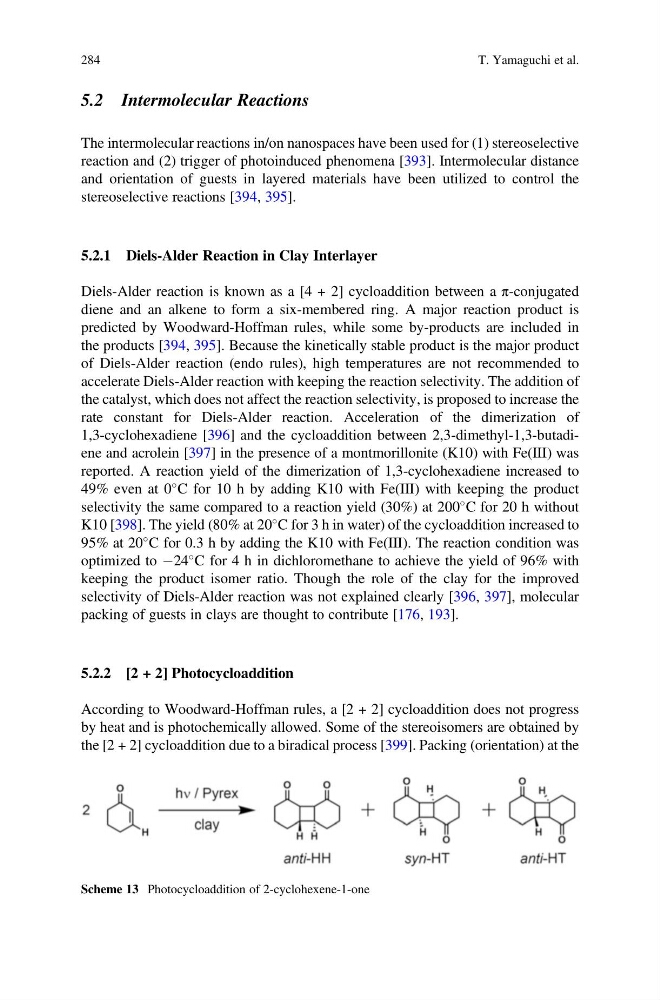
According to Woodward-Hoffman rules, a [2 + 2] cycloaddition does not progress
by heat and is photochemically allowed. Some of the stereoisomers are obtained by
the [2 + 2] cycloaddition due to a biradical process [399]. Packing (orientation) at the
Scheme 13 Photocycloaddition of 2-cyclohexene-1-one
284
T. Yamaguchi et al.
The intermolecular reactions in/on nanospaces have been used for (1) stereoselective
reaction and (2) trigger of photoinduced phenomena [393]. Intermolecular distance
and orientation of guests in layered materials have been utilized to control the
stereoselective reactions [394, 395].
5.2.1 Diels-Alder Reaction in Clay Interlayer
Diels-Alder reaction is known as a [4 + 2] cycloaddition between a π-conjugated
diene and an alkene to form a six-membered ring. A major reaction product is
predicted by Woodward-Hoffman rules, while some by-products are included in
the products [394, 395]. Because the kinetically stable product is the major product
of Diels-Alder reaction (endo rules), high temperatures are not recommended to
accelerate Diels-Alder reaction with keeping the reaction selectivity. The addition of
the catalyst, which does not affect the reaction selectivity, is proposed to increase the
rate constant for Diels-Alder reaction. Acceleration of the dimerization of
1,3-cyclohexadiene [396] and the cycloaddition between 2,3-dimethyl-1,3-butadiene and acrolein [397] in the presence of a montmorillonite (K10) with Fe(III) was
reported. A reaction yield of the dimerization of 1,3-cyclohexadiene increased to
49% even at 0
C for 10 h by adding K10 with Fe(III) with keeping the product
selectivity the same compared to a reaction yield (30%) at 200
C for 20 h without
K10 [398]. The yield (80% at 20
C for 3 h in water) of the cycloaddition increased to
95% at 20
C for 0.3 h by adding the K10 with Fe(III). The reaction condition was
optimized to À24
C for 4 h in dichloromethane to achieve the yield of 96% with
keeping the product isomer ratio. Though the role of the clay for the improved
selectivity of Diels-Alder reaction was not explained clearly [396, 397], molecular
packing of guests in clays are thought to contribute [176, 193].
5.2.2 [2 + 2] Photocycloaddition
According to Woodward-Hoffman rules, a [2 + 2] cycloaddition does not progress
by heat and is photochemically allowed. Some of the stereoisomers are obtained by
the [2 + 2] cycloaddition due to a biradical process [399]. Packing (orientation) at the
Scheme 13 Photocycloaddition of 2-cyclohexene-1-one
284
T. Yamaguchi et al.