

An-DAE covalently bound on magadiite gave improved reversibility of the
photocyclization compared with that in an ethanol solution [368, 369]. The molecular rotation from the antiparallel to the parallel conformation of An-DAE was
suppressed by the covalent attachment to the silicate layer. Reversibility of photochromisms was also improved by restricting the molecular motion by the confinements. It was also claimed that the suppression of the parallel conformation
improved the reversibility. The suppression of the generation of the photoinactive
isomer was also concerned for the reversibility.
5.1.3 Spiropyran
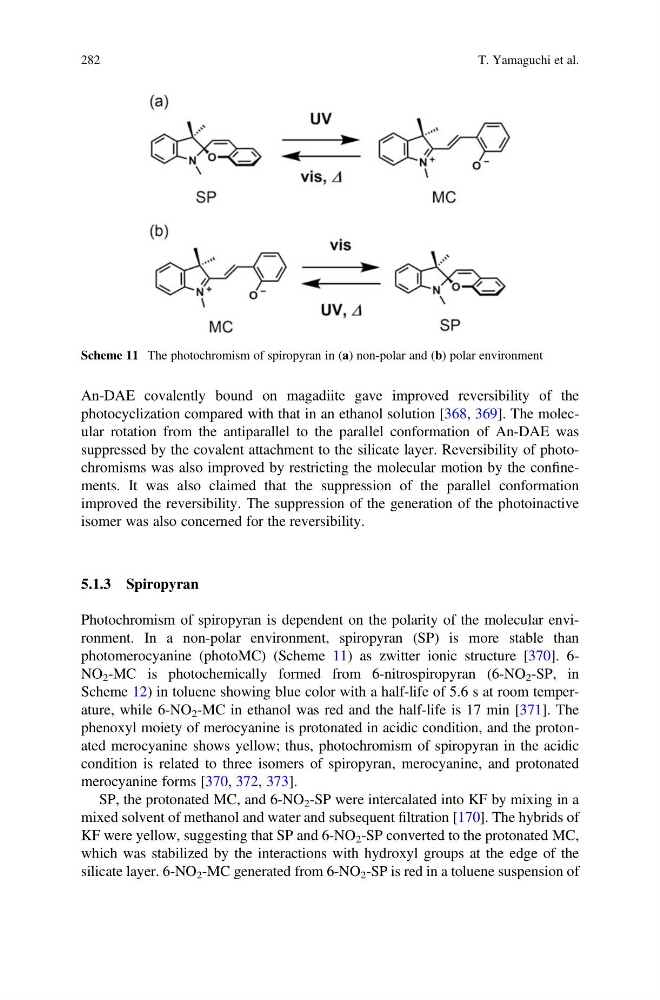
Photochromism of spiropyran is dependent on the polarity of the molecular environment. In a non-polar environment, spiropyran (SP) is more stable than
photomerocyanine (photoMC) (Scheme 11) as zwitter ionic structure [370]. 6NO 2 -MC is photochemically formed from 6-nitrospiropyran (6-NO 2 -SP, in
Scheme 12) in toluene showing blue color with a half-life of 5.6 s at room temperature, while 6-NO 2 -MC in ethanol was red and the half-life is 17 min [371]. The
phenoxyl moiety of merocyanine is protonated in acidic condition, and the protonated merocyanine shows yellow; thus, photochromism of spiropyran in the acidic
condition is related to three isomers of spiropyran, merocyanine, and protonated
merocyanine forms [370, 372, 373].
SP, the protonated MC, and 6-NO 2 -SP were intercalated into KF by mixing in a
mixed solvent of methanol and water and subsequent filtration [170]. The hybrids of
KF were yellow, suggesting that SP and 6-NO 2 -SP converted to the protonated MC,
which was stabilized by the interactions with hydroxyl groups at the edge of the
silicate layer. 6-NO 2 -MC generated from 6-NO 2 -SP is red in a toluene suspension of
Scheme 11 The photochromism of spiropyran in (a) non-polar and (b) polar environment
282
T. Yamaguchi et al.
photocyclization compared with that in an ethanol solution [368, 369]. The molecular rotation from the antiparallel to the parallel conformation of An-DAE was
suppressed by the covalent attachment to the silicate layer. Reversibility of photochromisms was also improved by restricting the molecular motion by the confinements. It was also claimed that the suppression of the parallel conformation
improved the reversibility. The suppression of the generation of the photoinactive
isomer was also concerned for the reversibility.
5.1.3 Spiropyran
Photochromism of spiropyran is dependent on the polarity of the molecular environment. In a non-polar environment, spiropyran (SP) is more stable than
photomerocyanine (photoMC) (Scheme 11) as zwitter ionic structure [370]. 6NO 2 -MC is photochemically formed from 6-nitrospiropyran (6-NO 2 -SP, in
Scheme 12) in toluene showing blue color with a half-life of 5.6 s at room temperature, while 6-NO 2 -MC in ethanol was red and the half-life is 17 min [371]. The
phenoxyl moiety of merocyanine is protonated in acidic condition, and the protonated merocyanine shows yellow; thus, photochromism of spiropyran in the acidic
condition is related to three isomers of spiropyran, merocyanine, and protonated
merocyanine forms [370, 372, 373].
SP, the protonated MC, and 6-NO 2 -SP were intercalated into KF by mixing in a
mixed solvent of methanol and water and subsequent filtration [170]. The hybrids of
KF were yellow, suggesting that SP and 6-NO 2 -SP converted to the protonated MC,
which was stabilized by the interactions with hydroxyl groups at the edge of the
silicate layer. 6-NO 2 -MC generated from 6-NO 2 -SP is red in a toluene suspension of
Scheme 11 The photochromism of spiropyran in (a) non-polar and (b) polar environment
282
T. Yamaguchi et al.