

photoinactive parallel and photoactive antiparallel conformations, and the ratio of
these conformations are almost equal in solution [354]. In addition to the photoinduced oxidation of thiophen rings [355], a photoinactive isomer, which formed by
the condensation of two thiophen rings, was reported as a deactivation process of
diarylethenes [356–359]. In order to improve the reversibility and the yield of
photocyclization, control of the molecular conformation of the diarylethene has
been examined by the molecular and supramolecular designs using such intramolecular interactions as hydrogen bonds [360, 361], intramolecular steric repulsion
[362, 363], as well as the host-guest interactions in nanospaces [364, 365]. Almost
unity quantum yield (98%) of a ring-closing reaction of a diarylethene derivative was
achieved in a hexane solution by restricting the molecular motion with intramolecular hydrogen bonds, being smaller in polar solvents (in methanol solution: 54%)
[360, 361].
Restricted molecular motion by host-guest interactions is expected to affect the
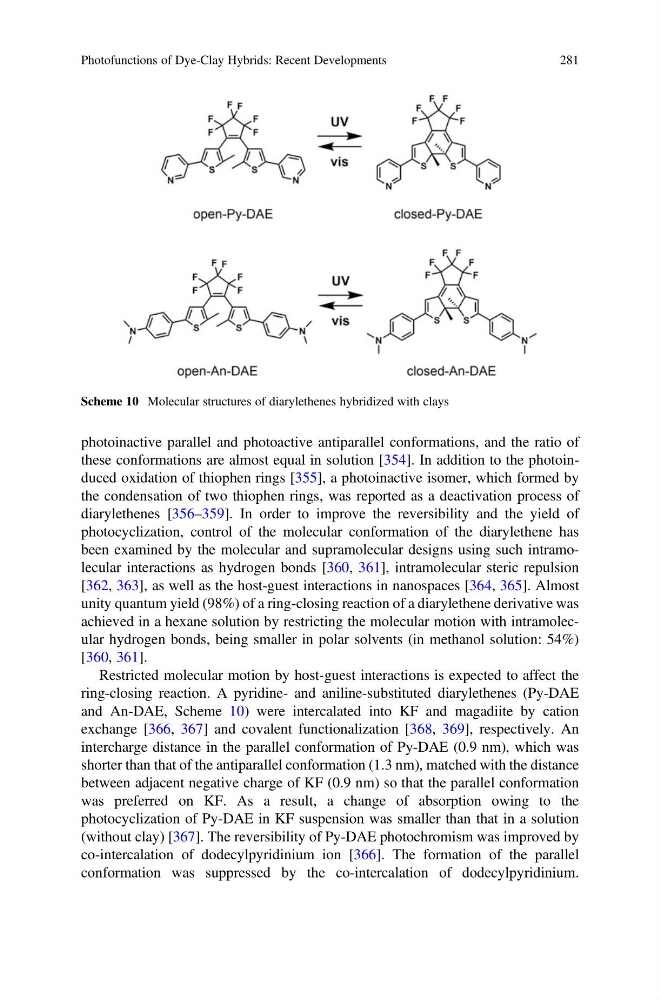
ring-closing reaction. A pyridine- and aniline-substituted diarylethenes (Py-DAE
and An-DAE, Scheme 10) were intercalated into KF and magadiite by cation
exchange [366, 367] and covalent functionalization [368, 369], respectively. An
intercharge distance in the parallel conformation of Py-DAE (0.9 nm), which was
shorter than that of the antiparallel conformation (1.3 nm), matched with the distance
between adjacent negative charge of KF (0.9 nm) so that the parallel conformation
was preferred on KF. As a result, a change of absorption owing to the
photocyclization of Py-DAE in KF suspension was smaller than that in a solution
(without clay) [367]. The reversibility of Py-DAE photochromism was improved by
co-intercalation of dodecylpyridinium ion [366]. The formation of the parallel
conformation was suppressed by the co-intercalation of dodecylpyridinium.
Scheme 10 Molecular structures of diarylethenes hybridized with clays
Photofunctions of Dye-Clay Hybrids: Recent Developments
281
these conformations are almost equal in solution [354]. In addition to the photoinduced oxidation of thiophen rings [355], a photoinactive isomer, which formed by
the condensation of two thiophen rings, was reported as a deactivation process of
diarylethenes [356–359]. In order to improve the reversibility and the yield of
photocyclization, control of the molecular conformation of the diarylethene has
been examined by the molecular and supramolecular designs using such intramolecular interactions as hydrogen bonds [360, 361], intramolecular steric repulsion
[362, 363], as well as the host-guest interactions in nanospaces [364, 365]. Almost
unity quantum yield (98%) of a ring-closing reaction of a diarylethene derivative was
achieved in a hexane solution by restricting the molecular motion with intramolecular hydrogen bonds, being smaller in polar solvents (in methanol solution: 54%)
[360, 361].
Restricted molecular motion by host-guest interactions is expected to affect the
ring-closing reaction. A pyridine- and aniline-substituted diarylethenes (Py-DAE
and An-DAE, Scheme 10) were intercalated into KF and magadiite by cation
exchange [366, 367] and covalent functionalization [368, 369], respectively. An
intercharge distance in the parallel conformation of Py-DAE (0.9 nm), which was
shorter than that of the antiparallel conformation (1.3 nm), matched with the distance
between adjacent negative charge of KF (0.9 nm) so that the parallel conformation
was preferred on KF. As a result, a change of absorption owing to the
photocyclization of Py-DAE in KF suspension was smaller than that in a solution
(without clay) [367]. The reversibility of Py-DAE photochromism was improved by
co-intercalation of dodecylpyridinium ion [366]. The formation of the parallel
conformation was suppressed by the co-intercalation of dodecylpyridinium.
Scheme 10 Molecular structures of diarylethenes hybridized with clays
Photofunctions of Dye-Clay Hybrids: Recent Developments
281