

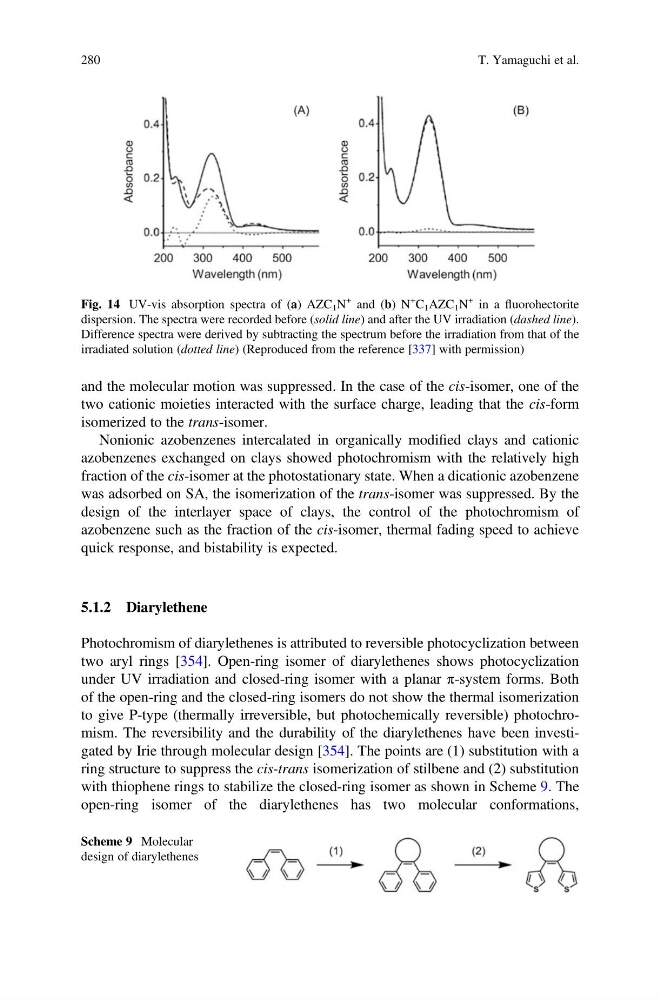
and the molecular motion was suppressed. In the case of the cis-isomer, one of the
two cationic moieties interacted with the surface charge, leading that the cis-form
isomerized to the trans-isomer.
Nonionic azobenzenes intercalated in organically modified clays and cationic
azobenzenes exchanged on clays showed photochromism with the relatively high
fraction of the cis-isomer at the photostationary state. When a dicationic azobenzene
was adsorbed on SA, the isomerization of the trans-isomer was suppressed. By the
design of the interlayer space of clays, the control of the photochromism of
azobenzene such as the fraction of the cis-isomer, thermal fading speed to achieve
quick response, and bistability is expected.
5.1.2 Diarylethene
Photochromism of diarylethenes is attributed to reversible photocyclization between
two aryl rings [354]. Open-ring isomer of diarylethenes shows photocyclization
under UV irradiation and closed-ring isomer with a planar π-system forms. Both
of the open-ring and the closed-ring isomers do not show the thermal isomerization
to give P-type (thermally irreversible, but photochemically reversible) photochromism. The reversibility and the durability of the diarylethenes have been investigated by Irie through molecular design [354]. The points are (1) substitution with a
ring structure to suppress the cis-trans isomerization of stilbene and (2) substitution
with thiophene rings to stabilize the closed-ring isomer as shown in Scheme 9. The
open-ring isomer of the diarylethenes has two molecular conformations,
Scheme 9 Molecular
design of diarylethenes
Fig. 14 UV-vis absorption spectra of (a) AZC 1 N
+ and (b) N
+ C 1 AZC 1 N
+ in a fluorohectorite
dispersion. The spectra were recorded before (solid line) and after the UV irradiation (dashed line).
Difference spectra were derived by subtracting the spectrum before the irradiation from that of the
irradiated solution (dotted line) (Reproduced from the reference [337] with permission)
280
T. Yamaguchi et al.
two cationic moieties interacted with the surface charge, leading that the cis-form
isomerized to the trans-isomer.
Nonionic azobenzenes intercalated in organically modified clays and cationic
azobenzenes exchanged on clays showed photochromism with the relatively high
fraction of the cis-isomer at the photostationary state. When a dicationic azobenzene
was adsorbed on SA, the isomerization of the trans-isomer was suppressed. By the
design of the interlayer space of clays, the control of the photochromism of
azobenzene such as the fraction of the cis-isomer, thermal fading speed to achieve
quick response, and bistability is expected.
5.1.2 Diarylethene
Photochromism of diarylethenes is attributed to reversible photocyclization between
two aryl rings [354]. Open-ring isomer of diarylethenes shows photocyclization
under UV irradiation and closed-ring isomer with a planar π-system forms. Both
of the open-ring and the closed-ring isomers do not show the thermal isomerization
to give P-type (thermally irreversible, but photochemically reversible) photochromism. The reversibility and the durability of the diarylethenes have been investigated by Irie through molecular design [354]. The points are (1) substitution with a
ring structure to suppress the cis-trans isomerization of stilbene and (2) substitution
with thiophene rings to stabilize the closed-ring isomer as shown in Scheme 9. The
open-ring isomer of the diarylethenes has two molecular conformations,
Scheme 9 Molecular
design of diarylethenes
Fig. 14 UV-vis absorption spectra of (a) AZC 1 N
+ and (b) N
+ C 1 AZC 1 N
+ in a fluorohectorite
dispersion. The spectra were recorded before (solid line) and after the UV irradiation (dashed line).
Difference spectra were derived by subtracting the spectrum before the irradiation from that of the
irradiated solution (dotted line) (Reproduced from the reference [337] with permission)
280
T. Yamaguchi et al.