

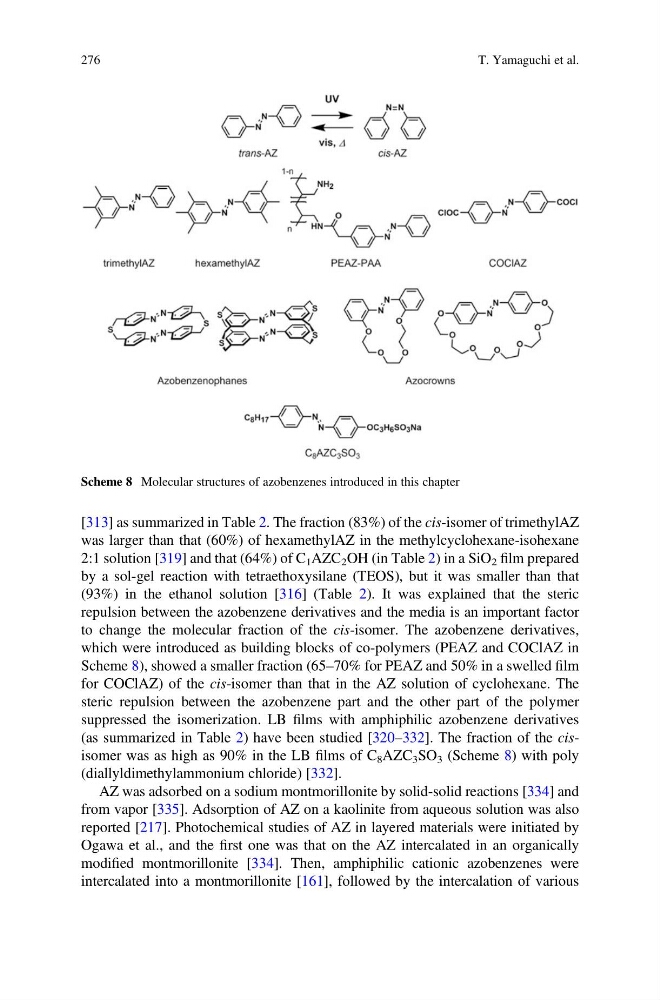
[313] as summarized in Table 2. The fraction (83%) of the cis-isomer of trimethylAZ
was larger than that (60%) of hexamethylAZ in the methylcyclohexane-isohexane
2:1 solution [319] and that (64%) of C 1 AZC 2 OH (in Table 2) in a SiO 2 film prepared
by a sol-gel reaction with tetraethoxysilane (TEOS), but it was smaller than that
(93%) in the ethanol solution [316] (Table 2). It was explained that the steric
repulsion between the azobenzene derivatives and the media is an important factor
to change the molecular fraction of the cis-isomer. The azobenzene derivatives,
which were introduced as building blocks of co-polymers (PEAZ and COClAZ in
Scheme 8), showed a smaller fraction (65–70% for PEAZ and 50% in a swelled film
for COClAZ) of the cis-isomer than that in the AZ solution of cyclohexane. The
steric repulsion between the azobenzene part and the other part of the polymer
suppressed the isomerization. LB films with amphiphilic azobenzene derivatives
(as summarized in Table 2) have been studied [320–332]. The fraction of the cisisomer was as high as 90% in the LB films of C 8 AZC 3 SO 3 (Scheme 8) with poly
(diallyldimethylammonium chloride) [332].
AZ was adsorbed on a sodium montmorillonite by solid-solid reactions [334] and
from vapor [335]. Adsorption of AZ on a kaolinite from aqueous solution was also
reported [217]. Photochemical studies of AZ in layered materials were initiated by
Ogawa et al., and the first one was that on the AZ intercalated in an organically
modified montmorillonite [334]. Then, amphiphilic cationic azobenzenes were
intercalated into a montmorillonite [161], followed by the intercalation of various
Scheme 8 Molecular structures of azobenzenes introduced in this chapter
276
T. Yamaguchi et al.
was larger than that (60%) of hexamethylAZ in the methylcyclohexane-isohexane
2:1 solution [319] and that (64%) of C 1 AZC 2 OH (in Table 2) in a SiO 2 film prepared
by a sol-gel reaction with tetraethoxysilane (TEOS), but it was smaller than that
(93%) in the ethanol solution [316] (Table 2). It was explained that the steric
repulsion between the azobenzene derivatives and the media is an important factor
to change the molecular fraction of the cis-isomer. The azobenzene derivatives,
which were introduced as building blocks of co-polymers (PEAZ and COClAZ in
Scheme 8), showed a smaller fraction (65–70% for PEAZ and 50% in a swelled film
for COClAZ) of the cis-isomer than that in the AZ solution of cyclohexane. The
steric repulsion between the azobenzene part and the other part of the polymer
suppressed the isomerization. LB films with amphiphilic azobenzene derivatives
(as summarized in Table 2) have been studied [320–332]. The fraction of the cisisomer was as high as 90% in the LB films of C 8 AZC 3 SO 3 (Scheme 8) with poly
(diallyldimethylammonium chloride) [332].
AZ was adsorbed on a sodium montmorillonite by solid-solid reactions [334] and
from vapor [335]. Adsorption of AZ on a kaolinite from aqueous solution was also
reported [217]. Photochemical studies of AZ in layered materials were initiated by
Ogawa et al., and the first one was that on the AZ intercalated in an organically
modified montmorillonite [334]. Then, amphiphilic cationic azobenzenes were
intercalated into a montmorillonite [161], followed by the intercalation of various
Scheme 8 Molecular structures of azobenzenes introduced in this chapter
276
T. Yamaguchi et al.