

5 Photochemical Reactions
5.1 Intramolecular Reactions Affected by Host-Guest
Interactions
Molecular reactions of organic compounds interacted in clays are different from
those in solutions. The molecular reactions of the organic molecules were affected
by the polarity of interlayer space and/or by the suppression of molecular vibration in
the interlayer space [8, 10, 307].
5.1.1 Azobenzene
Azobenzene (AZ) shows photoisomerization from trans- to cis-isomer by UV
irradiation, and the cis-isomer returns to the initial trans-isomer by heat or visible
light irradiation as shown in Scheme 8. The half-lives of the thermal isomerization of
the cis-isomer to the trans-isomer of AZ in a benzene solution at room temperature
and 60
C were 119 [308] and 1.5 h [309], respectively, in the dark following firstorder kinetics. The polarity and the viscosity of the solvent affect the
photoisomerization of AZ [310, 311], and the photoisomerization was suppressed
in packed states [312]. Accordingly, the host-guest interactions are expected to affect
the photoisomerization.
Here, a fraction of the cis-isomer of AZ is used as a measure of
photoisomerization. The fractions of the cis-isomer of AZ at the photostationary
state in cyclohexane [313] and in toluene [314] solutions were 80 and 90%,
respectively. Although the fraction of the cis-isomer is different depending on the
substituents of the azobenzene and the wavelength of the incident light [315], the
fraction of the cis-isomer in polymethyl methacrylate (PMMA) was as high as that in
the toluene solution [316]. The fraction of the cis-isomer became smaller in poly
(styrenesulfonate) (PSS) [317], azobenzene polymer [318], SiO 2 [316], and zeolite
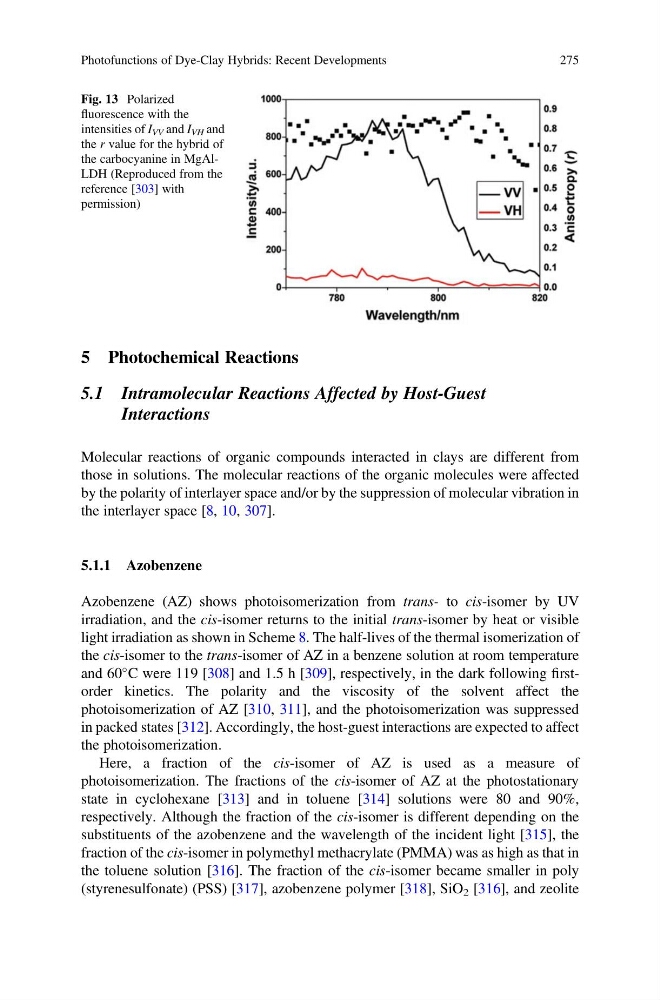
Fig. 13 Polarized
fluorescence with the
intensities of I VV and I VH and
the r value for the hybrid of
the carbocyanine in MgAlLDH (Reproduced from the
reference [303] with
permission)
Photofunctions of Dye-Clay Hybrids: Recent Developments
275
5.1 Intramolecular Reactions Affected by Host-Guest
Interactions
Molecular reactions of organic compounds interacted in clays are different from
those in solutions. The molecular reactions of the organic molecules were affected
by the polarity of interlayer space and/or by the suppression of molecular vibration in
the interlayer space [8, 10, 307].
5.1.1 Azobenzene
Azobenzene (AZ) shows photoisomerization from trans- to cis-isomer by UV
irradiation, and the cis-isomer returns to the initial trans-isomer by heat or visible
light irradiation as shown in Scheme 8. The half-lives of the thermal isomerization of
the cis-isomer to the trans-isomer of AZ in a benzene solution at room temperature
and 60
C were 119 [308] and 1.5 h [309], respectively, in the dark following firstorder kinetics. The polarity and the viscosity of the solvent affect the
photoisomerization of AZ [310, 311], and the photoisomerization was suppressed
in packed states [312]. Accordingly, the host-guest interactions are expected to affect
the photoisomerization.
Here, a fraction of the cis-isomer of AZ is used as a measure of
photoisomerization. The fractions of the cis-isomer of AZ at the photostationary
state in cyclohexane [313] and in toluene [314] solutions were 80 and 90%,
respectively. Although the fraction of the cis-isomer is different depending on the
substituents of the azobenzene and the wavelength of the incident light [315], the
fraction of the cis-isomer in polymethyl methacrylate (PMMA) was as high as that in
the toluene solution [316]. The fraction of the cis-isomer became smaller in poly
(styrenesulfonate) (PSS) [317], azobenzene polymer [318], SiO 2 [316], and zeolite
Fig. 13 Polarized
fluorescence with the
intensities of I VV and I VH and
the r value for the hybrid of
the carbocyanine in MgAlLDH (Reproduced from the
reference [303] with
permission)
Photofunctions of Dye-Clay Hybrids: Recent Developments
275