

Polarized fluorescence of rhodamine B [296], fluorescein [297], pyrene [298],
cyanine [299], niflumic acid [300], bis(N-methylacridinium) [301], tris
(8-hydroxyquinolate-5-sulfonate)aluminum(III) [302], polyphenylene [303], and
polythiophene [304] in LDH films prepared by LbL technique was reported. The
anisotropic value r as defined by Eq. (1) was derived to discuss the dye orientation
from emission anisotropy.
r ¼
I VV À I VH
I VV þ 2I VH
ð1Þ
In (1), I VV and I VH are emission intensities with vertical and horizontal directions
excited by vertical light [305]. The fluorescence spectra of a carbocyanine (Scheme
4) intercalated in a MgAl-LDH [303] showed anisotropy (Fig. 13) with the r value as
high as 0.8, where the value was higher than that in a solution (0.2) and nearly twice
of the theoretical highest value in the case without macroscopic alignment (0.4)
[299]. The r value of the carbocyanine was larger than pyrene (0.26) [298], fluorescein (0.3) [297], and fluorenone derivatives (0.25) [306], which have planar molecular structures. The orientation of the intercalated dye in MgAl-LDH was thought to
induce the anisotropy.
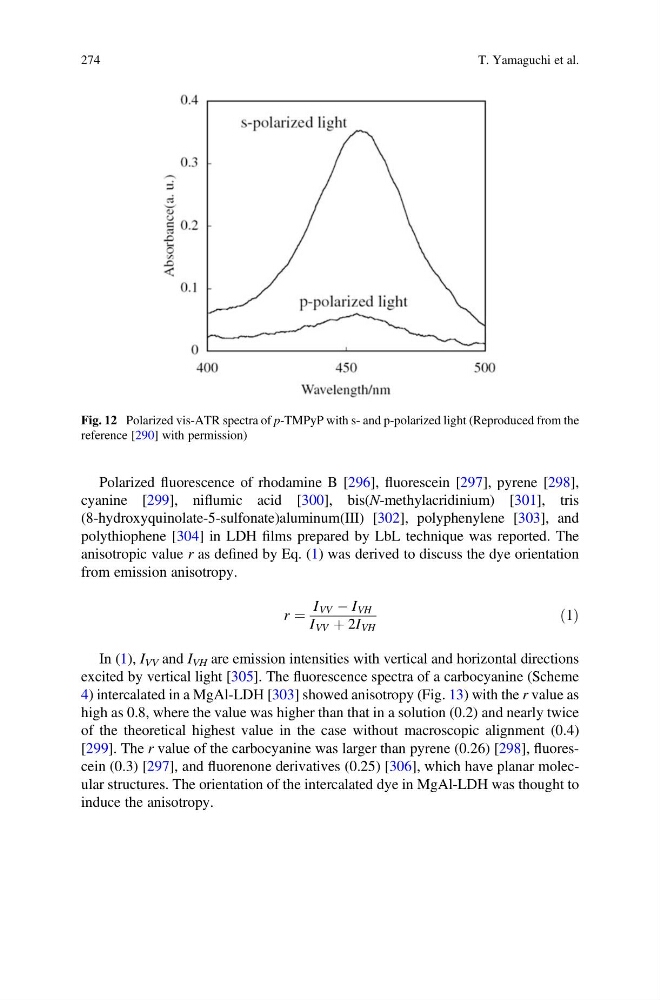
Fig. 12 Polarized vis-ATR spectra of p-TMPyP with s- and p-polarized light (Reproduced from the
reference [290] with permission)
274
T. Yamaguchi et al.
cyanine [299], niflumic acid [300], bis(N-methylacridinium) [301], tris
(8-hydroxyquinolate-5-sulfonate)aluminum(III) [302], polyphenylene [303], and
polythiophene [304] in LDH films prepared by LbL technique was reported. The
anisotropic value r as defined by Eq. (1) was derived to discuss the dye orientation
from emission anisotropy.
r ¼
I VV À I VH
I VV þ 2I VH
ð1Þ
In (1), I VV and I VH are emission intensities with vertical and horizontal directions
excited by vertical light [305]. The fluorescence spectra of a carbocyanine (Scheme
4) intercalated in a MgAl-LDH [303] showed anisotropy (Fig. 13) with the r value as
high as 0.8, where the value was higher than that in a solution (0.2) and nearly twice
of the theoretical highest value in the case without macroscopic alignment (0.4)
[299]. The r value of the carbocyanine was larger than pyrene (0.26) [298], fluorescein (0.3) [297], and fluorenone derivatives (0.25) [306], which have planar molecular structures. The orientation of the intercalated dye in MgAl-LDH was thought to
induce the anisotropy.
Fig. 12 Polarized vis-ATR spectra of p-TMPyP with s- and p-polarized light (Reproduced from the
reference [290] with permission)
274
T. Yamaguchi et al.