

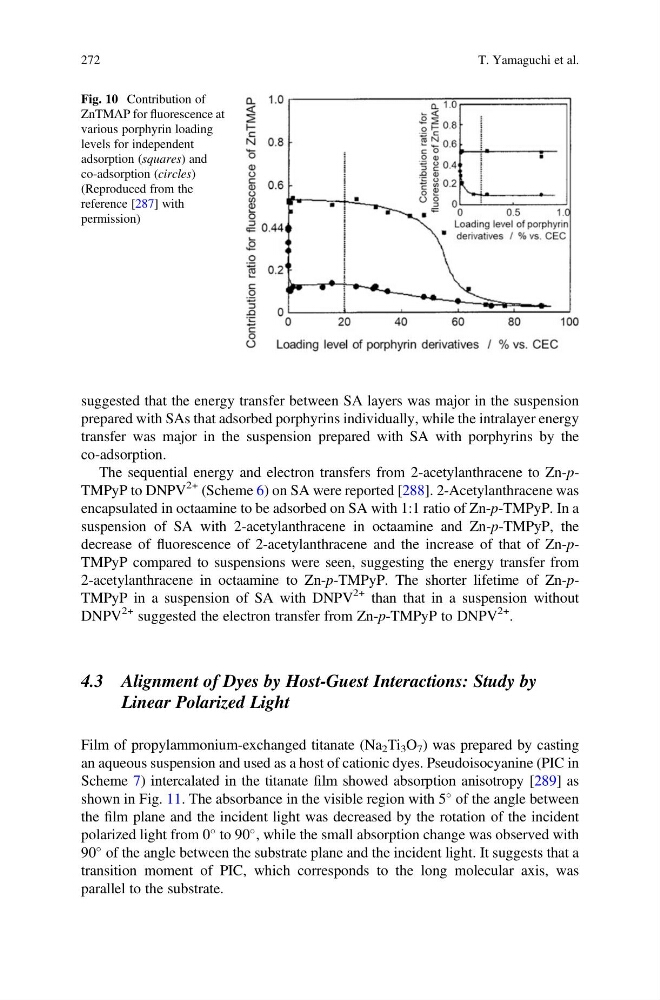
suggested that the energy transfer between SA layers was major in the suspension
prepared with SAs that adsorbed porphyrins individually, while the intralayer energy
transfer was major in the suspension prepared with SA with porphyrins by the
co-adsorption.
The sequential energy and electron transfers from 2-acetylanthracene to Zn-pTMPyP to DNPV
2+ (Scheme 6) on SA were reported [288]. 2-Acetylanthracene was
encapsulated in octaamine to be adsorbed on SA with 1:1 ratio of Zn-p-TMPyP. In a
suspension of SA with 2-acetylanthracene in octaamine and Zn-p-TMPyP, the
decrease of fluorescence of 2-acetylanthracene and the increase of that of Zn-pTMPyP compared to suspensions were seen, suggesting the energy transfer from
2-acetylanthracene in octaamine to Zn-p-TMPyP. The shorter lifetime of Zn-pTMPyP in a suspension of SA with DNPV
2+ than that in a suspension without
DNPV
2+ suggested the electron transfer from Zn-p-TMPyP to DNPV
2+ .
4.3 Alignment of Dyes by Host-Guest Interactions: Study by
Linear Polarized Light
Film of propylammonium-exchanged titanate (Na 2 Ti 3 O 7 ) was prepared by casting
an aqueous suspension and used as a host of cationic dyes. Pseudoisocyanine (PIC in
Scheme 7) intercalated in the titanate film showed absorption anisotropy [289] as
shown in Fig. 11. The absorbance in the visible region with 5
of the angle between
the film plane and the incident light was decreased by the rotation of the incident
polarized light from 0
to 90
, while the small absorption change was observed with
90
of the angle between the substrate plane and the incident light. It suggests that a
transition moment of PIC, which corresponds to the long molecular axis, was
parallel to the substrate.
Fig. 10 Contribution of
ZnTMAP for fluorescence at
various porphyrin loading
levels for independent
adsorption (squares) and
co-adsorption (circles)
(Reproduced from the
reference [287] with
permission)
272
T. Yamaguchi et al.
prepared with SAs that adsorbed porphyrins individually, while the intralayer energy
transfer was major in the suspension prepared with SA with porphyrins by the
co-adsorption.
The sequential energy and electron transfers from 2-acetylanthracene to Zn-pTMPyP to DNPV
2+ (Scheme 6) on SA were reported [288]. 2-Acetylanthracene was
encapsulated in octaamine to be adsorbed on SA with 1:1 ratio of Zn-p-TMPyP. In a
suspension of SA with 2-acetylanthracene in octaamine and Zn-p-TMPyP, the
decrease of fluorescence of 2-acetylanthracene and the increase of that of Zn-pTMPyP compared to suspensions were seen, suggesting the energy transfer from
2-acetylanthracene in octaamine to Zn-p-TMPyP. The shorter lifetime of Zn-pTMPyP in a suspension of SA with DNPV
2+ than that in a suspension without
DNPV
2+ suggested the electron transfer from Zn-p-TMPyP to DNPV
2+ .
4.3 Alignment of Dyes by Host-Guest Interactions: Study by
Linear Polarized Light
Film of propylammonium-exchanged titanate (Na 2 Ti 3 O 7 ) was prepared by casting
an aqueous suspension and used as a host of cationic dyes. Pseudoisocyanine (PIC in
Scheme 7) intercalated in the titanate film showed absorption anisotropy [289] as
shown in Fig. 11. The absorbance in the visible region with 5
of the angle between
the film plane and the incident light was decreased by the rotation of the incident
polarized light from 0
to 90
, while the small absorption change was observed with
90
of the angle between the substrate plane and the incident light. It suggests that a
transition moment of PIC, which corresponds to the long molecular axis, was
parallel to the substrate.
Fig. 10 Contribution of
ZnTMAP for fluorescence at
various porphyrin loading
levels for independent
adsorption (squares) and
co-adsorption (circles)
(Reproduced from the
reference [287] with
permission)
272
T. Yamaguchi et al.