

2,4-dichlorophenol [285], and the color depended on the layer charge density and the
concentration of the adsorbents. The hectorite-like layered silicate was synthesized
from LiF, Mg(OH), and SiO 2 sol with various ratios to vary the layer charge density
[286]. The color of the hybrids of the hectorite and MV
2+ changed from yellow to
purple green and purple by the adsorption of N,N-dimethylaniline depending on the
layer charge density and the increase of the concentration of N,N-dimethylaniline.
Color changed from yellow to orange was seen by the adsorption of
2,4-dichlorophenol. The color of the hybrids with N,N-dimethylaniline was
explained to the formation of methyl violet, and that with 2,4-dichlorophenol was
attributed to the charge-transfer complexes.
Effects of the molecular location and orientation on the energy transfer between
adjacent molecules have been investigated in porphyrin-smectites systems [19, 211,
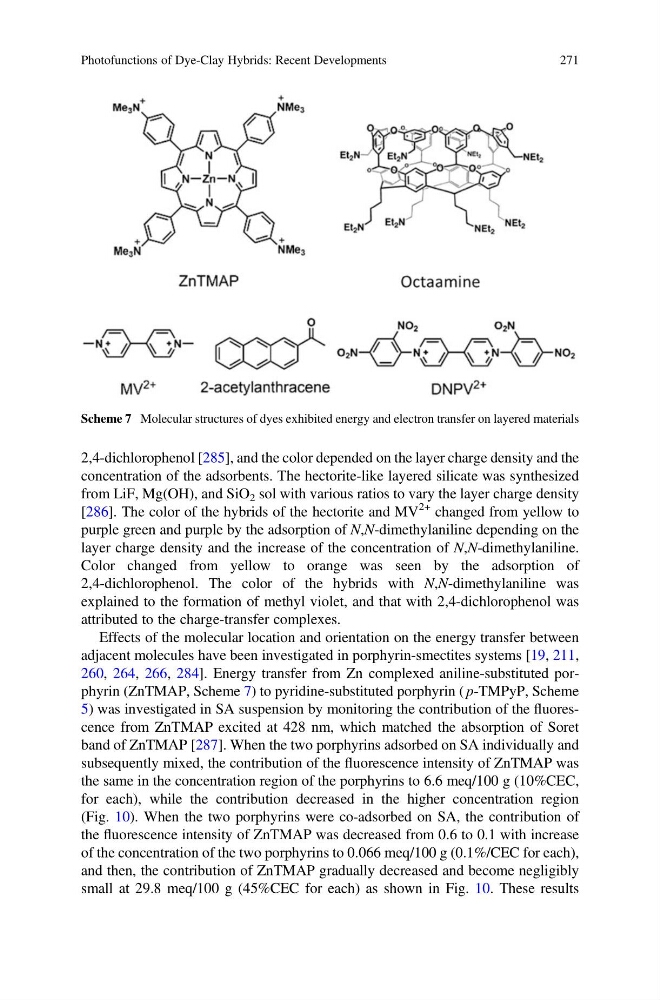
260, 264, 266, 284]. Energy transfer from Zn complexed aniline-substituted porphyrin (ZnTMAP, Scheme 7) to pyridine-substituted porphyrin ( p-TMPyP, Scheme
5) was investigated in SA suspension by monitoring the contribution of the fluorescence from ZnTMAP excited at 428 nm, which matched the absorption of Soret
band of ZnTMAP [287]. When the two porphyrins adsorbed on SA individually and
subsequently mixed, the contribution of the fluorescence intensity of ZnTMAP was
the same in the concentration region of the porphyrins to 6.6 meq/100 g (10%CEC,
for each), while the contribution decreased in the higher concentration region
(Fig. 10). When the two porphyrins were co-adsorbed on SA, the contribution of
the fluorescence intensity of ZnTMAP was decreased from 0.6 to 0.1 with increase
of the concentration of the two porphyrins to 0.066 meq/100 g (0.1%/CEC for each),
and then, the contribution of ZnTMAP gradually decreased and become negligibly
small at 29.8 meq/100 g (45%CEC for each) as shown in Fig. 10. These results
Scheme 7 Molecular structures of dyes exhibited energy and electron transfer on layered materials
Photofunctions of Dye-Clay Hybrids: Recent Developments
271
concentration of the adsorbents. The hectorite-like layered silicate was synthesized
from LiF, Mg(OH), and SiO 2 sol with various ratios to vary the layer charge density
[286]. The color of the hybrids of the hectorite and MV
2+ changed from yellow to
purple green and purple by the adsorption of N,N-dimethylaniline depending on the
layer charge density and the increase of the concentration of N,N-dimethylaniline.
Color changed from yellow to orange was seen by the adsorption of
2,4-dichlorophenol. The color of the hybrids with N,N-dimethylaniline was
explained to the formation of methyl violet, and that with 2,4-dichlorophenol was
attributed to the charge-transfer complexes.
Effects of the molecular location and orientation on the energy transfer between
adjacent molecules have been investigated in porphyrin-smectites systems [19, 211,
260, 264, 266, 284]. Energy transfer from Zn complexed aniline-substituted porphyrin (ZnTMAP, Scheme 7) to pyridine-substituted porphyrin ( p-TMPyP, Scheme
5) was investigated in SA suspension by monitoring the contribution of the fluorescence from ZnTMAP excited at 428 nm, which matched the absorption of Soret
band of ZnTMAP [287]. When the two porphyrins adsorbed on SA individually and
subsequently mixed, the contribution of the fluorescence intensity of ZnTMAP was
the same in the concentration region of the porphyrins to 6.6 meq/100 g (10%CEC,
for each), while the contribution decreased in the higher concentration region
(Fig. 10). When the two porphyrins were co-adsorbed on SA, the contribution of
the fluorescence intensity of ZnTMAP was decreased from 0.6 to 0.1 with increase
of the concentration of the two porphyrins to 0.066 meq/100 g (0.1%/CEC for each),
and then, the contribution of ZnTMAP gradually decreased and become negligibly
small at 29.8 meq/100 g (45%CEC for each) as shown in Fig. 10. These results
Scheme 7 Molecular structures of dyes exhibited energy and electron transfer on layered materials
Photofunctions of Dye-Clay Hybrids: Recent Developments
271