

hectorite [227, 231], nontronite [227, 231], vermiculite [229], titanates [234], niobates [235–238], and layered zirconium phosphate [239, 240]. The absorption
spectra of MV
2+ showed bathochromic a shift by the intercalation into smectites
(KF, SA, and LP-XLG) [233], the layered zirconium phosphate/phosphonates
[239, 240], and niobate [235–238]. The intercalated hybrid showed reversible
color change to blue by the photoinduced charge transfer from the host.
Non-emissive MV
2+ showed fluorescence in an aqueous suspension of a hectorite
(San Bernardino) and a montmorillonite (Clay Spur, Wyoming), and this phenomenon was explained by the planar structure of MV
2+ on the silicate layer [231]. This
phenomenon can be explained as “adsorption-induced emission.” The emission
intensity of MV
2+ increased by the decrease of the loading amount (by the increase
of the concentration of the clays). The self-quenching of fluorescence of MV
2+ on
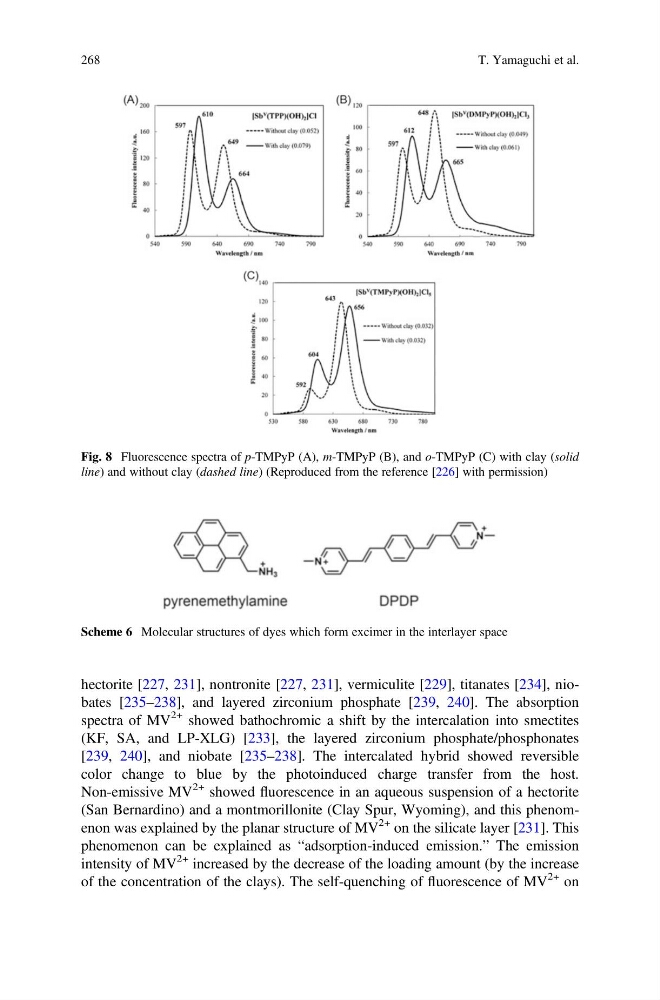
Fig. 8 Fluorescence spectra of p-TMPyP (A), m-TMPyP (B), and o-TMPyP (C) with clay (solid
line) and without clay (dashed line) (Reproduced from the reference [226] with permission)
Scheme 6 Molecular structures of dyes which form excimer in the interlayer space
268
T. Yamaguchi et al.
spectra of MV
2+ showed bathochromic a shift by the intercalation into smectites
(KF, SA, and LP-XLG) [233], the layered zirconium phosphate/phosphonates
[239, 240], and niobate [235–238]. The intercalated hybrid showed reversible
color change to blue by the photoinduced charge transfer from the host.
Non-emissive MV
2+ showed fluorescence in an aqueous suspension of a hectorite
(San Bernardino) and a montmorillonite (Clay Spur, Wyoming), and this phenomenon was explained by the planar structure of MV
2+ on the silicate layer [231]. This
phenomenon can be explained as “adsorption-induced emission.” The emission
intensity of MV
2+ increased by the decrease of the loading amount (by the increase
of the concentration of the clays). The self-quenching of fluorescence of MV
2+ on
Fig. 8 Fluorescence spectra of p-TMPyP (A), m-TMPyP (B), and o-TMPyP (C) with clay (solid
line) and without clay (dashed line) (Reproduced from the reference [226] with permission)
Scheme 6 Molecular structures of dyes which form excimer in the interlayer space
268
T. Yamaguchi et al.