

porphyrin moieties and the phenyl substituents on the silicate layer. The relationship
between the shift of the Soret band and the molecular structure of porphyrins has
been studied to find that the matching of the intercharge distance of the porphyrins
and the distance of the adjacent negative charge of the silicate layer was important
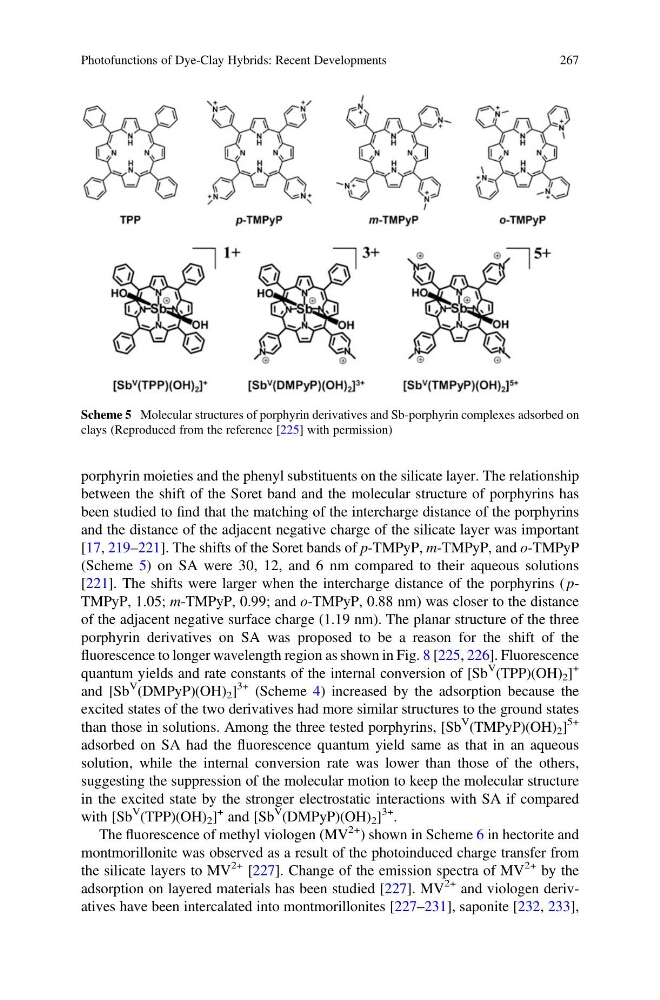
[17, 219–221]. The shifts of the Soret bands of p-TMPyP, m-TMPyP, and o-TMPyP
(Scheme 5) on SA were 30, 12, and 6 nm compared to their aqueous solutions
[221]. The shifts were larger when the intercharge distance of the porphyrins ( pTMPyP, 1.05; m-TMPyP, 0.99; and o-TMPyP, 0.88 nm) was closer to the distance
of the adjacent negative surface charge (1.19 nm). The planar structure of the three
porphyrin derivatives on SA was proposed to be a reason for the shift of the
fluorescence to longer wavelength region as shown in Fig. 8 [225, 226]. Fluorescence
quantum yields and rate constants of the internal conversion of [Sb
V (TPP)(OH) 2 ]
+
and [Sb
V (DMPyP)(OH) 2 ]
3+ (Scheme 4) increased by the adsorption because the
excited states of the two derivatives had more similar structures to the ground states
than those in solutions. Among the three tested porphyrins, [Sb
V (TMPyP)(OH) 2 ]
5+
adsorbed on SA had the fluorescence quantum yield same as that in an aqueous
solution, while the internal conversion rate was lower than those of the others,
suggesting the suppression of the molecular motion to keep the molecular structure
in the excited state by the stronger electrostatic interactions with SA if compared
with [Sb
V (TPP)(OH) 2 ]
+ and [Sb
V (DMPyP)(OH) 2 ]
3+ .
The fluorescence of methyl viologen (MV
2+ ) shown in Scheme 6 in hectorite and
montmorillonite was observed as a result of the photoinduced charge transfer from
the silicate layers to MV
2+ [227]. Change of the emission spectra of MV
2+ by the
adsorption on layered materials has been studied [227]. MV
2+ and viologen derivatives have been intercalated into montmorillonites [227–231], saponite [232, 233],
Scheme 5 Molecular structures of porphyrin derivatives and Sb-porphyrin complexes adsorbed on
clays (Reproduced from the reference [225] with permission)
Photofunctions of Dye-Clay Hybrids: Recent Developments
267
between the shift of the Soret band and the molecular structure of porphyrins has
been studied to find that the matching of the intercharge distance of the porphyrins
and the distance of the adjacent negative charge of the silicate layer was important
[17, 219–221]. The shifts of the Soret bands of p-TMPyP, m-TMPyP, and o-TMPyP
(Scheme 5) on SA were 30, 12, and 6 nm compared to their aqueous solutions
[221]. The shifts were larger when the intercharge distance of the porphyrins ( pTMPyP, 1.05; m-TMPyP, 0.99; and o-TMPyP, 0.88 nm) was closer to the distance
of the adjacent negative surface charge (1.19 nm). The planar structure of the three
porphyrin derivatives on SA was proposed to be a reason for the shift of the
fluorescence to longer wavelength region as shown in Fig. 8 [225, 226]. Fluorescence
quantum yields and rate constants of the internal conversion of [Sb
V (TPP)(OH) 2 ]
+
and [Sb
V (DMPyP)(OH) 2 ]
3+ (Scheme 4) increased by the adsorption because the
excited states of the two derivatives had more similar structures to the ground states
than those in solutions. Among the three tested porphyrins, [Sb
V (TMPyP)(OH) 2 ]
5+
adsorbed on SA had the fluorescence quantum yield same as that in an aqueous
solution, while the internal conversion rate was lower than those of the others,
suggesting the suppression of the molecular motion to keep the molecular structure
in the excited state by the stronger electrostatic interactions with SA if compared
with [Sb
V (TPP)(OH) 2 ]
+ and [Sb
V (DMPyP)(OH) 2 ]
3+ .
The fluorescence of methyl viologen (MV
2+ ) shown in Scheme 6 in hectorite and
montmorillonite was observed as a result of the photoinduced charge transfer from
the silicate layers to MV
2+ [227]. Change of the emission spectra of MV
2+ by the
adsorption on layered materials has been studied [227]. MV
2+ and viologen derivatives have been intercalated into montmorillonites [227–231], saponite [232, 233],
Scheme 5 Molecular structures of porphyrin derivatives and Sb-porphyrin complexes adsorbed on
clays (Reproduced from the reference [225] with permission)
Photofunctions of Dye-Clay Hybrids: Recent Developments
267