

the clays was proposed as a reason of the weaker emission at the high loading
amount.
Absorption at 410 and 450 nm appeared in powder of pyrene hybridized with
LP-RD by UV irradiation. Electron spin resonance experiment with and without O 2
(triplet quencher) indicated that the absorption was from a triplet state of radical
cation of pyrene [241]. The radical cation of pyrene was thought to be generated by
the photoinduced charge transfer from pyrene to LP-RD. The color of the hybrid was
different depending on the pre-activation temperature of LP-RD. The intensity of the
ESR signal was higher when the pre-activation temperature was lower, suggesting
the interactions of the surface water/OH groups with the adsorbed pyrene.
4.2.2 Excimer Formation
Pyrene has been used as a probe to investigate the surface chemistry [242–247] and
refractive index [248] of clays as well as the surface modification with
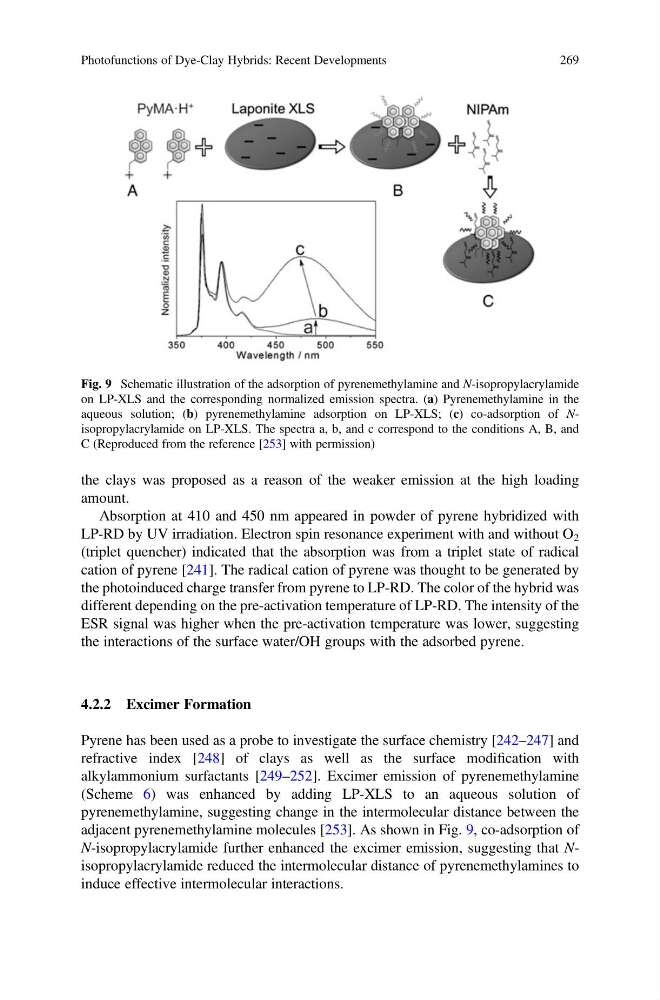
alkylammonium surfactants [249–252]. Excimer emission of pyrenemethylamine
(Scheme 6) was enhanced by adding LP-XLS to an aqueous solution of
pyrenemethylamine, suggesting change in the intermolecular distance between the
adjacent pyrenemethylamine molecules [253]. As shown in Fig. 9, co-adsorption of
N-isopropylacrylamide further enhanced the excimer emission, suggesting that Nisopropylacrylamide reduced the intermolecular distance of pyrenemethylamines to
induce effective intermolecular interactions.
Fig. 9 Schematic illustration of the adsorption of pyrenemethylamine and N-isopropylacrylamide
on LP-XLS and the corresponding normalized emission spectra. (a) Pyrenemethylamine in the
aqueous solution; (b) pyrenemethylamine adsorption on LP-XLS; (c) co-adsorption of Nisopropylacrylamide on LP-XLS. The spectra a, b, and c correspond to the conditions A, B, and
C (Reproduced from the reference [253] with permission)
Photofunctions of Dye-Clay Hybrids: Recent Developments
269
amount.
Absorption at 410 and 450 nm appeared in powder of pyrene hybridized with
LP-RD by UV irradiation. Electron spin resonance experiment with and without O 2
(triplet quencher) indicated that the absorption was from a triplet state of radical
cation of pyrene [241]. The radical cation of pyrene was thought to be generated by
the photoinduced charge transfer from pyrene to LP-RD. The color of the hybrid was
different depending on the pre-activation temperature of LP-RD. The intensity of the
ESR signal was higher when the pre-activation temperature was lower, suggesting
the interactions of the surface water/OH groups with the adsorbed pyrene.
4.2.2 Excimer Formation
Pyrene has been used as a probe to investigate the surface chemistry [242–247] and
refractive index [248] of clays as well as the surface modification with
alkylammonium surfactants [249–252]. Excimer emission of pyrenemethylamine
(Scheme 6) was enhanced by adding LP-XLS to an aqueous solution of
pyrenemethylamine, suggesting change in the intermolecular distance between the
adjacent pyrenemethylamine molecules [253]. As shown in Fig. 9, co-adsorption of
N-isopropylacrylamide further enhanced the excimer emission, suggesting that Nisopropylacrylamide reduced the intermolecular distance of pyrenemethylamines to
induce effective intermolecular interactions.
Fig. 9 Schematic illustration of the adsorption of pyrenemethylamine and N-isopropylacrylamide
on LP-XLS and the corresponding normalized emission spectra. (a) Pyrenemethylamine in the
aqueous solution; (b) pyrenemethylamine adsorption on LP-XLS; (c) co-adsorption of Nisopropylacrylamide on LP-XLS. The spectra a, b, and c correspond to the conditions A, B, and
C (Reproduced from the reference [253] with permission)
Photofunctions of Dye-Clay Hybrids: Recent Developments
269