

decoloration suppressed upon visible light irradiation over the R6G in SA or in PVP
[144]. It was thought that the suppressed oxygen diffusion in the layered structure of
SA-PVP contributed to the observed stability.
Another important process is charge transfer (CT) interactions from dyes to
layered materials which induce bathochromic shift of absorption spectra
[145, 146]. Hybridization of biphenyl with a synthetic hectorite (laponite)-induced
absorption at 320 nm attributed to the CT transition, where the biphenyl acted as an
electron donor and electron-deficient sites or Lewis acid sites of laponite were
electron acceptors [147]. The CT interactions induced a triplet state of biphenyl by
recombination from the CT state, and subsequent phosphorescence at 480 nm was
observed at 130
C which was stronger than the fluorescence.
Anthraquinone-2-sulfonic
acid
was
hybridized
with
MgAl-LDH
(Mg 0.65 Al 0.35 (OH) 2 (CO 3 ) 0.01 ), and the hybrid showed photoinduced reduction of
the anthraquinone in formamide as shown by the color change from colorless to red
[148]. The red color returned to the initial colorless in the dark. The mono-anionic
and di-anionic anthraquinones with different lifetime were observed (13.9 and
16.9 min). The solvent was thought to act as the electron donor, and a surface of
the MgAl-LDH provides a high pH environment to stabilize the anionic
anthraquinone.
Another example is the diverse coloration of retinal Schiff base by the interactions with different smectites. Retinal in rhodopsin as a photoreceptive unit exists as
a protonated Schiff base in a cis-isomeric state [149], and the rhodopsin provides
three different environments for the retinal Schiff base to give blue (λ max ¼ 425 nm),
green (λ max ¼ 530 nm), and red (λ max ¼ 560 nm) colors with broad absorption
[150]. The similar absorption changes of the retinal Schiff base were observed by
mixing the retinal Schiff base with three montmorillonites, Bengel Bright
11 obtained from Wyoming, USA (Hojun Ind. Co., Japan) (479 nm), a
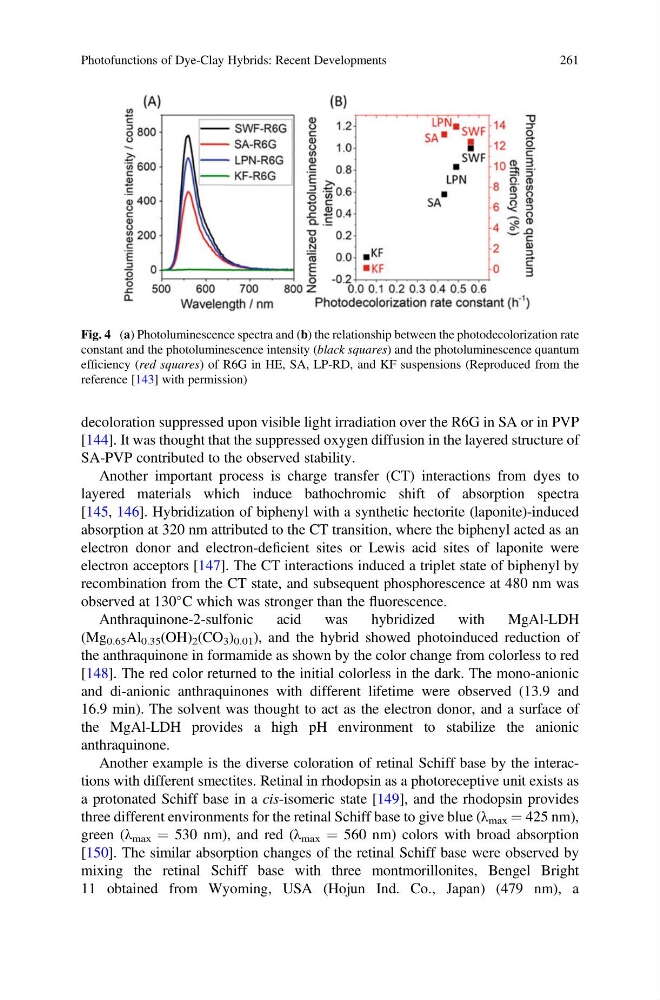
Fig. 4 (a) Photoluminescence spectra and (b) the relationship between the photodecolorization rate
constant and the photoluminescence intensity (black squares) and the photoluminescence quantum
efficiency (red squares) of R6G in HE, SA, LP-RD, and KF suspensions (Reproduced from the
reference [143] with permission)
Photofunctions of Dye-Clay Hybrids: Recent Developments
261
[144]. It was thought that the suppressed oxygen diffusion in the layered structure of
SA-PVP contributed to the observed stability.
Another important process is charge transfer (CT) interactions from dyes to
layered materials which induce bathochromic shift of absorption spectra
[145, 146]. Hybridization of biphenyl with a synthetic hectorite (laponite)-induced
absorption at 320 nm attributed to the CT transition, where the biphenyl acted as an
electron donor and electron-deficient sites or Lewis acid sites of laponite were
electron acceptors [147]. The CT interactions induced a triplet state of biphenyl by
recombination from the CT state, and subsequent phosphorescence at 480 nm was
observed at 130
C which was stronger than the fluorescence.
Anthraquinone-2-sulfonic
acid
was
hybridized
with
MgAl-LDH
(Mg 0.65 Al 0.35 (OH) 2 (CO 3 ) 0.01 ), and the hybrid showed photoinduced reduction of
the anthraquinone in formamide as shown by the color change from colorless to red
[148]. The red color returned to the initial colorless in the dark. The mono-anionic
and di-anionic anthraquinones with different lifetime were observed (13.9 and
16.9 min). The solvent was thought to act as the electron donor, and a surface of
the MgAl-LDH provides a high pH environment to stabilize the anionic
anthraquinone.
Another example is the diverse coloration of retinal Schiff base by the interactions with different smectites. Retinal in rhodopsin as a photoreceptive unit exists as
a protonated Schiff base in a cis-isomeric state [149], and the rhodopsin provides
three different environments for the retinal Schiff base to give blue (λ max ¼ 425 nm),
green (λ max ¼ 530 nm), and red (λ max ¼ 560 nm) colors with broad absorption
[150]. The similar absorption changes of the retinal Schiff base were observed by
mixing the retinal Schiff base with three montmorillonites, Bengel Bright
11 obtained from Wyoming, USA (Hojun Ind. Co., Japan) (479 nm), a
Fig. 4 (a) Photoluminescence spectra and (b) the relationship between the photodecolorization rate
constant and the photoluminescence intensity (black squares) and the photoluminescence quantum
efficiency (red squares) of R6G in HE, SA, LP-RD, and KF suspensions (Reproduced from the
reference [143] with permission)
Photofunctions of Dye-Clay Hybrids: Recent Developments
261