

is known that a rate constant of internal conversion is limited by Franck-Condon
factor which is the overlap integral of vibrational parts of wave functions in the states
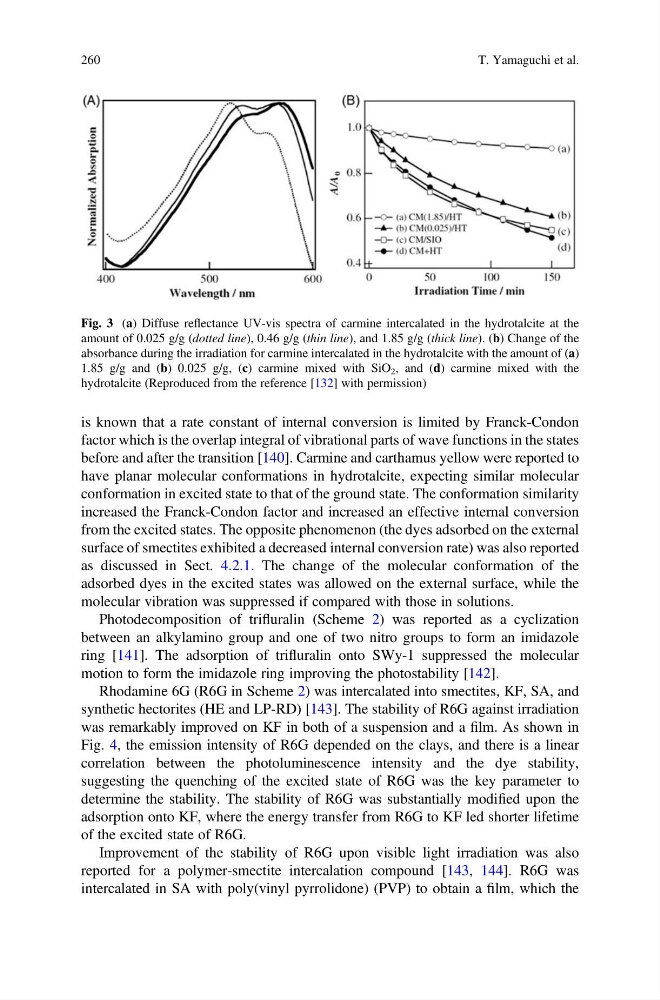
before and after the transition [140]. Carmine and carthamus yellow were reported to
have planar molecular conformations in hydrotalcite, expecting similar molecular
conformation in excited state to that of the ground state. The conformation similarity
increased the Franck-Condon factor and increased an effective internal conversion
from the excited states. The opposite phenomenon (the dyes adsorbed on the external
surface of smectites exhibited a decreased internal conversion rate) was also reported
as discussed in Sect. 4.2.1. The change of the molecular conformation of the
adsorbed dyes in the excited states was allowed on the external surface, while the
molecular vibration was suppressed if compared with those in solutions.
Photodecomposition of trifluralin (Scheme 2) was reported as a cyclization
between an alkylamino group and one of two nitro groups to form an imidazole
ring [141]. The adsorption of trifluralin onto SWy-1 suppressed the molecular
motion to form the imidazole ring improving the photostability [142].
Rhodamine 6G (R6G in Scheme 2) was intercalated into smectites, KF, SA, and
synthetic hectorites (HE and LP-RD) [143]. The stability of R6G against irradiation
was remarkably improved on KF in both of a suspension and a film. As shown in
Fig. 4, the emission intensity of R6G depended on the clays, and there is a linear
correlation between the photoluminescence intensity and the dye stability,
suggesting the quenching of the excited state of R6G was the key parameter to
determine the stability. The stability of R6G was substantially modified upon the
adsorption onto KF, where the energy transfer from R6G to KF led shorter lifetime
of the excited state of R6G.
Improvement of the stability of R6G upon visible light irradiation was also
reported for a polymer-smectite intercalation compound [143, 144]. R6G was
intercalated in SA with poly(vinyl pyrrolidone) (PVP) to obtain a film, which the
Fig. 3 (a) Diffuse reflectance UV-vis spectra of carmine intercalated in the hydrotalcite at the
amount of 0.025 g/g (dotted line), 0.46 g/g (thin line), and 1.85 g/g (thick line). (b) Change of the
absorbance during the irradiation for carmine intercalated in the hydrotalcite with the amount of (a)
1.85 g/g and (b) 0.025 g/g, (c) carmine mixed with SiO 2 , and (d) carmine mixed with the
hydrotalcite (Reproduced from the reference [132] with permission)
260
T. Yamaguchi et al.
factor which is the overlap integral of vibrational parts of wave functions in the states
before and after the transition [140]. Carmine and carthamus yellow were reported to
have planar molecular conformations in hydrotalcite, expecting similar molecular
conformation in excited state to that of the ground state. The conformation similarity
increased the Franck-Condon factor and increased an effective internal conversion
from the excited states. The opposite phenomenon (the dyes adsorbed on the external
surface of smectites exhibited a decreased internal conversion rate) was also reported
as discussed in Sect. 4.2.1. The change of the molecular conformation of the
adsorbed dyes in the excited states was allowed on the external surface, while the
molecular vibration was suppressed if compared with those in solutions.
Photodecomposition of trifluralin (Scheme 2) was reported as a cyclization
between an alkylamino group and one of two nitro groups to form an imidazole
ring [141]. The adsorption of trifluralin onto SWy-1 suppressed the molecular
motion to form the imidazole ring improving the photostability [142].
Rhodamine 6G (R6G in Scheme 2) was intercalated into smectites, KF, SA, and
synthetic hectorites (HE and LP-RD) [143]. The stability of R6G against irradiation
was remarkably improved on KF in both of a suspension and a film. As shown in
Fig. 4, the emission intensity of R6G depended on the clays, and there is a linear
correlation between the photoluminescence intensity and the dye stability,
suggesting the quenching of the excited state of R6G was the key parameter to
determine the stability. The stability of R6G was substantially modified upon the
adsorption onto KF, where the energy transfer from R6G to KF led shorter lifetime
of the excited state of R6G.
Improvement of the stability of R6G upon visible light irradiation was also
reported for a polymer-smectite intercalation compound [143, 144]. R6G was
intercalated in SA with poly(vinyl pyrrolidone) (PVP) to obtain a film, which the
Fig. 3 (a) Diffuse reflectance UV-vis spectra of carmine intercalated in the hydrotalcite at the
amount of 0.025 g/g (dotted line), 0.46 g/g (thin line), and 1.85 g/g (thick line). (b) Change of the
absorbance during the irradiation for carmine intercalated in the hydrotalcite with the amount of (a)
1.85 g/g and (b) 0.025 g/g, (c) carmine mixed with SiO 2 , and (d) carmine mixed with the
hydrotalcite (Reproduced from the reference [132] with permission)
260
T. Yamaguchi et al.