

interactions between the oxygen of the layered silicates and the π-electron of the
dyes made the molecular orientation of the dyes parallel to the silicate layer.
Stability of dyes is one of the prerequisites for the practical application, and the
dye-clay interactions have been expected to play a role in it [116–126]. The
improvements of the stability of the dyes upon irradiation and heating have been
seen in (1) cationic dyes with smectites, (2) anionic dyes with layered double
hydroxides (LDHs), and (3) nonionic dyes with organically modified smectites
and LDHs. The improvements of the stabilities of the dyes by the hybridization
with the layered materials were explained as results of reducing the intensity of the
incident light by the absorption and scattering with the host [127–129], electronic
stabilization of the dye [130–132], and suppressed gas diffusion mainly oxygen in
the hydrophobic environment [111, 133–139].
An example of the improved chemical stability of the anthocyanin by the
interactions with SA was shown by the color change upon exposure to acidic and
basic atmospheres repeatedly [102]. Such natural dyes as β-carotene, anthocyanin,
carmine, annatto, and carthamus yellow were adsorbed on a hydrotalcite [111, 139]
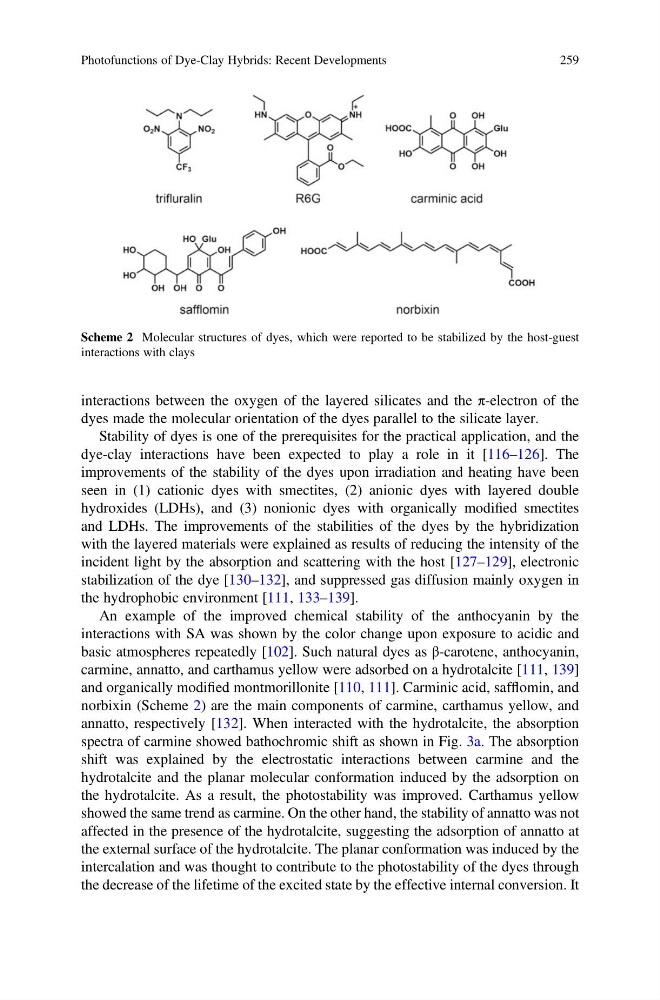
and organically modified montmorillonite [110, 111]. Carminic acid, safflomin, and
norbixin (Scheme 2) are the main components of carmine, carthamus yellow, and
annatto, respectively [132]. When interacted with the hydrotalcite, the absorption
spectra of carmine showed bathochromic shift as shown in Fig. 3a. The absorption
shift was explained by the electrostatic interactions between carmine and the
hydrotalcite and the planar molecular conformation induced by the adsorption on
the hydrotalcite. As a result, the photostability was improved. Carthamus yellow
showed the same trend as carmine. On the other hand, the stability of annatto was not
affected in the presence of the hydrotalcite, suggesting the adsorption of annatto at
the external surface of the hydrotalcite. The planar conformation was induced by the
intercalation and was thought to contribute to the photostability of the dyes through
the decrease of the lifetime of the excited state by the effective internal conversion. It
Scheme 2 Molecular structures of dyes, which were reported to be stabilized by the host-guest
interactions with clays
Photofunctions of Dye-Clay Hybrids: Recent Developments
259
dyes made the molecular orientation of the dyes parallel to the silicate layer.
Stability of dyes is one of the prerequisites for the practical application, and the
dye-clay interactions have been expected to play a role in it [116–126]. The
improvements of the stability of the dyes upon irradiation and heating have been
seen in (1) cationic dyes with smectites, (2) anionic dyes with layered double
hydroxides (LDHs), and (3) nonionic dyes with organically modified smectites
and LDHs. The improvements of the stabilities of the dyes by the hybridization
with the layered materials were explained as results of reducing the intensity of the
incident light by the absorption and scattering with the host [127–129], electronic
stabilization of the dye [130–132], and suppressed gas diffusion mainly oxygen in
the hydrophobic environment [111, 133–139].
An example of the improved chemical stability of the anthocyanin by the
interactions with SA was shown by the color change upon exposure to acidic and
basic atmospheres repeatedly [102]. Such natural dyes as β-carotene, anthocyanin,
carmine, annatto, and carthamus yellow were adsorbed on a hydrotalcite [111, 139]
and organically modified montmorillonite [110, 111]. Carminic acid, safflomin, and
norbixin (Scheme 2) are the main components of carmine, carthamus yellow, and
annatto, respectively [132]. When interacted with the hydrotalcite, the absorption
spectra of carmine showed bathochromic shift as shown in Fig. 3a. The absorption
shift was explained by the electrostatic interactions between carmine and the
hydrotalcite and the planar molecular conformation induced by the adsorption on
the hydrotalcite. As a result, the photostability was improved. Carthamus yellow
showed the same trend as carmine. On the other hand, the stability of annatto was not
affected in the presence of the hydrotalcite, suggesting the adsorption of annatto at
the external surface of the hydrotalcite. The planar conformation was induced by the
intercalation and was thought to contribute to the photostability of the dyes through
the decrease of the lifetime of the excited state by the effective internal conversion. It
Scheme 2 Molecular structures of dyes, which were reported to be stabilized by the host-guest
interactions with clays
Photofunctions of Dye-Clay Hybrids: Recent Developments
259