

process and thus be easily detected [85]. The phosphorescence sensor exhibited a
fast, but highly reversible, response toward the solvents. The forbidden tripletsinglet exciton excitation energy transfer is the explanation of this interesting
phenomenon. The ED(singlet) ! EA(triplet) energy transfer process was more
efficient for sensing applications than the singlet-singlet process [84, 85]. In some
cases, the nanoparticles themselves can participate in a FRET process. For example,
layered MoS 2 exhibits the properties of an efficient fluorescence quencher, which
was used in the selective detection of kanamycin residue in milk [114]. Some hybrid
systems can respond to ambient conditions such as temperature [115, 116] or pH
[47, 86].
Modern applications also include the sensing of biological compounds. FRET has
been successfully applied for new clinical diagnostic methods and protein analytical
techniques. Graphene oxide (GO) nanosheets easily dispersible in water were used
for sensing immunoglobulin [117]. The GO played the role of a quencher in the
selective FRET aptasensor. The luminescence from the fluorescein-labeled aptamer
adsorbed onto the surface of GO was quenched by the host via a FRET mechanism.
In the presence of the antibody immunoglobulin E (IgE), the bonding of IgE and the
aptamer was stronger, which prevented the adsorption of the aptamer to GO. The
result of the presence of IgE was the persistence of strong luminescence also in the
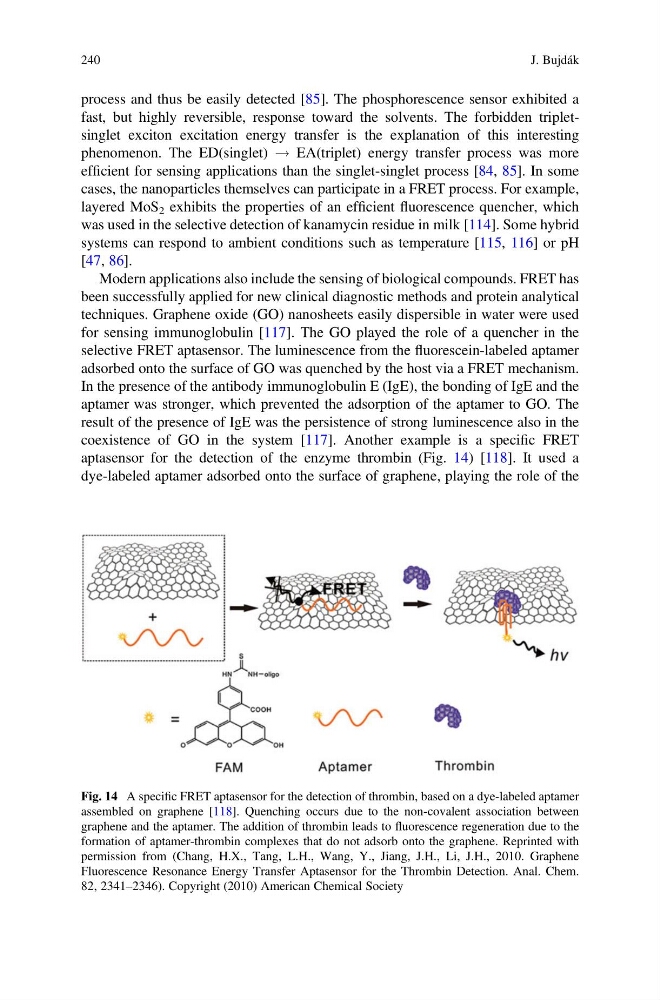
coexistence of GO in the system [117]. Another example is a specific FRET
aptasensor for the detection of the enzyme thrombin (Fig. 14) [118]. It used a
dye-labeled aptamer adsorbed onto the surface of graphene, playing the role of the
Fig. 14 A specific FRET aptasensor for the detection of thrombin, based on a dye-labeled aptamer
assembled on graphene [118]. Quenching occurs due to the non-covalent association between
graphene and the aptamer. The addition of thrombin leads to fluorescence regeneration due to the
formation of aptamer-thrombin complexes that do not adsorb onto the graphene. Reprinted with
permission from (Chang, H.X., Tang, L.H., Wang, Y., Jiang, J.H., Li, J.H., 2010. Graphene
Fluorescence Resonance Energy Transfer Aptasensor for the Thrombin Detection. Anal. Chem.
82, 2341–2346). Copyright (2010) American Chemical Society
240
J. Bujdák
fast, but highly reversible, response toward the solvents. The forbidden tripletsinglet exciton excitation energy transfer is the explanation of this interesting
phenomenon. The ED(singlet) ! EA(triplet) energy transfer process was more
efficient for sensing applications than the singlet-singlet process [84, 85]. In some
cases, the nanoparticles themselves can participate in a FRET process. For example,
layered MoS 2 exhibits the properties of an efficient fluorescence quencher, which
was used in the selective detection of kanamycin residue in milk [114]. Some hybrid
systems can respond to ambient conditions such as temperature [115, 116] or pH
[47, 86].
Modern applications also include the sensing of biological compounds. FRET has
been successfully applied for new clinical diagnostic methods and protein analytical
techniques. Graphene oxide (GO) nanosheets easily dispersible in water were used
for sensing immunoglobulin [117]. The GO played the role of a quencher in the
selective FRET aptasensor. The luminescence from the fluorescein-labeled aptamer
adsorbed onto the surface of GO was quenched by the host via a FRET mechanism.
In the presence of the antibody immunoglobulin E (IgE), the bonding of IgE and the
aptamer was stronger, which prevented the adsorption of the aptamer to GO. The
result of the presence of IgE was the persistence of strong luminescence also in the
coexistence of GO in the system [117]. Another example is a specific FRET
aptasensor for the detection of the enzyme thrombin (Fig. 14) [118]. It used a
dye-labeled aptamer adsorbed onto the surface of graphene, playing the role of the
Fig. 14 A specific FRET aptasensor for the detection of thrombin, based on a dye-labeled aptamer
assembled on graphene [118]. Quenching occurs due to the non-covalent association between
graphene and the aptamer. The addition of thrombin leads to fluorescence regeneration due to the
formation of aptamer-thrombin complexes that do not adsorb onto the graphene. Reprinted with
permission from (Chang, H.X., Tang, L.H., Wang, Y., Jiang, J.H., Li, J.H., 2010. Graphene
Fluorescence Resonance Energy Transfer Aptasensor for the Thrombin Detection. Anal. Chem.
82, 2341–2346). Copyright (2010) American Chemical Society
240
J. Bujdák