

the reversible reactions of ring formation and ring opening, which are very sensitive
to the molecular environment [4]. There are several papers describing the functionality of new types of sensors using organic dyes and layered nanoparticles. There are
dozens of examples using such hybrid systems in connection with FRET for sensing
various analytes, such as inorganic ions [37, 41]. One typical example is sensing the
vapors of various organic liquids [56, 83–85]. For example, the color of emitted light
sensitively changed when the dyes/LDH hybrid films were exposed to the vapor of
different volatile organic solvents [84]. In the presence of nitrobenzene, the luminescence was totally quenched. This was explained by an electron transfer process to
the electron-deficient LUMO orbital of the nitrobenzene molecules. The presence of
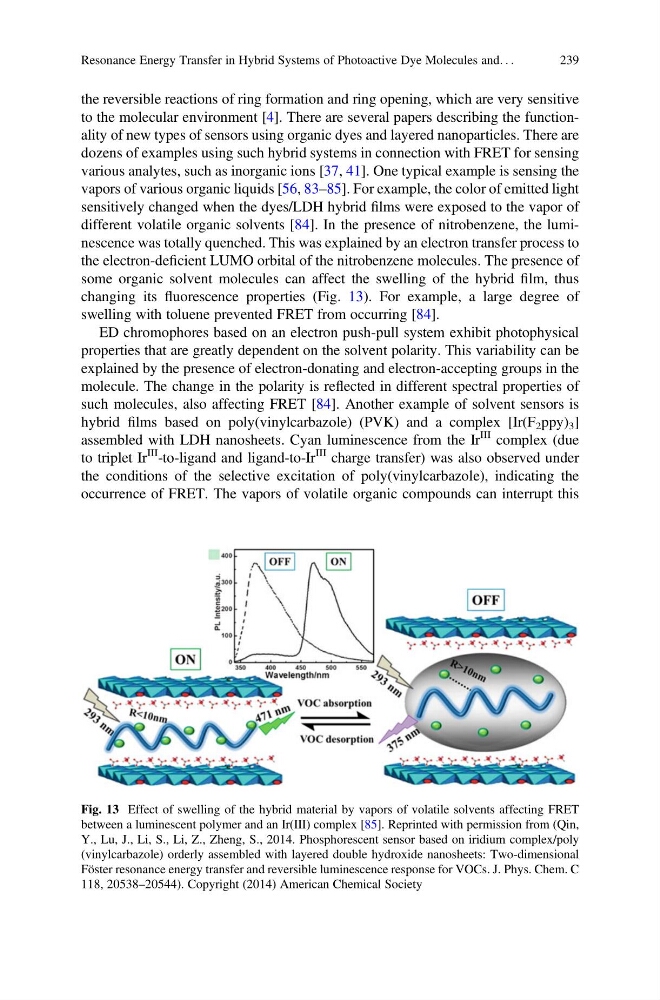
some organic solvent molecules can affect the swelling of the hybrid film, thus
changing its fluorescence properties (Fig. 13). For example, a large degree of
swelling with toluene prevented FRET from occurring [84].
ED chromophores based on an electron push-pull system exhibit photophysical
properties that are greatly dependent on the solvent polarity. This variability can be
explained by the presence of electron-donating and electron-accepting groups in the
molecule. The change in the polarity is reflected in different spectral properties of
such molecules, also affecting FRET [84]. Another example of solvent sensors is
hybrid films based on poly(vinylcarbazole) (PVK) and a complex [Ir(F 2 ppy) 3 ]
assembled with LDH nanosheets. Cyan luminescence from the Ir
III complex (due
to triplet Ir
III -to-ligand and ligand-to-Ir
III charge transfer) was also observed under
the conditions of the selective excitation of poly(vinylcarbazole), indicating the
occurrence of FRET. The vapors of volatile organic compounds can interrupt this
Fig. 13 Effect of swelling of the hybrid material by vapors of volatile solvents affecting FRET
between a luminescent polymer and an Ir(III) complex [85]. Reprinted with permission from (Qin,
Y., Lu, J., Li, S., Li, Z., Zheng, S., 2014. Phosphorescent sensor based on iridium complex/poly
(vinylcarbazole) orderly assembled with layered double hydroxide nanosheets: Two-dimensional
Föster resonance energy transfer and reversible luminescence response for VOCs. J. Phys. Chem. C
118, 20538–20544). Copyright (2014) American Chemical Society
Resonance Energy Transfer in Hybrid Systems of Photoactive Dye Molecules and. . .
239
to the molecular environment [4]. There are several papers describing the functionality of new types of sensors using organic dyes and layered nanoparticles. There are
dozens of examples using such hybrid systems in connection with FRET for sensing
various analytes, such as inorganic ions [37, 41]. One typical example is sensing the
vapors of various organic liquids [56, 83–85]. For example, the color of emitted light
sensitively changed when the dyes/LDH hybrid films were exposed to the vapor of
different volatile organic solvents [84]. In the presence of nitrobenzene, the luminescence was totally quenched. This was explained by an electron transfer process to
the electron-deficient LUMO orbital of the nitrobenzene molecules. The presence of
some organic solvent molecules can affect the swelling of the hybrid film, thus
changing its fluorescence properties (Fig. 13). For example, a large degree of
swelling with toluene prevented FRET from occurring [84].
ED chromophores based on an electron push-pull system exhibit photophysical
properties that are greatly dependent on the solvent polarity. This variability can be
explained by the presence of electron-donating and electron-accepting groups in the
molecule. The change in the polarity is reflected in different spectral properties of
such molecules, also affecting FRET [84]. Another example of solvent sensors is
hybrid films based on poly(vinylcarbazole) (PVK) and a complex [Ir(F 2 ppy) 3 ]
assembled with LDH nanosheets. Cyan luminescence from the Ir
III complex (due
to triplet Ir
III -to-ligand and ligand-to-Ir
III charge transfer) was also observed under
the conditions of the selective excitation of poly(vinylcarbazole), indicating the
occurrence of FRET. The vapors of volatile organic compounds can interrupt this
Fig. 13 Effect of swelling of the hybrid material by vapors of volatile solvents affecting FRET
between a luminescent polymer and an Ir(III) complex [85]. Reprinted with permission from (Qin,
Y., Lu, J., Li, S., Li, Z., Zheng, S., 2014. Phosphorescent sensor based on iridium complex/poly
(vinylcarbazole) orderly assembled with layered double hydroxide nanosheets: Two-dimensional
Föster resonance energy transfer and reversible luminescence response for VOCs. J. Phys. Chem. C
118, 20538–20544). Copyright (2014) American Chemical Society
Resonance Energy Transfer in Hybrid Systems of Photoactive Dye Molecules and. . .
239