

quencher. Due to the non-covalent bond between the aptamer and graphene, the
fluorescence of the luminophores linked to the aptamer was effectively quenched.
The addition of thrombin led to the generation of fluorescence due to the formation
of thrombin-aptamer complexes, which had a weak affinity for the surface of
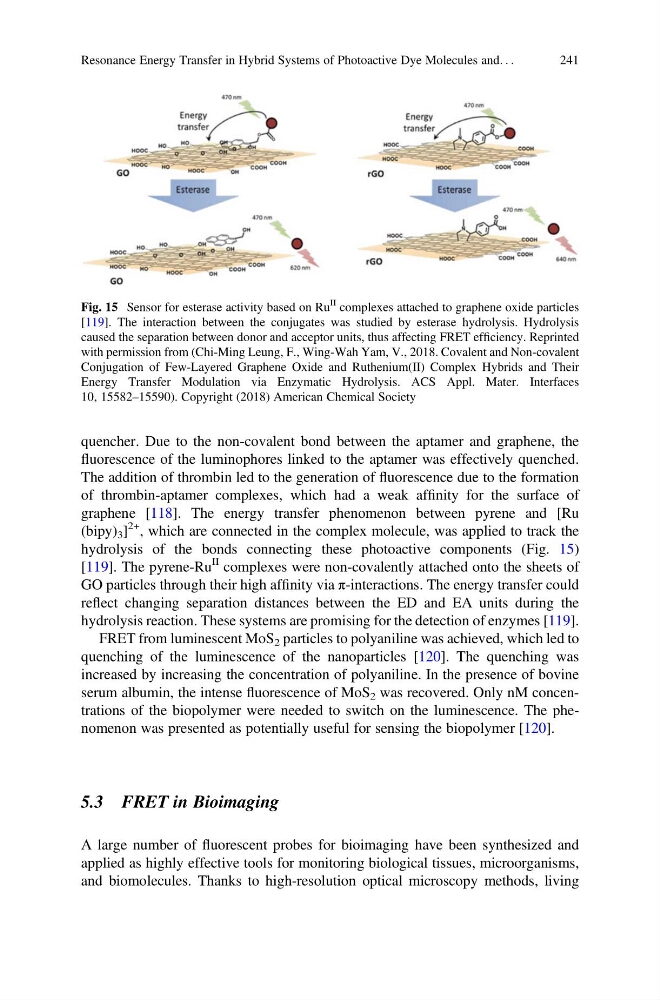
graphene [118]. The energy transfer phenomenon between pyrene and [Ru
(bipy) 3 ]
2+ , which are connected in the complex molecule, was applied to track the
hydrolysis of the bonds connecting these photoactive components (Fig. 15)
[119]. The pyrene-Ru
II complexes were non-covalently attached onto the sheets of
GO particles through their high affinity via π-interactions. The energy transfer could
reflect changing separation distances between the ED and EA units during the
hydrolysis reaction. These systems are promising for the detection of enzymes [119].
FRET from luminescent MoS 2 particles to polyaniline was achieved, which led to
quenching of the luminescence of the nanoparticles [120]. The quenching was
increased by increasing the concentration of polyaniline. In the presence of bovine
serum albumin, the intense fluorescence of MoS 2 was recovered. Only nM concentrations of the biopolymer were needed to switch on the luminescence. The phenomenon was presented as potentially useful for sensing the biopolymer [120].
5.3 FRET in Bioimaging
A large number of fluorescent probes for bioimaging have been synthesized and
applied as highly effective tools for monitoring biological tissues, microorganisms,
and biomolecules. Thanks to high-resolution optical microscopy methods, living
Fig. 15 Sensor for esterase activity based on Ru
II complexes attached to graphene oxide particles
[119]. The interaction between the conjugates was studied by esterase hydrolysis. Hydrolysis
caused the separation between donor and acceptor units, thus affecting FRET efficiency. Reprinted
with permission from (Chi-Ming Leung, F., Wing-Wah Yam, V., 2018. Covalent and Non-covalent
Conjugation of Few-Layered Graphene Oxide and Ruthenium(II) Complex Hybrids and Their
Energy Transfer Modulation via Enzymatic Hydrolysis. ACS Appl. Mater. Interfaces
10, 15582–15590). Copyright (2018) American Chemical Society
Resonance Energy Transfer in Hybrid Systems of Photoactive Dye Molecules and. . .
241
fluorescence of the luminophores linked to the aptamer was effectively quenched.
The addition of thrombin led to the generation of fluorescence due to the formation
of thrombin-aptamer complexes, which had a weak affinity for the surface of
graphene [118]. The energy transfer phenomenon between pyrene and [Ru
(bipy) 3 ]
2+ , which are connected in the complex molecule, was applied to track the
hydrolysis of the bonds connecting these photoactive components (Fig. 15)
[119]. The pyrene-Ru
II complexes were non-covalently attached onto the sheets of
GO particles through their high affinity via π-interactions. The energy transfer could
reflect changing separation distances between the ED and EA units during the
hydrolysis reaction. These systems are promising for the detection of enzymes [119].
FRET from luminescent MoS 2 particles to polyaniline was achieved, which led to
quenching of the luminescence of the nanoparticles [120]. The quenching was
increased by increasing the concentration of polyaniline. In the presence of bovine
serum albumin, the intense fluorescence of MoS 2 was recovered. Only nM concentrations of the biopolymer were needed to switch on the luminescence. The phenomenon was presented as potentially useful for sensing the biopolymer [120].
5.3 FRET in Bioimaging
A large number of fluorescent probes for bioimaging have been synthesized and
applied as highly effective tools for monitoring biological tissues, microorganisms,
and biomolecules. Thanks to high-resolution optical microscopy methods, living
Fig. 15 Sensor for esterase activity based on Ru
II complexes attached to graphene oxide particles
[119]. The interaction between the conjugates was studied by esterase hydrolysis. Hydrolysis
caused the separation between donor and acceptor units, thus affecting FRET efficiency. Reprinted
with permission from (Chi-Ming Leung, F., Wing-Wah Yam, V., 2018. Covalent and Non-covalent
Conjugation of Few-Layered Graphene Oxide and Ruthenium(II) Complex Hybrids and Their
Energy Transfer Modulation via Enzymatic Hydrolysis. ACS Appl. Mater. Interfaces
10, 15582–15590). Copyright (2018) American Chemical Society
Resonance Energy Transfer in Hybrid Systems of Photoactive Dye Molecules and. . .
241