

distances and FRET is clearly documented by an experiment based on the hybrid
colloidal systems of layered silicate and two dyes, R6G and Ox4 [11]. The dyes
formed a suitable couple for FRET with an R 0 of approximately 5.5 nm. The FRET
efficiency can be controlled simply by adjusting the amounts of dye molecules and
adsorbent to an appropriate ratio. Due to the quantitative adsorption of the dye
cations onto the surface of layered silicate, the dyes/Sap ratio essentially determined
the concentration of the dye molecules on the silicate particles. As it turned out,
changes in just the Sap concentration in the colloid resulted in significant color
changes of the emitted light with the same dye concentrations (Fig. 5). When the
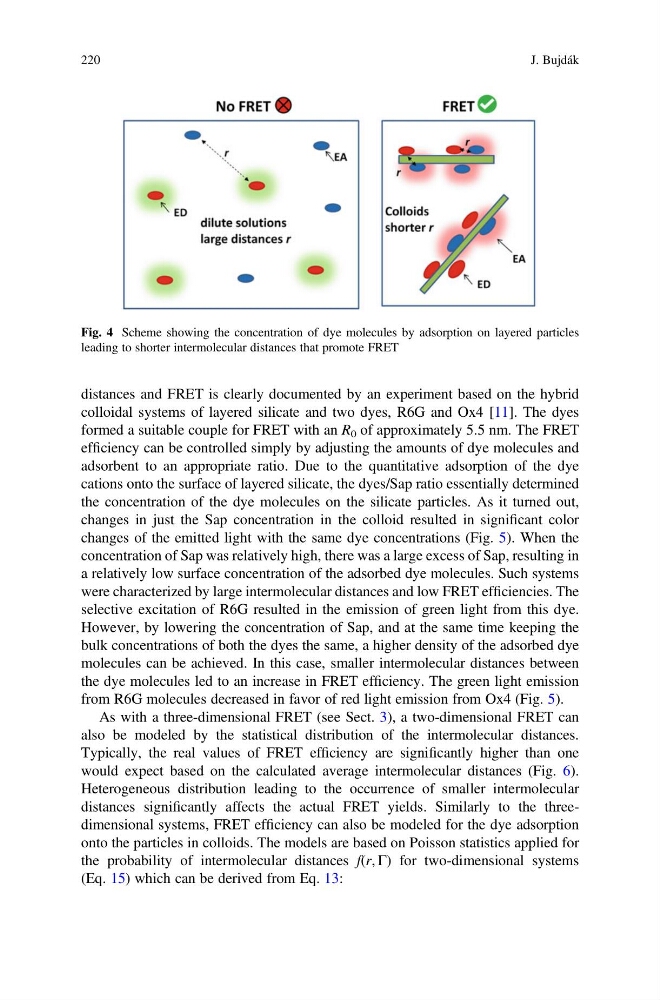
concentration of Sap was relatively high, there was a large excess of Sap, resulting in
a relatively low surface concentration of the adsorbed dye molecules. Such systems
were characterized by large intermolecular distances and low FRET efficiencies. The
selective excitation of R6G resulted in the emission of green light from this dye.
However, by lowering the concentration of Sap, and at the same time keeping the
bulk concentrations of both the dyes the same, a higher density of the adsorbed dye
molecules can be achieved. In this case, smaller intermolecular distances between
the dye molecules led to an increase in FRET efficiency. The green light emission
from R6G molecules decreased in favor of red light emission from Ox4 (Fig. 5).
As with a three-dimensional FRET (see Sect. 3), a two-dimensional FRET can
also be modeled by the statistical distribution of the intermolecular distances.
Typically, the real values of FRET efficiency are significantly higher than one
would expect based on the calculated average intermolecular distances (Fig. 6).
Heterogeneous distribution leading to the occurrence of smaller intermolecular
distances significantly affects the actual FRET yields. Similarly to the threedimensional systems, FRET efficiency can also be modeled for the dye adsorption
onto the particles in colloids. The models are based on Poisson statistics applied for
the probability of intermolecular distances f(r, Γ) for two-dimensional systems
(Eq. 15) which can be derived from Eq. 13:
Fig. 4 Scheme showing the concentration of dye molecules by adsorption on layered particles
leading to shorter intermolecular distances that promote FRET
220
J. Bujdák
colloidal systems of layered silicate and two dyes, R6G and Ox4 [11]. The dyes
formed a suitable couple for FRET with an R 0 of approximately 5.5 nm. The FRET
efficiency can be controlled simply by adjusting the amounts of dye molecules and
adsorbent to an appropriate ratio. Due to the quantitative adsorption of the dye
cations onto the surface of layered silicate, the dyes/Sap ratio essentially determined
the concentration of the dye molecules on the silicate particles. As it turned out,
changes in just the Sap concentration in the colloid resulted in significant color
changes of the emitted light with the same dye concentrations (Fig. 5). When the
concentration of Sap was relatively high, there was a large excess of Sap, resulting in
a relatively low surface concentration of the adsorbed dye molecules. Such systems
were characterized by large intermolecular distances and low FRET efficiencies. The
selective excitation of R6G resulted in the emission of green light from this dye.
However, by lowering the concentration of Sap, and at the same time keeping the
bulk concentrations of both the dyes the same, a higher density of the adsorbed dye
molecules can be achieved. In this case, smaller intermolecular distances between
the dye molecules led to an increase in FRET efficiency. The green light emission
from R6G molecules decreased in favor of red light emission from Ox4 (Fig. 5).
As with a three-dimensional FRET (see Sect. 3), a two-dimensional FRET can
also be modeled by the statistical distribution of the intermolecular distances.
Typically, the real values of FRET efficiency are significantly higher than one
would expect based on the calculated average intermolecular distances (Fig. 6).
Heterogeneous distribution leading to the occurrence of smaller intermolecular
distances significantly affects the actual FRET yields. Similarly to the threedimensional systems, FRET efficiency can also be modeled for the dye adsorption
onto the particles in colloids. The models are based on Poisson statistics applied for
the probability of intermolecular distances f(r, Γ) for two-dimensional systems
(Eq. 15) which can be derived from Eq. 13:
Fig. 4 Scheme showing the concentration of dye molecules by adsorption on layered particles
leading to shorter intermolecular distances that promote FRET
220
J. Bujdák