

4.2.3 Distribution of Molecules and FRET in Hybrid Systems
As mentioned in Sect. 3, homogeneous solutions do not provide sufficiently small
intermolecular distances for efficient FRET. Non-radiative energy transfer only
occurs in highly concentrated solutions and with very low yields. In addition, high
concentrations produce other phenomena such as high light absorption and low
transparency, reabsorption of an emitted light (radiative energy transfer), and molecular aggregation. One possible way to prepare systems with relatively high FRET
efficiencies is by using colloidal dispersions that contain particles that effectively
adsorb dye molecules onto their surface. Depending on the degree of adsorption and
the concentrations of the components, it is possible to control the surface concentration and the intermolecular distances of the adsorbed dye molecules (Fig. 4).
Essentially, this strategy is not limited to the type or shape of the particles, and
efficient adsorption of dye molecules can occur on the surfaces of spherical,
two-dimensional, or one-dimensional nanoparticles. As mentioned in Sect. 1,
nanoporous materials have been used for this absorption to concentrate dye molecules in the cavities for controlled energy transfer. Layered nanomaterials are also
very good substrates for such a purpose. Some of them can fully expand in water or
other liquids to form colloidal systems based on completely dispersed individual
nanoparticles. The stability of such systems and, optionally, the size of particles
significantly affect the optical properties of such colloids. It is advantageous if the
particle size is smaller than the wavelength of vis light, so that the colloidal
dispersion would be transparent and the light scattering minimized.
FRET could be used as a method to estimate the distribution of adsorbed dye
molecules on an inorganic surface [51]. The possibility of regulating intermolecular
High charge
FRET
Rhodamine 3B
Low charge
Oxazine 4
quenching
Clay mineral layer
emission
H-dimer
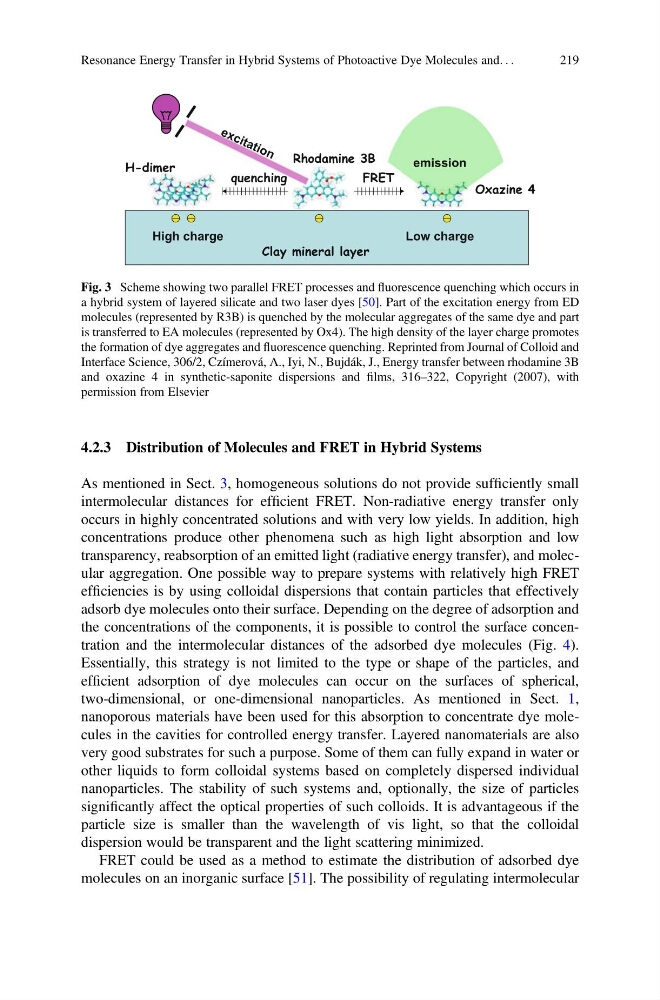
Fig. 3 Scheme showing two parallel FRET processes and fluorescence quenching which occurs in
a hybrid system of layered silicate and two laser dyes [50]. Part of the excitation energy from ED
molecules (represented by R3B) is quenched by the molecular aggregates of the same dye and part
is transferred to EA molecules (represented by Ox4). The high density of the layer charge promotes
the formation of dye aggregates and fluorescence quenching. Reprinted from Journal of Colloid and
Interface Science, 306/2, Czímerová, A., Iyi, N., Bujdák, J., Energy transfer between rhodamine 3B
and oxazine 4 in synthetic-saponite dispersions and films, 316–322, Copyright (2007), with
permission from Elsevier
Resonance Energy Transfer in Hybrid Systems of Photoactive Dye Molecules and. . .
219
As mentioned in Sect. 3, homogeneous solutions do not provide sufficiently small
intermolecular distances for efficient FRET. Non-radiative energy transfer only
occurs in highly concentrated solutions and with very low yields. In addition, high
concentrations produce other phenomena such as high light absorption and low
transparency, reabsorption of an emitted light (radiative energy transfer), and molecular aggregation. One possible way to prepare systems with relatively high FRET
efficiencies is by using colloidal dispersions that contain particles that effectively
adsorb dye molecules onto their surface. Depending on the degree of adsorption and
the concentrations of the components, it is possible to control the surface concentration and the intermolecular distances of the adsorbed dye molecules (Fig. 4).
Essentially, this strategy is not limited to the type or shape of the particles, and
efficient adsorption of dye molecules can occur on the surfaces of spherical,
two-dimensional, or one-dimensional nanoparticles. As mentioned in Sect. 1,
nanoporous materials have been used for this absorption to concentrate dye molecules in the cavities for controlled energy transfer. Layered nanomaterials are also
very good substrates for such a purpose. Some of them can fully expand in water or
other liquids to form colloidal systems based on completely dispersed individual
nanoparticles. The stability of such systems and, optionally, the size of particles
significantly affect the optical properties of such colloids. It is advantageous if the
particle size is smaller than the wavelength of vis light, so that the colloidal
dispersion would be transparent and the light scattering minimized.
FRET could be used as a method to estimate the distribution of adsorbed dye
molecules on an inorganic surface [51]. The possibility of regulating intermolecular
High charge
FRET
Rhodamine 3B
Low charge
Oxazine 4
quenching
Clay mineral layer
emission
H-dimer
Fig. 3 Scheme showing two parallel FRET processes and fluorescence quenching which occurs in
a hybrid system of layered silicate and two laser dyes [50]. Part of the excitation energy from ED
molecules (represented by R3B) is quenched by the molecular aggregates of the same dye and part
is transferred to EA molecules (represented by Ox4). The high density of the layer charge promotes
the formation of dye aggregates and fluorescence quenching. Reprinted from Journal of Colloid and
Interface Science, 306/2, Czímerová, A., Iyi, N., Bujdák, J., Energy transfer between rhodamine 3B
and oxazine 4 in synthetic-saponite dispersions and films, 316–322, Copyright (2007), with
permission from Elsevier
Resonance Energy Transfer in Hybrid Systems of Photoactive Dye Molecules and. . .
219