

distance in solution. This is because the orientation of molecules is rarely perfectly
anisotropic, and excited fluorophores may undergo a fast reorientation over a
timescale much shorter than the lifetime of the excited state of a molecule. Hence,
modulating the distance between the interacting ED and EA molecules and the
spectral overlap integral are considered the two main ways to change the energy
transfer efficiency [4].
In its physical nature, FRET also includes a phenomenon called energy migration.
This takes place between the molecules of the same type and can compete with
FRET between different fluorophore molecules. To be effective, the energy migration must be rapid enough to compete not only with FRET but also other concurrent
processes, such as spontaneous emissions and quenching. The factors influencing an
energy migration are very similar to those for FRET: a high spectral overlap integral
and sufficiently small intermolecular distances. Logically, the dyes that have a small
Stokes shift would be most appropriate for the energy migration. A specific example
of energy migration is also the energy transfer between molecules inside an individual supramolecule of a J-type assembly.
3 Distribution of Molecules and Intermolecular Distances
The distance between ED and EA molecules plays an essential role in the FRET
process (Eq. (8)). When a single pair of ED and EA molecules are involved in FRET,
the distance between the molecules can be relatively well estimated. For example, if
the molecules are fixed to a biopolymer chain, the intermolecular distance represents
the distance between the sites on the polymer chains where the molecules are
attached. In this case, it is relatively simple to estimate FRET efficiency. However,
if FRET occurs in a system in which a large number of interacting molecules coexist
together, then all the interactions of the participating molecules must be taken into
account. Even homogeneous systems, such as a mixed two-dye solution, are relatively complex. On the other hand, conventional dilute solutions of organic dyes
give only very small FRET quantum yields. The reason for this is the relatively large
intermolecular distances. The yields only become significant at relatively high
concentrations. Under these conditions, it is also possible to observe a radiant energy
transfer, when emitted light is re-absorbed. The re-absorption can be efficiently
ED
EA
θ D
θ A
θ DA
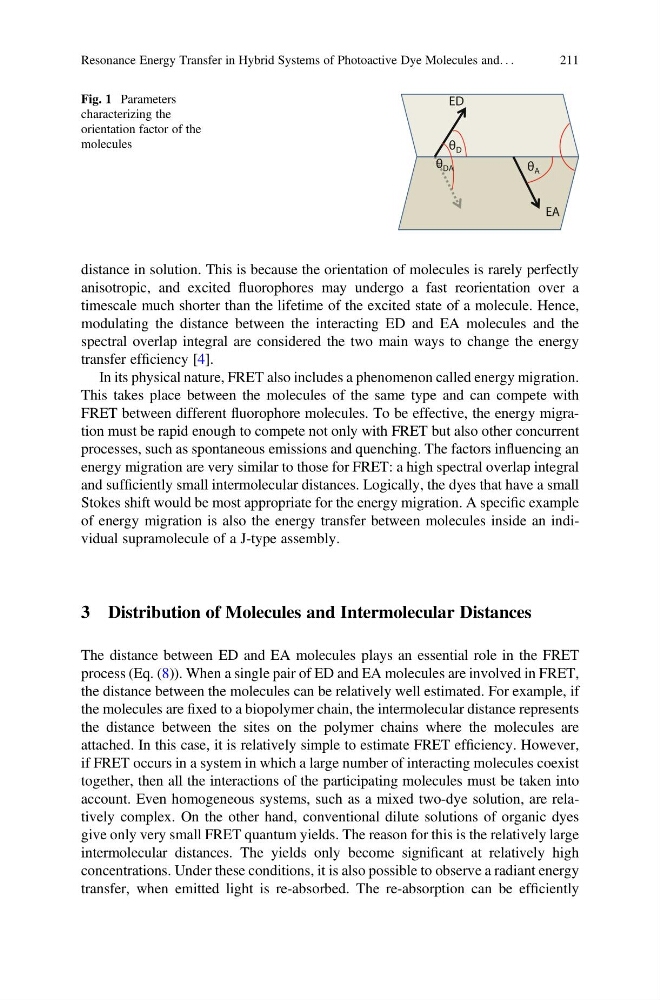
Fig. 1 Parameters
characterizing the
orientation factor of the
molecules
Resonance Energy Transfer in Hybrid Systems of Photoactive Dye Molecules and. . .
211
anisotropic, and excited fluorophores may undergo a fast reorientation over a
timescale much shorter than the lifetime of the excited state of a molecule. Hence,
modulating the distance between the interacting ED and EA molecules and the
spectral overlap integral are considered the two main ways to change the energy
transfer efficiency [4].
In its physical nature, FRET also includes a phenomenon called energy migration.
This takes place between the molecules of the same type and can compete with
FRET between different fluorophore molecules. To be effective, the energy migration must be rapid enough to compete not only with FRET but also other concurrent
processes, such as spontaneous emissions and quenching. The factors influencing an
energy migration are very similar to those for FRET: a high spectral overlap integral
and sufficiently small intermolecular distances. Logically, the dyes that have a small
Stokes shift would be most appropriate for the energy migration. A specific example
of energy migration is also the energy transfer between molecules inside an individual supramolecule of a J-type assembly.
3 Distribution of Molecules and Intermolecular Distances
The distance between ED and EA molecules plays an essential role in the FRET
process (Eq. (8)). When a single pair of ED and EA molecules are involved in FRET,
the distance between the molecules can be relatively well estimated. For example, if
the molecules are fixed to a biopolymer chain, the intermolecular distance represents
the distance between the sites on the polymer chains where the molecules are
attached. In this case, it is relatively simple to estimate FRET efficiency. However,
if FRET occurs in a system in which a large number of interacting molecules coexist
together, then all the interactions of the participating molecules must be taken into
account. Even homogeneous systems, such as a mixed two-dye solution, are relatively complex. On the other hand, conventional dilute solutions of organic dyes
give only very small FRET quantum yields. The reason for this is the relatively large
intermolecular distances. The yields only become significant at relatively high
concentrations. Under these conditions, it is also possible to observe a radiant energy
transfer, when emitted light is re-absorbed. The re-absorption can be efficiently
ED
EA
θ D
θ A
θ DA
Fig. 1 Parameters
characterizing the
orientation factor of the
molecules
Resonance Energy Transfer in Hybrid Systems of Photoactive Dye Molecules and. . .
211