

molecules tend to be adsorbed in a way where the aromatic system of the molecule
and silicate surface are parallel to each other, mainly due to the hydrophobic
interaction between them in aqueous solution. By changing the solvent composition,
it was found that the adsorption orientation was no longer parallel [54–58]. In a
parallel adsorption state, the adsorbed molecule experiences the steric effect of the
surface. On the other hand, in a non-parallel (tilted) adsorption state, the adsorbed
molecule does not experience such steric effect of the surface, and the situation is
similar to that in the bulk solution.
By exploiting the reversible change in molecular orientation, environmentally
responsive materials can be constructed, because orientation change can induce a
color change. For example, dye-clay complexes have been reported to exhibit
solvatochromic [59] and chromism effects, based on changes in humidity
[60]. Transparent films composed of these dye-clay complexes can be used as
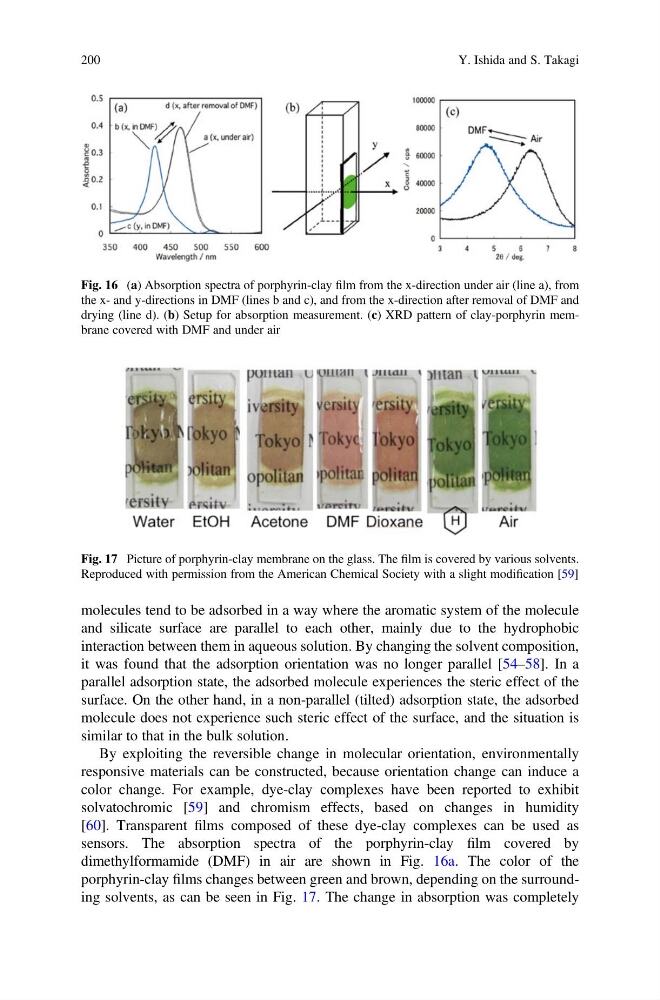
sensors. The absorption spectra of the porphyrin-clay film covered by
dimethylformamide (DMF) in air are shown in Fig. 16a. The color of the
porphyrin-clay films changes between green and brown, depending on the surrounding solvents, as can be seen in Fig. 17. The change in absorption was completely
Fig. 16 (a) Absorption spectra of porphyrin-clay film from the x-direction under air (line a), from
the x- and y-directions in DMF (lines b and c), and from the x-direction after removal of DMF and
drying (line d). (b) Setup for absorption measurement. (c) XRD pattern of clay-porphyrin membrane covered with DMF and under air
Fig. 17 Picture of porphyrin-clay membrane on the glass. The film is covered by various solvents.
Reproduced with permission from the American Chemical Society with a slight modification [59]
200
Y. Ishida and S. Takagi
and silicate surface are parallel to each other, mainly due to the hydrophobic
interaction between them in aqueous solution. By changing the solvent composition,
it was found that the adsorption orientation was no longer parallel [54–58]. In a
parallel adsorption state, the adsorbed molecule experiences the steric effect of the
surface. On the other hand, in a non-parallel (tilted) adsorption state, the adsorbed
molecule does not experience such steric effect of the surface, and the situation is
similar to that in the bulk solution.
By exploiting the reversible change in molecular orientation, environmentally
responsive materials can be constructed, because orientation change can induce a
color change. For example, dye-clay complexes have been reported to exhibit
solvatochromic [59] and chromism effects, based on changes in humidity
[60]. Transparent films composed of these dye-clay complexes can be used as
sensors. The absorption spectra of the porphyrin-clay film covered by
dimethylformamide (DMF) in air are shown in Fig. 16a. The color of the
porphyrin-clay films changes between green and brown, depending on the surrounding solvents, as can be seen in Fig. 17. The change in absorption was completely
Fig. 16 (a) Absorption spectra of porphyrin-clay film from the x-direction under air (line a), from
the x- and y-directions in DMF (lines b and c), and from the x-direction after removal of DMF and
drying (line d). (b) Setup for absorption measurement. (c) XRD pattern of clay-porphyrin membrane covered with DMF and under air
Fig. 17 Picture of porphyrin-clay membrane on the glass. The film is covered by various solvents.
Reproduced with permission from the American Chemical Society with a slight modification [59]
200
Y. Ishida and S. Takagi