

8 Reversible Environment-Responsiveness of Dyes in/on
Layered Silicates
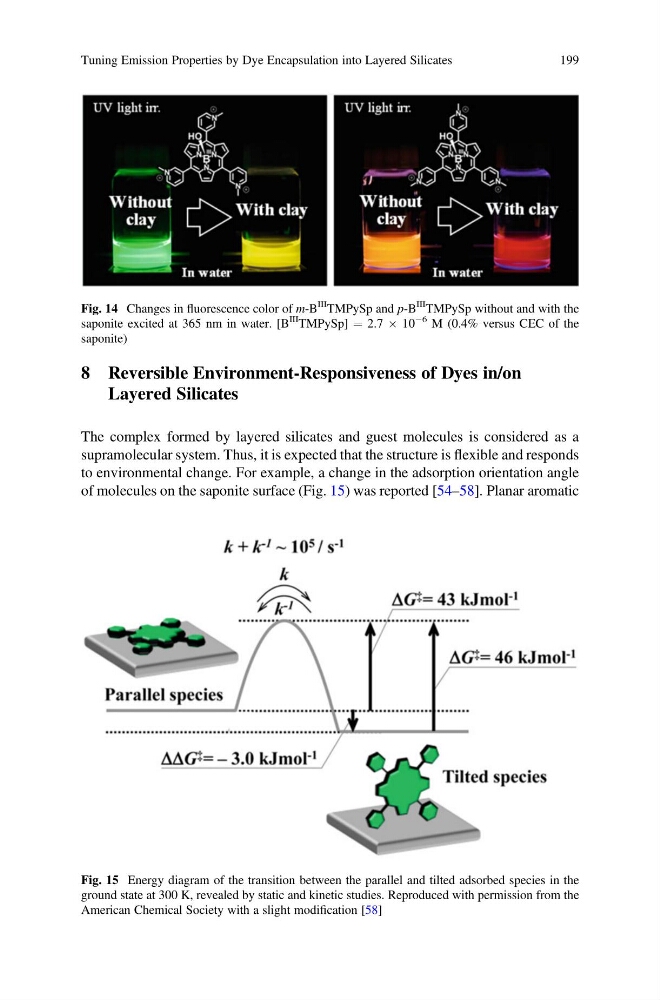
The complex formed by layered silicates and guest molecules is considered as a
supramolecular system. Thus, it is expected that the structure is flexible and responds
to environmental change. For example, a change in the adsorption orientation angle
of molecules on the saponite surface (Fig. 15) was reported [54–58]. Planar aromatic
Fig. 14 Changes in fluorescence color of m-B
III TMPySp and p-B
III TMPySp without and with the
saponite excited at 365 nm in water. [B
III TMPySp] ¼ 2.7 Â 10
À6 M (0.4% versus CEC of the
saponite)
Fig. 15 Energy diagram of the transition between the parallel and tilted adsorbed species in the
ground state at 300 K, revealed by static and kinetic studies. Reproduced with permission from the
American Chemical Society with a slight modification [58]
Tuning Emission Properties by Dye Encapsulation into Layered Silicates
199
Layered Silicates
The complex formed by layered silicates and guest molecules is considered as a
supramolecular system. Thus, it is expected that the structure is flexible and responds
to environmental change. For example, a change in the adsorption orientation angle
of molecules on the saponite surface (Fig. 15) was reported [54–58]. Planar aromatic
Fig. 14 Changes in fluorescence color of m-B
III TMPySp and p-B
III TMPySp without and with the
saponite excited at 365 nm in water. [B
III TMPySp] ¼ 2.7 Â 10
À6 M (0.4% versus CEC of the
saponite)
Fig. 15 Energy diagram of the transition between the parallel and tilted adsorbed species in the
ground state at 300 K, revealed by static and kinetic studies. Reproduced with permission from the
American Chemical Society with a slight modification [58]
Tuning Emission Properties by Dye Encapsulation into Layered Silicates
199