

resembling effect and structure fixing effect, were proposed to explain the fluorescence enhancement behavior in clay [38].
The photochemical property should strongly depend on the surrounding environment such as a solution, solid surface, mesopore, and so on. So far, it has been
difficult to discuss the photochemical properties in such media. The layered silicate
surface is expected to be an ideal media to explore the effect of the chemical reaction
field. The authors expect that novel methods for X-fixation induced emission
(X ¼ glass, metal, zeolite, MOF, and so on) will be discovered. It should be noted
that the behavior of the solid surface is unique not only for emission properties but
also for chemical reactions. The photo-isomerization reaction [53], artificial light
harvesting system, and artificial photosynthetic system have been examined on
layered silicate surface.
7 Color Tuning of Dyes in/on Layered Silicates
The spectral shift in the absorption spectra of layered silicates was described in Sect.
5. Similarly, the spectral shift in the emission spectra is also possible, and thus,
layered silicates can tune the emission color of molecules. The typical procedure to
tune the emission color requires organic synthesis, where the synthetic process is
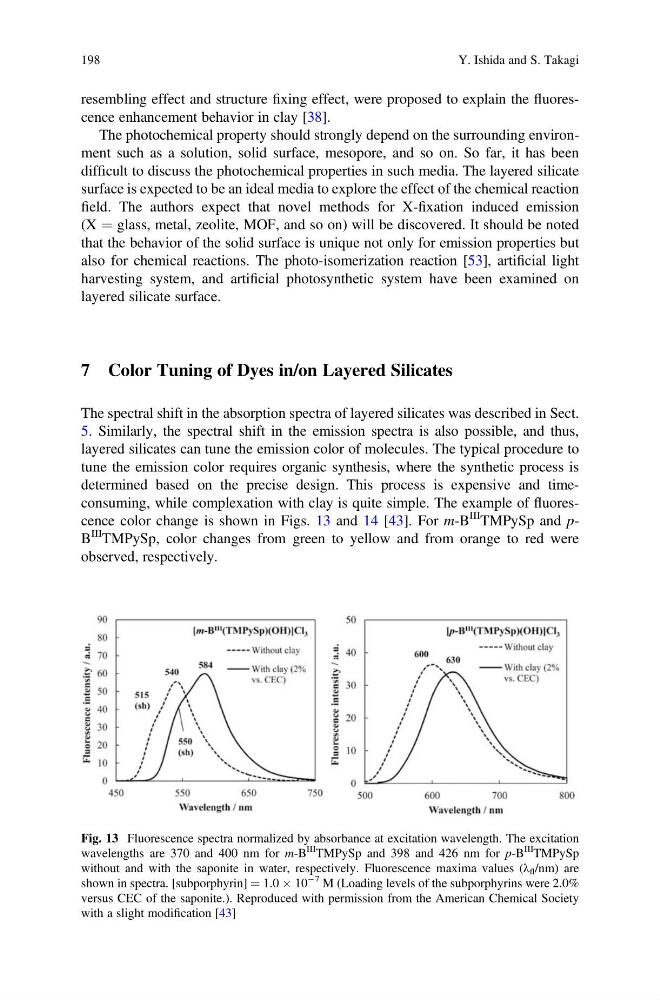
determined based on the precise design. This process is expensive and timeconsuming, while complexation with clay is quite simple. The example of fluorescence color change is shown in Figs. 13 and 14 [43]. For m-B
III TMPySp and pB
III TMPySp, color changes from green to yellow and from orange to red were
observed, respectively.
Fig. 13 Fluorescence spectra normalized by absorbance at excitation wavelength. The excitation
wavelengths are 370 and 400 nm for m-B
III TMPySp and 398 and 426 nm for p-B
III
TMPySp
without and with the saponite in water, respectively. Fluorescence maxima values (λ fl /nm) are
shown in spectra. [subporphyrin] ¼ 1.0 Â 10
À7 M (Loading levels of the subporphyrins were 2.0%
versus CEC of the saponite.). Reproduced with permission from the American Chemical Society
with a slight modification [43]
198
Y. Ishida and S. Takagi
The photochemical property should strongly depend on the surrounding environment such as a solution, solid surface, mesopore, and so on. So far, it has been
difficult to discuss the photochemical properties in such media. The layered silicate
surface is expected to be an ideal media to explore the effect of the chemical reaction
field. The authors expect that novel methods for X-fixation induced emission
(X ¼ glass, metal, zeolite, MOF, and so on) will be discovered. It should be noted
that the behavior of the solid surface is unique not only for emission properties but
also for chemical reactions. The photo-isomerization reaction [53], artificial light
harvesting system, and artificial photosynthetic system have been examined on
layered silicate surface.
7 Color Tuning of Dyes in/on Layered Silicates
The spectral shift in the absorption spectra of layered silicates was described in Sect.
5. Similarly, the spectral shift in the emission spectra is also possible, and thus,
layered silicates can tune the emission color of molecules. The typical procedure to
tune the emission color requires organic synthesis, where the synthetic process is
determined based on the precise design. This process is expensive and timeconsuming, while complexation with clay is quite simple. The example of fluorescence color change is shown in Figs. 13 and 14 [43]. For m-B
III TMPySp and pB
III TMPySp, color changes from green to yellow and from orange to red were
observed, respectively.
Fig. 13 Fluorescence spectra normalized by absorbance at excitation wavelength. The excitation
wavelengths are 370 and 400 nm for m-B
III TMPySp and 398 and 426 nm for p-B
III
TMPySp
without and with the saponite in water, respectively. Fluorescence maxima values (λ fl /nm) are
shown in spectra. [subporphyrin] ¼ 1.0 Â 10
À7 M (Loading levels of the subporphyrins were 2.0%
versus CEC of the saponite.). Reproduced with permission from the American Chemical Society
with a slight modification [43]
198
Y. Ishida and S. Takagi