

synchronized with the change in interlayer distance, as can be seen in Fig. 16c. As
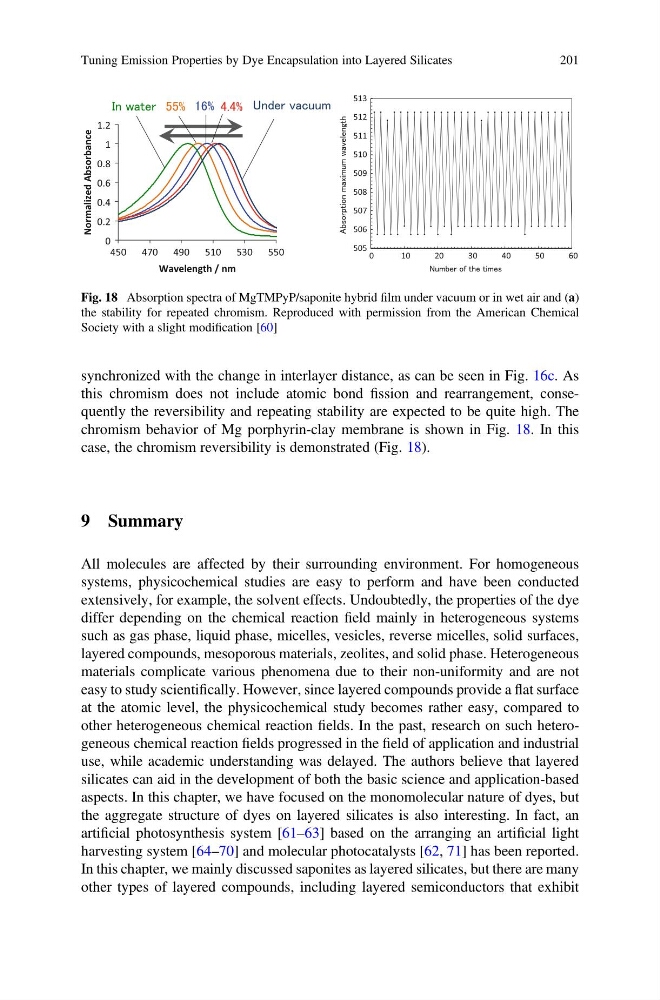
this chromism does not include atomic bond fission and rearrangement, consequently the reversibility and repeating stability are expected to be quite high. The
chromism behavior of Mg porphyrin-clay membrane is shown in Fig. 18. In this
case, the chromism reversibility is demonstrated (Fig. 18).
9 Summary
All molecules are affected by their surrounding environment. For homogeneous
systems, physicochemical studies are easy to perform and have been conducted
extensively, for example, the solvent effects. Undoubtedly, the properties of the dye
differ depending on the chemical reaction field mainly in heterogeneous systems
such as gas phase, liquid phase, micelles, vesicles, reverse micelles, solid surfaces,
layered compounds, mesoporous materials, zeolites, and solid phase. Heterogeneous
materials complicate various phenomena due to their non-uniformity and are not
easy to study scientifically. However, since layered compounds provide a flat surface
at the atomic level, the physicochemical study becomes rather easy, compared to
other heterogeneous chemical reaction fields. In the past, research on such heterogeneous chemical reaction fields progressed in the field of application and industrial
use, while academic understanding was delayed. The authors believe that layered
silicates can aid in the development of both the basic science and application-based
aspects. In this chapter, we have focused on the monomolecular nature of dyes, but
the aggregate structure of dyes on layered silicates is also interesting. In fact, an
artificial photosynthesis system [61–63] based on the arranging an artificial light
harvesting system [64–70] and molecular photocatalysts [62, 71] has been reported.
In this chapter, we mainly discussed saponites as layered silicates, but there are many
other types of layered compounds, including layered semiconductors that exhibit
0
0.2
0.4
0.6
0.8
1
1.2
450 470 490 510 530 550
Normalized Absorbance
Wavelength / nm
505
506
507
508
509
510
511
512
513
0
1 0
2 0
3 0
4 0
5 0
6 0
Fig. 18 Absorption spectra of MgTMPyP/saponite hybrid film under vacuum or in wet air and (a)
the stability for repeated chromism. Reproduced with permission from the American Chemical
Society with a slight modification [60]
Tuning Emission Properties by Dye Encapsulation into Layered Silicates
201
this chromism does not include atomic bond fission and rearrangement, consequently the reversibility and repeating stability are expected to be quite high. The
chromism behavior of Mg porphyrin-clay membrane is shown in Fig. 18. In this
case, the chromism reversibility is demonstrated (Fig. 18).
9 Summary
All molecules are affected by their surrounding environment. For homogeneous
systems, physicochemical studies are easy to perform and have been conducted
extensively, for example, the solvent effects. Undoubtedly, the properties of the dye
differ depending on the chemical reaction field mainly in heterogeneous systems
such as gas phase, liquid phase, micelles, vesicles, reverse micelles, solid surfaces,
layered compounds, mesoporous materials, zeolites, and solid phase. Heterogeneous
materials complicate various phenomena due to their non-uniformity and are not
easy to study scientifically. However, since layered compounds provide a flat surface
at the atomic level, the physicochemical study becomes rather easy, compared to
other heterogeneous chemical reaction fields. In the past, research on such heterogeneous chemical reaction fields progressed in the field of application and industrial
use, while academic understanding was delayed. The authors believe that layered
silicates can aid in the development of both the basic science and application-based
aspects. In this chapter, we have focused on the monomolecular nature of dyes, but
the aggregate structure of dyes on layered silicates is also interesting. In fact, an
artificial photosynthesis system [61–63] based on the arranging an artificial light
harvesting system [64–70] and molecular photocatalysts [62, 71] has been reported.
In this chapter, we mainly discussed saponites as layered silicates, but there are many
other types of layered compounds, including layered semiconductors that exhibit
0
0.2
0.4
0.6
0.8
1
1.2
450 470 490 510 530 550
Normalized Absorbance
Wavelength / nm
505
506
507
508
509
510
511
512
513
0
1 0
2 0
3 0
4 0
5 0
6 0
Fig. 18 Absorption spectra of MgTMPyP/saponite hybrid film under vacuum or in wet air and (a)
the stability for repeated chromism. Reproduced with permission from the American Chemical
Society with a slight modification [60]
Tuning Emission Properties by Dye Encapsulation into Layered Silicates
201