

3.4 The RWLC-6 Templated MOF
The previous series of RWLC RuBpy templated MOFs utilized small benzene
carboxylate-type ligands and Zn(II) or Cd(II) metal nodes which produced small
cavities with crystallographically resolved RuBpy encapsulated within these cavities. In order to determine if RuBpy could template MOFs with larger cavities, a
synthesis was performed using the larger 1,3,5-tris-carboxyphenylethynyl benzene
(BTE) ligand which shares the same geometrical arrangement of carboxylate groups
as the BTCA ligand used in the synthesis of HKUST-1(Zn) but expands the length of
the linker. Under solvothermal conditions, the presence of Zn(II) cations and the
BTE ligand forms MOF-180 with cavities of 15 Å Â 23 Å forming a qom network
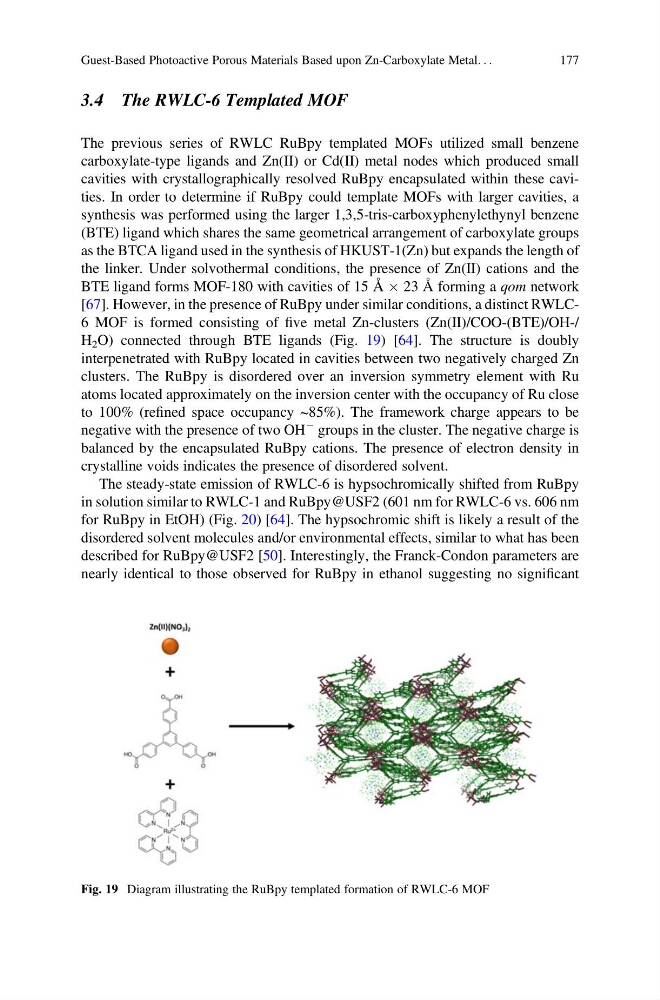
[67]. However, in the presence of RuBpy under similar conditions, a distinct RWLC6 MOF is formed consisting of five metal Zn-clusters (Zn(II)/COO-(BTE)/OH-/
H 2 O) connected through BTE ligands (Fig. 19) [64]. The structure is doubly
interpenetrated with RuBpy located in cavities between two negatively charged Zn
clusters. The RuBpy is disordered over an inversion symmetry element with Ru
atoms located approximately on the inversion center with the occupancy of Ru close
to 100% (refined space occupancy ~85%). The framework charge appears to be
negative with the presence of two OH
À groups in the cluster. The negative charge is
balanced by the encapsulated RuBpy cations. The presence of electron density in
crystalline voids indicates the presence of disordered solvent.
The steady-state emission of RWLC-6 is hypsochromically shifted from RuBpy
in solution similar to RWLC-1 and RuBpy@USF2 (601 nm for RWLC-6 vs. 606 nm
for RuBpy in EtOH) (Fig. 20) [64]. The hypsochromic shift is likely a result of the
disordered solvent molecules and/or environmental effects, similar to what has been
described for RuBpy@USF2 [50]. Interestingly, the Franck-Condon parameters are
nearly identical to those observed for RuBpy in ethanol suggesting no significant
Fig. 19 Diagram illustrating the RuBpy templated formation of RWLC-6 MOF
Guest-Based Photoactive Porous Materials Based upon Zn-Carboxylate Metal. . .
177
The previous series of RWLC RuBpy templated MOFs utilized small benzene
carboxylate-type ligands and Zn(II) or Cd(II) metal nodes which produced small
cavities with crystallographically resolved RuBpy encapsulated within these cavities. In order to determine if RuBpy could template MOFs with larger cavities, a
synthesis was performed using the larger 1,3,5-tris-carboxyphenylethynyl benzene
(BTE) ligand which shares the same geometrical arrangement of carboxylate groups
as the BTCA ligand used in the synthesis of HKUST-1(Zn) but expands the length of
the linker. Under solvothermal conditions, the presence of Zn(II) cations and the
BTE ligand forms MOF-180 with cavities of 15 Å Â 23 Å forming a qom network
[67]. However, in the presence of RuBpy under similar conditions, a distinct RWLC6 MOF is formed consisting of five metal Zn-clusters (Zn(II)/COO-(BTE)/OH-/
H 2 O) connected through BTE ligands (Fig. 19) [64]. The structure is doubly
interpenetrated with RuBpy located in cavities between two negatively charged Zn
clusters. The RuBpy is disordered over an inversion symmetry element with Ru
atoms located approximately on the inversion center with the occupancy of Ru close
to 100% (refined space occupancy ~85%). The framework charge appears to be
negative with the presence of two OH
À groups in the cluster. The negative charge is
balanced by the encapsulated RuBpy cations. The presence of electron density in
crystalline voids indicates the presence of disordered solvent.
The steady-state emission of RWLC-6 is hypsochromically shifted from RuBpy
in solution similar to RWLC-1 and RuBpy@USF2 (601 nm for RWLC-6 vs. 606 nm
for RuBpy in EtOH) (Fig. 20) [64]. The hypsochromic shift is likely a result of the
disordered solvent molecules and/or environmental effects, similar to what has been
described for RuBpy@USF2 [50]. Interestingly, the Franck-Condon parameters are
nearly identical to those observed for RuBpy in ethanol suggesting no significant
Fig. 19 Diagram illustrating the RuBpy templated formation of RWLC-6 MOF
Guest-Based Photoactive Porous Materials Based upon Zn-Carboxylate Metal. . .
177