

structural perturbations. It is likely that similar structural perturbations take place in
the other members of the RWLC series although the X-ray data is not of sufficient
quality to definitively make this determination.
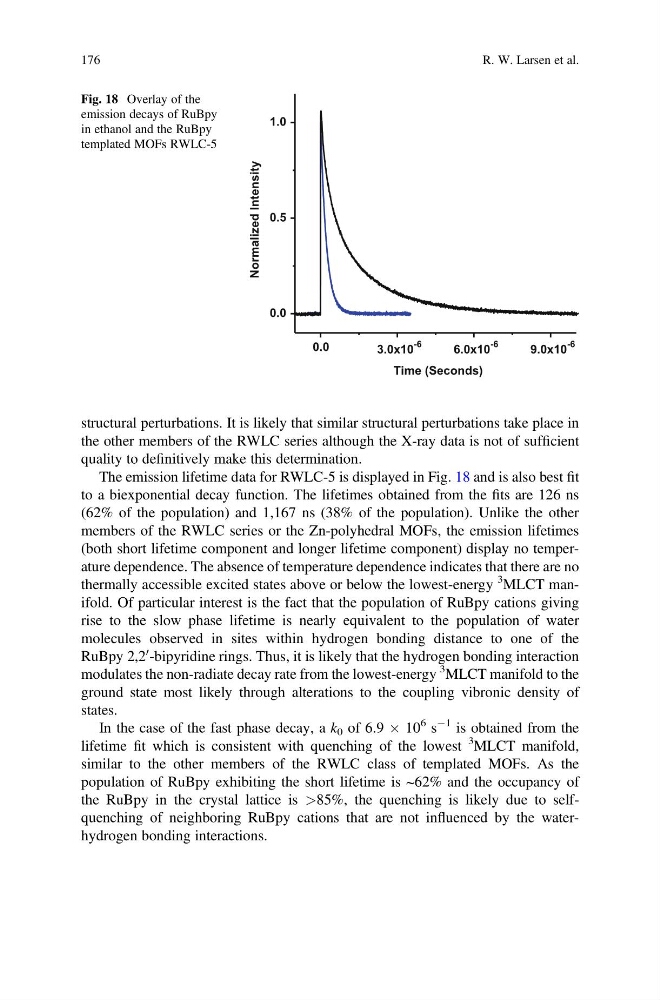
The emission lifetime data for RWLC-5 is displayed in Fig. 18 and is also best fit
to a biexponential decay function. The lifetimes obtained from the fits are 126 ns
(62% of the population) and 1,167 ns (38% of the population). Unlike the other
members of the RWLC series or the Zn-polyhedral MOFs, the emission lifetimes
(both short lifetime component and longer lifetime component) display no temperature dependence. The absence of temperature dependence indicates that there are no
thermally accessible excited states above or below the lowest-energy
3 MLCT manifold. Of particular interest is the fact that the population of RuBpy cations giving
rise to the slow phase lifetime is nearly equivalent to the population of water
molecules observed in sites within hydrogen bonding distance to one of the
RuBpy 2,2
0 -bipyridine rings. Thus, it is likely that the hydrogen bonding interaction
modulates the non-radiate decay rate from the lowest-energy
3 MLCT manifold to the
ground state most likely through alterations to the coupling vibronic density of
states.
In the case of the fast phase decay, a k 0 of 6.9 Â 10
6 s
À1 is obtained from the
lifetime fit which is consistent with quenching of the lowest
3 MLCT manifold,
similar to the other members of the RWLC class of templated MOFs. As the
population of RuBpy exhibiting the short lifetime is ~62% and the occupancy of
the RuBpy in the crystal lattice is >85%, the quenching is likely due to selfquenching of neighboring RuBpy cations that are not influenced by the waterhydrogen bonding interactions.
0.0
3.0x10
-6
6.0x10
-6
9.0x10
-6
0.0
0.5
1.0
Time (Seconds)
Normalized Intensity
Fig. 18 Overlay of the
emission decays of RuBpy
in ethanol and the RuBpy
templated MOFs RWLC-5
176
R. W. Larsen et al.
the other members of the RWLC series although the X-ray data is not of sufficient
quality to definitively make this determination.
The emission lifetime data for RWLC-5 is displayed in Fig. 18 and is also best fit
to a biexponential decay function. The lifetimes obtained from the fits are 126 ns
(62% of the population) and 1,167 ns (38% of the population). Unlike the other
members of the RWLC series or the Zn-polyhedral MOFs, the emission lifetimes
(both short lifetime component and longer lifetime component) display no temperature dependence. The absence of temperature dependence indicates that there are no
thermally accessible excited states above or below the lowest-energy
3 MLCT manifold. Of particular interest is the fact that the population of RuBpy cations giving
rise to the slow phase lifetime is nearly equivalent to the population of water
molecules observed in sites within hydrogen bonding distance to one of the
RuBpy 2,2
0 -bipyridine rings. Thus, it is likely that the hydrogen bonding interaction
modulates the non-radiate decay rate from the lowest-energy
3 MLCT manifold to the
ground state most likely through alterations to the coupling vibronic density of
states.
In the case of the fast phase decay, a k 0 of 6.9 Â 10
6 s
À1 is obtained from the
lifetime fit which is consistent with quenching of the lowest
3 MLCT manifold,
similar to the other members of the RWLC class of templated MOFs. As the
population of RuBpy exhibiting the short lifetime is ~62% and the occupancy of
the RuBpy in the crystal lattice is >85%, the quenching is likely due to selfquenching of neighboring RuBpy cations that are not influenced by the waterhydrogen bonding interactions.
0.0
3.0x10
-6
6.0x10
-6
9.0x10
-6
0.0
0.5
1.0
Time (Seconds)
Normalized Intensity
Fig. 18 Overlay of the
emission decays of RuBpy
in ethanol and the RuBpy
templated MOFs RWLC-5
176
R. W. Larsen et al.