

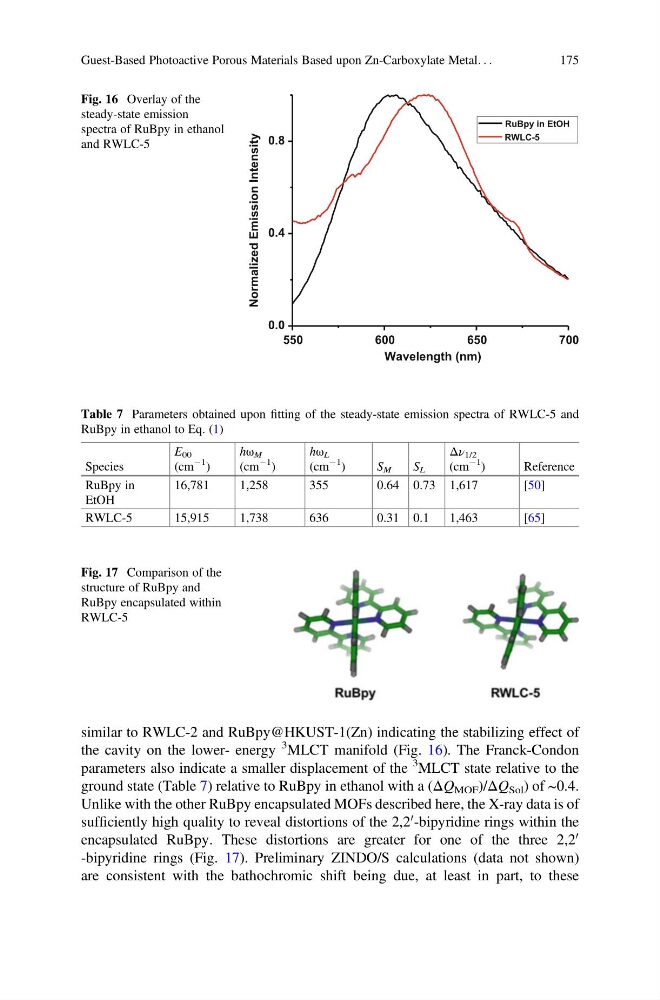
similar to RWLC-2 and RuBpy@HKUST-1(Zn) indicating the stabilizing effect of
the cavity on the lower- energy
3 MLCT manifold (Fig. 16). The Franck-Condon
parameters also indicate a smaller displacement of the
3 MLCT state relative to the
ground state (Table 7) relative to RuBpy in ethanol with a (ΔQ MOF )/ΔQ Sol ) of ~0.4.
Unlike with the other RuBpy encapsulated MOFs described here, the X-ray data is of
sufficiently high quality to reveal distortions of the 2,2
0 -bipyridine rings within the
encapsulated RuBpy. These distortions are greater for one of the three 2,2
0
-bipyridine rings (Fig. 17). Preliminary ZINDO/S calculations (data not shown)
are consistent with the bathochromic shift being due, at least in part, to these
550
600
650
700
0.0
0.4
0.8
Wavelength (nm)
RuBpy in EtOH
RWLC-5
Normalized Emission Intensity
Fig. 16 Overlay of the
steady-state emission
spectra of RuBpy in ethanol
and RWLC-5
Fig. 17 Comparison of the
structure of RuBpy and
RuBpy encapsulated within
RWLC-5
Table 7 Parameters obtained upon fitting of the steady-state emission spectra of RWLC-5 and
RuBpy in ethanol to Eq. (1)
Species
E 00
(cm
À1
)
hω M
(cm
À1
)
hω L
(cm
À1
)
S M
S L
Δν 1/2
(cm
À1
)
Reference
RuBpy in
EtOH
16,781
1,258
355
0.64 0.73 1,617
[50]
RWLC-5
15,915
1,738
636
0.31 0.1
1,463
[65]
Guest-Based Photoactive Porous Materials Based upon Zn-Carboxylate Metal. . .
175
the cavity on the lower- energy
3 MLCT manifold (Fig. 16). The Franck-Condon
parameters also indicate a smaller displacement of the
3 MLCT state relative to the
ground state (Table 7) relative to RuBpy in ethanol with a (ΔQ MOF )/ΔQ Sol ) of ~0.4.
Unlike with the other RuBpy encapsulated MOFs described here, the X-ray data is of
sufficiently high quality to reveal distortions of the 2,2
0 -bipyridine rings within the
encapsulated RuBpy. These distortions are greater for one of the three 2,2
0
-bipyridine rings (Fig. 17). Preliminary ZINDO/S calculations (data not shown)
are consistent with the bathochromic shift being due, at least in part, to these
550
600
650
700
0.0
0.4
0.8
Wavelength (nm)
RuBpy in EtOH
RWLC-5
Normalized Emission Intensity
Fig. 16 Overlay of the
steady-state emission
spectra of RuBpy in ethanol
and RWLC-5
Fig. 17 Comparison of the
structure of RuBpy and
RuBpy encapsulated within
RWLC-5
Table 7 Parameters obtained upon fitting of the steady-state emission spectra of RWLC-5 and
RuBpy in ethanol to Eq. (1)
Species
E 00
(cm
À1
)
hω M
(cm
À1
)
hω L
(cm
À1
)
S M
S L
Δν 1/2
(cm
À1
)
Reference
RuBpy in
EtOH
16,781
1,258
355
0.64 0.73 1,617
[50]
RWLC-5
15,915
1,738
636
0.31 0.1
1,463
[65]
Guest-Based Photoactive Porous Materials Based upon Zn-Carboxylate Metal. . .
175