

occupation and that emission originated from a fourth
3 MLCT located at ~900 cm
À1
above the lowest-energy
3 MLCT manifold [51]. From the temperature dependence
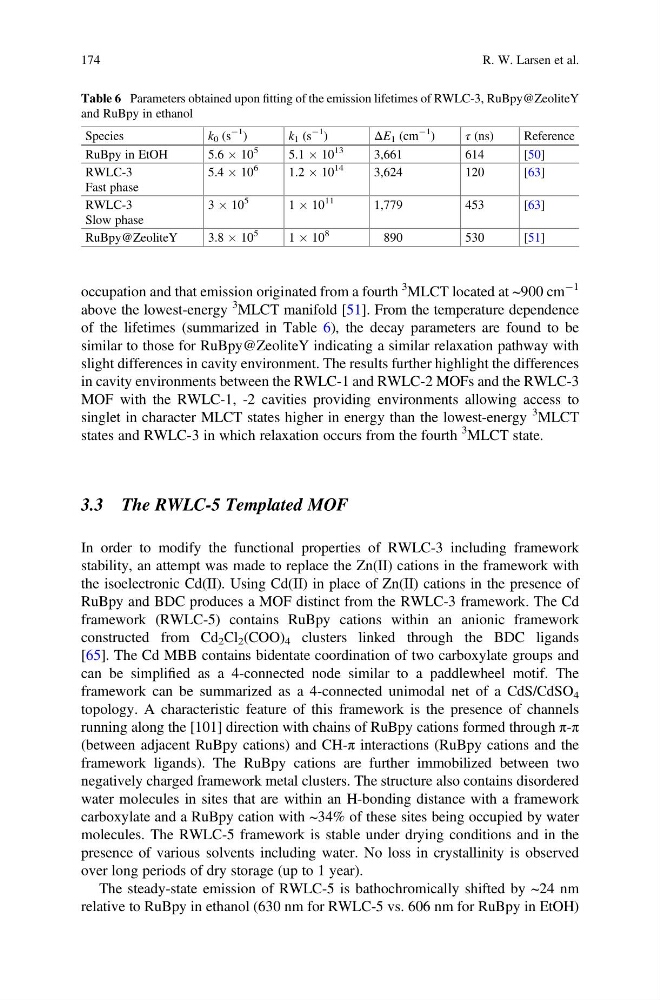
of the lifetimes (summarized in Table 6), the decay parameters are found to be
similar to those for RuBpy@ZeoliteY indicating a similar relaxation pathway with
slight differences in cavity environment. The results further highlight the differences
in cavity environments between the RWLC-1 and RWLC-2 MOFs and the RWLC-3
MOF with the RWLC-1, -2 cavities providing environments allowing access to
singlet in character MLCT states higher in energy than the lowest-energy
3 MLCT
states and RWLC-3 in which relaxation occurs from the fourth
3 MLCT state.
3.3 The RWLC-5 Templated MOF
In order to modify the functional properties of RWLC-3 including framework
stability, an attempt was made to replace the Zn(II) cations in the framework with
the isoelectronic Cd(II). Using Cd(II) in place of Zn(II) cations in the presence of
RuBpy and BDC produces a MOF distinct from the RWLC-3 framework. The Cd
framework (RWLC-5) contains RuBpy cations within an anionic framework
constructed from Cd 2 Cl 2 (COO) 4 clusters linked through the BDC ligands
[65]. The Cd MBB contains bidentate coordination of two carboxylate groups and
can be simplified as a 4-connected node similar to a paddlewheel motif. The
framework can be summarized as a 4-connected unimodal net of a CdS/CdSO 4
topology. A characteristic feature of this framework is the presence of channels
running along the [101] direction with chains of RuBpy cations formed through π-π
(between adjacent RuBpy cations) and CH-π interactions (RuBpy cations and the
framework ligands). The RuBpy cations are further immobilized between two
negatively charged framework metal clusters. The structure also contains disordered
water molecules in sites that are within an H-bonding distance with a framework
carboxylate and a RuBpy cation with ~34% of these sites being occupied by water
molecules. The RWLC-5 framework is stable under drying conditions and in the
presence of various solvents including water. No loss in crystallinity is observed
over long periods of dry storage (up to 1 year).
The steady-state emission of RWLC-5 is bathochromically shifted by ~24 nm
relative to RuBpy in ethanol (630 nm for RWLC-5 vs. 606 nm for RuBpy in EtOH)
Table 6 Parameters obtained upon fitting of the emission lifetimes of RWLC-3, RuBpy@ZeoliteY
and RuBpy in ethanol
Species
k 0 (s
À1
)
k 1 (s
À1
)
ΔE 1 (cm
À1
)
τ (ns)
Reference
RuBpy in EtOH
5.6 Â 10
5
5.1 Â 10
13
3,661
614
[50]
RWLC-3
Fast phase
5.4 Â 10
6
1.2 Â 10
14
3,624
120
[63]
RWLC-3
Slow phase
3 Â 10
5
1 Â 10
11
1,779
453
[63]
RuBpy@ZeoliteY
3.8 Â 10
5
1 Â 10
8
890
530
[51]
174
R. W. Larsen et al.
3 MLCT located at ~900 cm
À1
above the lowest-energy
3 MLCT manifold [51]. From the temperature dependence
of the lifetimes (summarized in Table 6), the decay parameters are found to be
similar to those for RuBpy@ZeoliteY indicating a similar relaxation pathway with
slight differences in cavity environment. The results further highlight the differences
in cavity environments between the RWLC-1 and RWLC-2 MOFs and the RWLC-3
MOF with the RWLC-1, -2 cavities providing environments allowing access to
singlet in character MLCT states higher in energy than the lowest-energy
3 MLCT
states and RWLC-3 in which relaxation occurs from the fourth
3 MLCT state.
3.3 The RWLC-5 Templated MOF
In order to modify the functional properties of RWLC-3 including framework
stability, an attempt was made to replace the Zn(II) cations in the framework with
the isoelectronic Cd(II). Using Cd(II) in place of Zn(II) cations in the presence of
RuBpy and BDC produces a MOF distinct from the RWLC-3 framework. The Cd
framework (RWLC-5) contains RuBpy cations within an anionic framework
constructed from Cd 2 Cl 2 (COO) 4 clusters linked through the BDC ligands
[65]. The Cd MBB contains bidentate coordination of two carboxylate groups and
can be simplified as a 4-connected node similar to a paddlewheel motif. The
framework can be summarized as a 4-connected unimodal net of a CdS/CdSO 4
topology. A characteristic feature of this framework is the presence of channels
running along the [101] direction with chains of RuBpy cations formed through π-π
(between adjacent RuBpy cations) and CH-π interactions (RuBpy cations and the
framework ligands). The RuBpy cations are further immobilized between two
negatively charged framework metal clusters. The structure also contains disordered
water molecules in sites that are within an H-bonding distance with a framework
carboxylate and a RuBpy cation with ~34% of these sites being occupied by water
molecules. The RWLC-5 framework is stable under drying conditions and in the
presence of various solvents including water. No loss in crystallinity is observed
over long periods of dry storage (up to 1 year).
The steady-state emission of RWLC-5 is bathochromically shifted by ~24 nm
relative to RuBpy in ethanol (630 nm for RWLC-5 vs. 606 nm for RuBpy in EtOH)
Table 6 Parameters obtained upon fitting of the emission lifetimes of RWLC-3, RuBpy@ZeoliteY
and RuBpy in ethanol
Species
k 0 (s
À1
)
k 1 (s
À1
)
ΔE 1 (cm
À1
)
τ (ns)
Reference
RuBpy in EtOH
5.6 Â 10
5
5.1 Â 10
13
3,661
614
[50]
RWLC-3
Fast phase
5.4 Â 10
6
1.2 Â 10
14
3,624
120
[63]
RWLC-3
Slow phase
3 Â 10
5
1 Â 10
11
1,779
453
[63]
RuBpy@ZeoliteY
3.8 Â 10
5
1 Â 10
8
890
530
[51]
174
R. W. Larsen et al.