

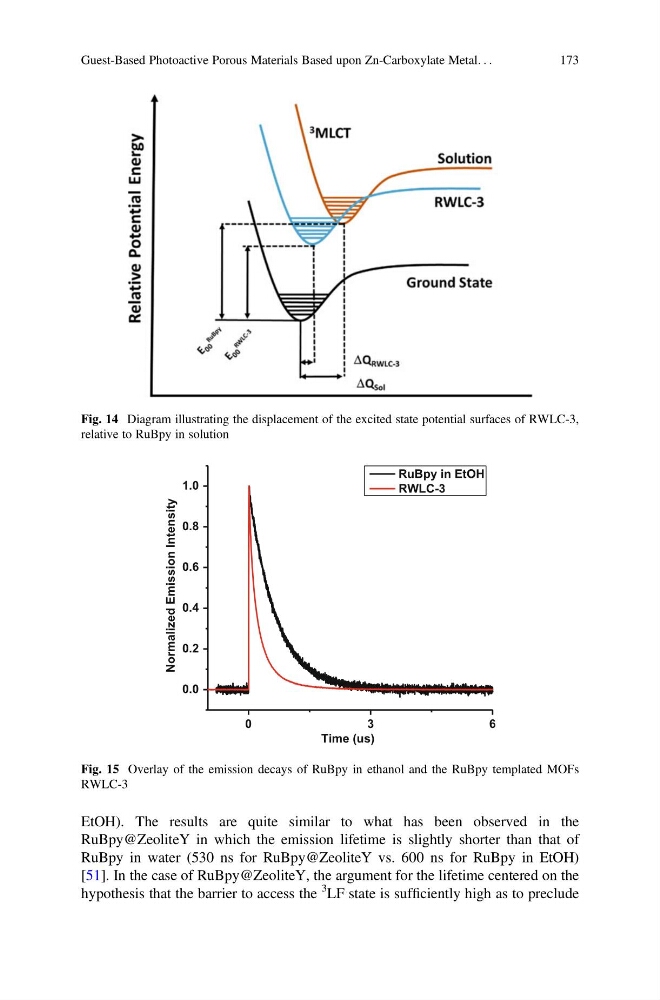
EtOH). The results are quite similar to what has been observed in the
RuBpy@ZeoliteY in which the emission lifetime is slightly shorter than that of
RuBpy in water (530 ns for RuBpy@ZeoliteY vs. 600 ns for RuBpy in EtOH)
[51]. In the case of RuBpy@ZeoliteY, the argument for the lifetime centered on the
hypothesis that the barrier to access the
3 LF state is sufficiently high as to preclude
Fig. 14 Diagram illustrating the displacement of the excited state potential surfaces of RWLC-3,
relative to RuBpy in solution
0
3
6
0.0
0.2
0.4
0.6
0.8
1.0
Time (us)
RuBpy in EtOH
RWLC-3
Normalized Emission Intensity
Fig. 15 Overlay of the emission decays of RuBpy in ethanol and the RuBpy templated MOFs
RWLC-3
Guest-Based Photoactive Porous Materials Based upon Zn-Carboxylate Metal. . .
173
RuBpy@ZeoliteY in which the emission lifetime is slightly shorter than that of
RuBpy in water (530 ns for RuBpy@ZeoliteY vs. 600 ns for RuBpy in EtOH)
[51]. In the case of RuBpy@ZeoliteY, the argument for the lifetime centered on the
hypothesis that the barrier to access the
3 LF state is sufficiently high as to preclude
Fig. 14 Diagram illustrating the displacement of the excited state potential surfaces of RWLC-3,
relative to RuBpy in solution
0
3
6
0.0
0.2
0.4
0.6
0.8
1.0
Time (us)
RuBpy in EtOH
RWLC-3
Normalized Emission Intensity
Fig. 15 Overlay of the emission decays of RuBpy in ethanol and the RuBpy templated MOFs
RWLC-3
Guest-Based Photoactive Porous Materials Based upon Zn-Carboxylate Metal. . .
173