

located within the channels. The RuBpy cations are disordered over two wellresolved positions around the inversion center.
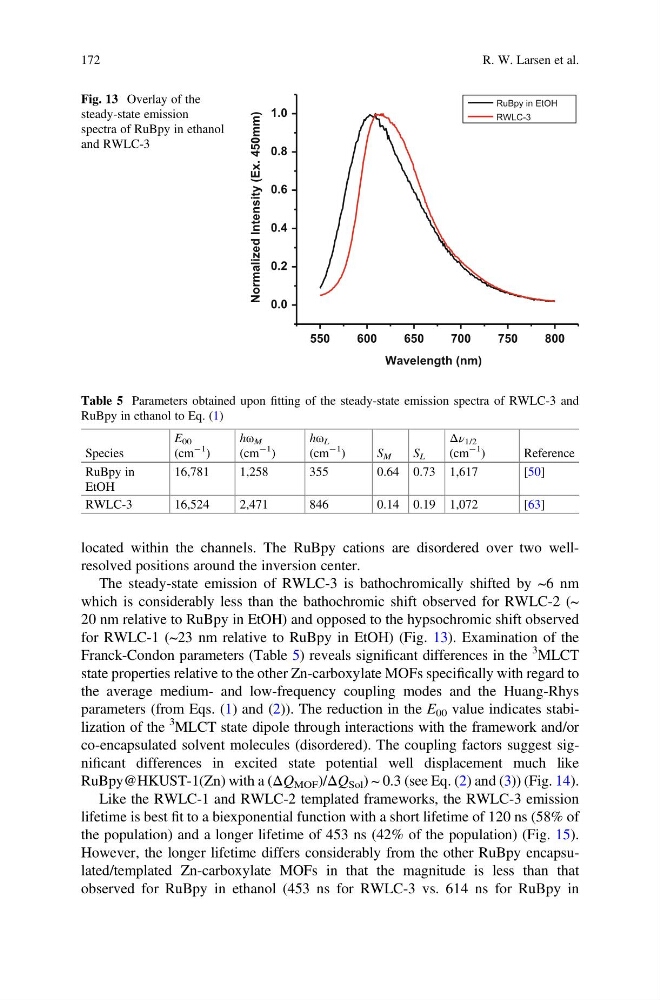
The steady-state emission of RWLC-3 is bathochromically shifted by ~6 nm
which is considerably less than the bathochromic shift observed for RWLC-2 (~
20 nm relative to RuBpy in EtOH) and opposed to the hypsochromic shift observed
for RWLC-1 (~23 nm relative to RuBpy in EtOH) (Fig. 13). Examination of the
Franck-Condon parameters (Table 5) reveals significant differences in the
3 MLCT
state properties relative to the other Zn-carboxylate MOFs specifically with regard to
the average medium- and low-frequency coupling modes and the Huang-Rhys
parameters (from Eqs. (1) and (2)). The reduction in the E 00 value indicates stabilization of the
3 MLCT state dipole through interactions with the framework and/or
co-encapsulated solvent molecules (disordered). The coupling factors suggest significant differences in excited state potential well displacement much like
RuBpy@HKUST-1(Zn) with a (ΔQ MOF )/ΔQ Sol ) ~ 0.3 (see Eq. (2) and (3)) (Fig. 14).
Like the RWLC-1 and RWLC-2 templated frameworks, the RWLC-3 emission
lifetime is best fit to a biexponential function with a short lifetime of 120 ns (58% of
the population) and a longer lifetime of 453 ns (42% of the population) (Fig. 15).
However, the longer lifetime differs considerably from the other RuBpy encapsulated/templated Zn-carboxylate MOFs in that the magnitude is less than that
observed for RuBpy in ethanol (453 ns for RWLC-3 vs. 614 ns for RuBpy in
550
600
650
700
750
800
0.0
0.2
0.4
0.6
0.8
1.0
Normalized Intensity (Ex. 450mm)
Wavelength (nm)
RuBpy in EtOH
RWLC-3
Fig. 13 Overlay of the
steady-state emission
spectra of RuBpy in ethanol
and RWLC-3
Table 5 Parameters obtained upon fitting of the steady-state emission spectra of RWLC-3 and
RuBpy in ethanol to Eq. (1)
Species
E 00
(cm
À1
)
hω M
(cm
À1
)
hω L
(cm
À1
)
S M
S L
Δν 1/2
(cm
À1
)
Reference
RuBpy in
EtOH
16,781
1,258
355
0.64 0.73 1,617
[50]
RWLC-3
16,524
2,471
846
0.14 0.19 1,072
[63]
172
R. W. Larsen et al.
The steady-state emission of RWLC-3 is bathochromically shifted by ~6 nm
which is considerably less than the bathochromic shift observed for RWLC-2 (~
20 nm relative to RuBpy in EtOH) and opposed to the hypsochromic shift observed
for RWLC-1 (~23 nm relative to RuBpy in EtOH) (Fig. 13). Examination of the
Franck-Condon parameters (Table 5) reveals significant differences in the
3 MLCT
state properties relative to the other Zn-carboxylate MOFs specifically with regard to
the average medium- and low-frequency coupling modes and the Huang-Rhys
parameters (from Eqs. (1) and (2)). The reduction in the E 00 value indicates stabilization of the
3 MLCT state dipole through interactions with the framework and/or
co-encapsulated solvent molecules (disordered). The coupling factors suggest significant differences in excited state potential well displacement much like
RuBpy@HKUST-1(Zn) with a (ΔQ MOF )/ΔQ Sol ) ~ 0.3 (see Eq. (2) and (3)) (Fig. 14).
Like the RWLC-1 and RWLC-2 templated frameworks, the RWLC-3 emission
lifetime is best fit to a biexponential function with a short lifetime of 120 ns (58% of
the population) and a longer lifetime of 453 ns (42% of the population) (Fig. 15).
However, the longer lifetime differs considerably from the other RuBpy encapsulated/templated Zn-carboxylate MOFs in that the magnitude is less than that
observed for RuBpy in ethanol (453 ns for RWLC-3 vs. 614 ns for RuBpy in
550
600
650
700
750
800
0.0
0.2
0.4
0.6
0.8
1.0
Normalized Intensity (Ex. 450mm)
Wavelength (nm)
RuBpy in EtOH
RWLC-3
Fig. 13 Overlay of the
steady-state emission
spectra of RuBpy in ethanol
and RWLC-3
Table 5 Parameters obtained upon fitting of the steady-state emission spectra of RWLC-3 and
RuBpy in ethanol to Eq. (1)
Species
E 00
(cm
À1
)
hω M
(cm
À1
)
hω L
(cm
À1
)
S M
S L
Δν 1/2
(cm
À1
)
Reference
RuBpy in
EtOH
16,781
1,258
355
0.64 0.73 1,617
[50]
RWLC-3
16,524
2,471
846
0.14 0.19 1,072
[63]
172
R. W. Larsen et al.