

MOFs and RuBpy in ethanol. In contrast, the decay rate constant for the relaxation of
the
3 MLCT to the singlet ground state (k 0 ) is nearly an order of magnitude larger for
RWLC-1 and RWLC-2 relative RuBpy in solution suggesting a quenching process
involving either self-quenching (RuBpy complexes encapsulated in close proximity)
or the presence of as yet unidentified quenching molecules co-encapsulated with the
RuBpy cations.
3.2 The RWLC-3 Templated MOF
The reaction of Zn(II) cations with a smaller 1,4-benzene dicarboxylate (BDC)
ligand in dimethylformamide produces the well-known MOF-5 material [66]. The
MOF-5 framework exhibits a zeolite-like topology with [Zn 4 O]
6+ groups organized
into an octahedral array of BDC ligands to form a porous cubic framework of space
group (Fm-3 m) [66]. The MOF-5 framework exhibits a surface area of
~3,500 m
2 g
À1 and a pore volume of 1.2 cm
3 . In the presence of RuBpy cations,
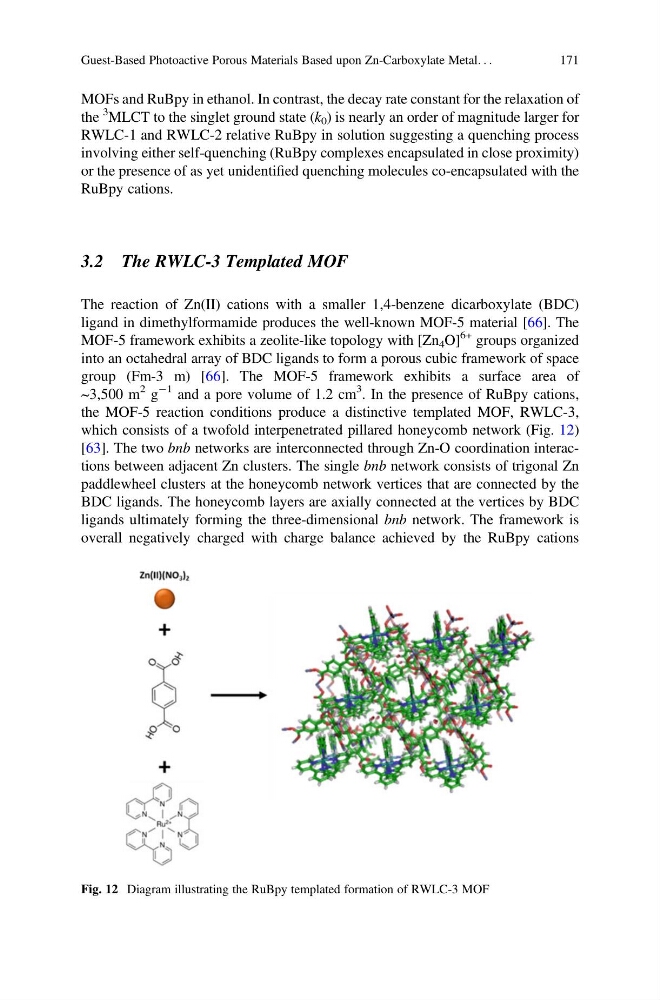
the MOF-5 reaction conditions produce a distinctive templated MOF, RWLC-3,
which consists of a twofold interpenetrated pillared honeycomb network (Fig. 12)
[63]. The two bnb networks are interconnected through Zn-O coordination interactions between adjacent Zn clusters. The single bnb network consists of trigonal Zn
paddlewheel clusters at the honeycomb network vertices that are connected by the
BDC ligands. The honeycomb layers are axially connected at the vertices by BDC
ligands ultimately forming the three-dimensional bnb network. The framework is
overall negatively charged with charge balance achieved by the RuBpy cations
Fig. 12 Diagram illustrating the RuBpy templated formation of RWLC-3 MOF
Guest-Based Photoactive Porous Materials Based upon Zn-Carboxylate Metal. . .
171
the
3 MLCT to the singlet ground state (k 0 ) is nearly an order of magnitude larger for
RWLC-1 and RWLC-2 relative RuBpy in solution suggesting a quenching process
involving either self-quenching (RuBpy complexes encapsulated in close proximity)
or the presence of as yet unidentified quenching molecules co-encapsulated with the
RuBpy cations.
3.2 The RWLC-3 Templated MOF
The reaction of Zn(II) cations with a smaller 1,4-benzene dicarboxylate (BDC)
ligand in dimethylformamide produces the well-known MOF-5 material [66]. The
MOF-5 framework exhibits a zeolite-like topology with [Zn 4 O]
6+ groups organized
into an octahedral array of BDC ligands to form a porous cubic framework of space
group (Fm-3 m) [66]. The MOF-5 framework exhibits a surface area of
~3,500 m
2 g
À1 and a pore volume of 1.2 cm
3 . In the presence of RuBpy cations,
the MOF-5 reaction conditions produce a distinctive templated MOF, RWLC-3,
which consists of a twofold interpenetrated pillared honeycomb network (Fig. 12)
[63]. The two bnb networks are interconnected through Zn-O coordination interactions between adjacent Zn clusters. The single bnb network consists of trigonal Zn
paddlewheel clusters at the honeycomb network vertices that are connected by the
BDC ligands. The honeycomb layers are axially connected at the vertices by BDC
ligands ultimately forming the three-dimensional bnb network. The framework is
overall negatively charged with charge balance achieved by the RuBpy cations
Fig. 12 Diagram illustrating the RuBpy templated formation of RWLC-3 MOF
Guest-Based Photoactive Porous Materials Based upon Zn-Carboxylate Metal. . .
171