

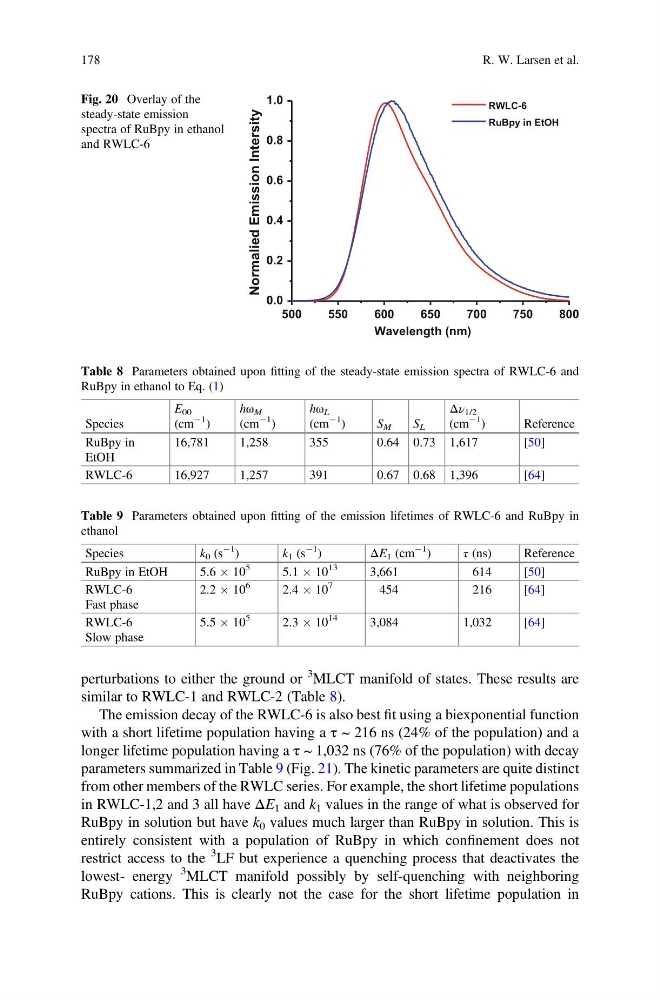
perturbations to either the ground or
3 MLCT manifold of states. These results are
similar to RWLC-1 and RWLC-2 (Table 8).
The emission decay of the RWLC-6 is also best fit using a biexponential function
with a short lifetime population having a τ ~ 216 ns (24% of the population) and a
longer lifetime population having a τ ~ 1,032 ns (76% of the population) with decay
parameters summarized in Table 9 (Fig. 21). The kinetic parameters are quite distinct
from other members of the RWLC series. For example, the short lifetime populations
in RWLC-1,2 and 3 all have ΔE 1 and k 1 values in the range of what is observed for
RuBpy in solution but have k 0 values much larger than RuBpy in solution. This is
entirely consistent with a population of RuBpy in which confinement does not
restrict access to the
3 LF but experience a quenching process that deactivates the
lowest- energy
3
MLCT manifold possibly by self-quenching with neighboring
RuBpy cations. This is clearly not the case for the short lifetime population in
500
550
600
650
700
750
800
0.0
0.2
0.4
0.6
0.8
1.0
Normalied Emission Intersity
Wavelength (nm)
RWLC-6
RuBpy in EtOH
Fig. 20 Overlay of the
steady-state emission
spectra of RuBpy in ethanol
and RWLC-6
Table 8 Parameters obtained upon fitting of the steady-state emission spectra of RWLC-6 and
RuBpy in ethanol to Eq. (1)
Species
E 00
(cm
À1
)
hω M
(cm
À1
)
hω L
(cm
À1
)
S M
S L
Δν 1/2
(cm
À1
)
Reference
RuBpy in
EtOH
16,781
1,258
355
0.64 0.73 1,617
[50]
RWLC-6
16,927
1,257
391
0.67 0.68 1,396
[64]
Table 9 Parameters obtained upon fitting of the emission lifetimes of RWLC-6 and RuBpy in
ethanol
Species
k 0 (s
À1
)
k 1 (s
À1
)
ΔE 1 (cm
À1
)
τ (ns)
Reference
RuBpy in EtOH
5.6 Â 10
5
5.1 Â 10
13
3,661
614
[50]
RWLC-6
Fast phase
2.2 Â 10
6
2.4 Â 10
7
454
216
[64]
RWLC-6
Slow phase
5.5 Â 10
5
2.3 Â 10
14
3,084
1,032
[64]
178
R. W. Larsen et al.
3 MLCT manifold of states. These results are
similar to RWLC-1 and RWLC-2 (Table 8).
The emission decay of the RWLC-6 is also best fit using a biexponential function
with a short lifetime population having a τ ~ 216 ns (24% of the population) and a
longer lifetime population having a τ ~ 1,032 ns (76% of the population) with decay
parameters summarized in Table 9 (Fig. 21). The kinetic parameters are quite distinct
from other members of the RWLC series. For example, the short lifetime populations
in RWLC-1,2 and 3 all have ΔE 1 and k 1 values in the range of what is observed for
RuBpy in solution but have k 0 values much larger than RuBpy in solution. This is
entirely consistent with a population of RuBpy in which confinement does not
restrict access to the
3 LF but experience a quenching process that deactivates the
lowest- energy
3
MLCT manifold possibly by self-quenching with neighboring
RuBpy cations. This is clearly not the case for the short lifetime population in
500
550
600
650
700
750
800
0.0
0.2
0.4
0.6
0.8
1.0
Normalied Emission Intersity
Wavelength (nm)
RWLC-6
RuBpy in EtOH
Fig. 20 Overlay of the
steady-state emission
spectra of RuBpy in ethanol
and RWLC-6
Table 8 Parameters obtained upon fitting of the steady-state emission spectra of RWLC-6 and
RuBpy in ethanol to Eq. (1)
Species
E 00
(cm
À1
)
hω M
(cm
À1
)
hω L
(cm
À1
)
S M
S L
Δν 1/2
(cm
À1
)
Reference
RuBpy in
EtOH
16,781
1,258
355
0.64 0.73 1,617
[50]
RWLC-6
16,927
1,257
391
0.67 0.68 1,396
[64]
Table 9 Parameters obtained upon fitting of the emission lifetimes of RWLC-6 and RuBpy in
ethanol
Species
k 0 (s
À1
)
k 1 (s
À1
)
ΔE 1 (cm
À1
)
τ (ns)
Reference
RuBpy in EtOH
5.6 Â 10
5
5.1 Â 10
13
3,661
614
[50]
RWLC-6
Fast phase
2.2 Â 10
6
2.4 Â 10
7
454
216
[64]
RWLC-6
Slow phase
5.5 Â 10
5
2.3 Â 10
14
3,084
1,032
[64]
178
R. W. Larsen et al.