

destabilize the
3 MLCT state manifold much like the charge associated with the USF2
framework discussed above.
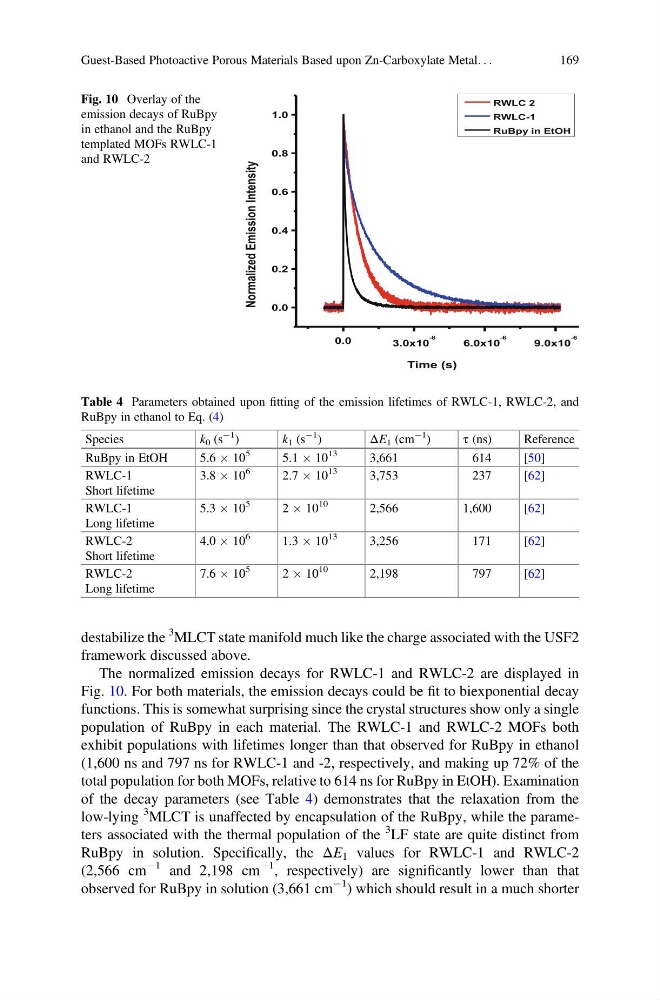
The normalized emission decays for RWLC-1 and RWLC-2 are displayed in
Fig. 10. For both materials, the emission decays could be fit to biexponential decay
functions. This is somewhat surprising since the crystal structures show only a single
population of RuBpy in each material. The RWLC-1 and RWLC-2 MOFs both
exhibit populations with lifetimes longer than that observed for RuBpy in ethanol
(1,600 ns and 797 ns for RWLC-1 and -2, respectively, and making up 72% of the
total population for both MOFs, relative to 614 ns for RuBpy in EtOH). Examination
of the decay parameters (see Table 4) demonstrates that the relaxation from the
low-lying
3 MLCT is unaffected by encapsulation of the RuBpy, while the parameters associated with the thermal population of the
3 LF state are quite distinct from
RuBpy in solution. Specifically, the ΔE 1 values for RWLC-1 and RWLC-2
(2,566 cm
À1 and 2,198 cm
À1 , respectively) are significantly lower than that
observed for RuBpy in solution (3,661 cm
À1 ) which should result in a much shorter
Fig. 10 Overlay of the
emission decays of RuBpy
in ethanol and the RuBpy
templated MOFs RWLC-1
and RWLC-2
Table 4 Parameters obtained upon fitting of the emission lifetimes of RWLC-1, RWLC-2, and
RuBpy in ethanol to Eq. (4)
Species
k 0 (s
À1
)
k 1 (s
À1 )
ΔE 1 (cm
À1
)
τ (ns)
Reference
RuBpy in EtOH
5.6 Â 10
5
5.1 Â 10
13
3,661
614
[50]
RWLC-1
Short lifetime
3.8 Â 10
6
2.7 Â 10
13
3,753
237
[62]
RWLC-1
Long lifetime
5.3 Â 10
5
2 Â 10
10
2,566
1,600
[62]
RWLC-2
Short lifetime
4.0 Â 10
6
1.3 Â 10
13
3,256
171
[62]
RWLC-2
Long lifetime
7.6 Â 10
5
2 Â 10
10
2,198
797
[62]
Guest-Based Photoactive Porous Materials Based upon Zn-Carboxylate Metal. . .
169
3 MLCT state manifold much like the charge associated with the USF2
framework discussed above.
The normalized emission decays for RWLC-1 and RWLC-2 are displayed in
Fig. 10. For both materials, the emission decays could be fit to biexponential decay
functions. This is somewhat surprising since the crystal structures show only a single
population of RuBpy in each material. The RWLC-1 and RWLC-2 MOFs both
exhibit populations with lifetimes longer than that observed for RuBpy in ethanol
(1,600 ns and 797 ns for RWLC-1 and -2, respectively, and making up 72% of the
total population for both MOFs, relative to 614 ns for RuBpy in EtOH). Examination
of the decay parameters (see Table 4) demonstrates that the relaxation from the
low-lying
3 MLCT is unaffected by encapsulation of the RuBpy, while the parameters associated with the thermal population of the
3 LF state are quite distinct from
RuBpy in solution. Specifically, the ΔE 1 values for RWLC-1 and RWLC-2
(2,566 cm
À1 and 2,198 cm
À1 , respectively) are significantly lower than that
observed for RuBpy in solution (3,661 cm
À1 ) which should result in a much shorter
Fig. 10 Overlay of the
emission decays of RuBpy
in ethanol and the RuBpy
templated MOFs RWLC-1
and RWLC-2
Table 4 Parameters obtained upon fitting of the emission lifetimes of RWLC-1, RWLC-2, and
RuBpy in ethanol to Eq. (4)
Species
k 0 (s
À1
)
k 1 (s
À1 )
ΔE 1 (cm
À1
)
τ (ns)
Reference
RuBpy in EtOH
5.6 Â 10
5
5.1 Â 10
13
3,661
614
[50]
RWLC-1
Short lifetime
3.8 Â 10
6
2.7 Â 10
13
3,753
237
[62]
RWLC-1
Long lifetime
5.3 Â 10
5
2 Â 10
10
2,566
1,600
[62]
RWLC-2
Short lifetime
4.0 Â 10
6
1.3 Â 10
13
3,256
171
[62]
RWLC-2
Long lifetime
7.6 Â 10
5
2 Â 10
10
2,198
797
[62]
Guest-Based Photoactive Porous Materials Based upon Zn-Carboxylate Metal. . .
169