

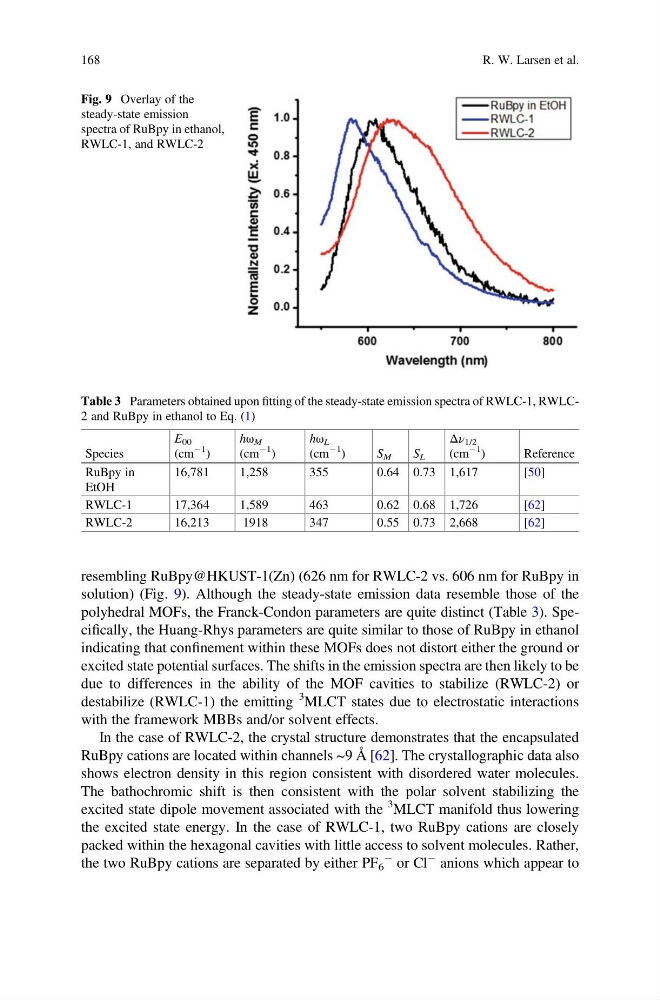
resembling RuBpy@HKUST-1(Zn) (626 nm for RWLC-2 vs. 606 nm for RuBpy in
solution) (Fig. 9). Although the steady-state emission data resemble those of the
polyhedral MOFs, the Franck-Condon parameters are quite distinct (Table 3). Specifically, the Huang-Rhys parameters are quite similar to those of RuBpy in ethanol
indicating that confinement within these MOFs does not distort either the ground or
excited state potential surfaces. The shifts in the emission spectra are then likely to be
due to differences in the ability of the MOF cavities to stabilize (RWLC-2) or
destabilize (RWLC-1) the emitting
3 MLCT states due to electrostatic interactions
with the framework MBBs and/or solvent effects.
In the case of RWLC-2, the crystal structure demonstrates that the encapsulated
RuBpy cations are located within channels ~9 Å [62]. The crystallographic data also
shows electron density in this region consistent with disordered water molecules.
The bathochromic shift is then consistent with the polar solvent stabilizing the
excited state dipole movement associated with the
3 MLCT manifold thus lowering
the excited state energy. In the case of RWLC-1, two RuBpy cations are closely
packed within the hexagonal cavities with little access to solvent molecules. Rather,
the two RuBpy cations are separated by either PF 6
À or Cl
À anions which appear to
Fig. 9 Overlay of the
steady-state emission
spectra of RuBpy in ethanol,
RWLC-1, and RWLC-2
Table 3 Parameters obtained upon fitting of the steady-state emission spectra of RWLC-1, RWLC2 and RuBpy in ethanol to Eq. (1)
Species
E 00
(cm
À1
)
hω M
(cm
À1
)
hω L
(cm
À1
)
S M
S L
Δν 1/2
(cm
À1
)
Reference
RuBpy in
EtOH
16,781
1,258
355
0.64 0.73 1,617
[50]
RWLC-1
17,364
1,589
463
0.62 0.68 1,726
[62]
RWLC-2
16,213
1918
347
0.55 0.73 2,668
[62]
168
R. W. Larsen et al.
solution) (Fig. 9). Although the steady-state emission data resemble those of the
polyhedral MOFs, the Franck-Condon parameters are quite distinct (Table 3). Specifically, the Huang-Rhys parameters are quite similar to those of RuBpy in ethanol
indicating that confinement within these MOFs does not distort either the ground or
excited state potential surfaces. The shifts in the emission spectra are then likely to be
due to differences in the ability of the MOF cavities to stabilize (RWLC-2) or
destabilize (RWLC-1) the emitting
3 MLCT states due to electrostatic interactions
with the framework MBBs and/or solvent effects.
In the case of RWLC-2, the crystal structure demonstrates that the encapsulated
RuBpy cations are located within channels ~9 Å [62]. The crystallographic data also
shows electron density in this region consistent with disordered water molecules.
The bathochromic shift is then consistent with the polar solvent stabilizing the
excited state dipole movement associated with the
3 MLCT manifold thus lowering
the excited state energy. In the case of RWLC-1, two RuBpy cations are closely
packed within the hexagonal cavities with little access to solvent molecules. Rather,
the two RuBpy cations are separated by either PF 6
À or Cl
À anions which appear to
Fig. 9 Overlay of the
steady-state emission
spectra of RuBpy in ethanol,
RWLC-1, and RWLC-2
Table 3 Parameters obtained upon fitting of the steady-state emission spectra of RWLC-1, RWLC2 and RuBpy in ethanol to Eq. (1)
Species
E 00
(cm
À1
)
hω M
(cm
À1
)
hω L
(cm
À1
)
S M
S L
Δν 1/2
(cm
À1
)
Reference
RuBpy in
EtOH
16,781
1,258
355
0.64 0.73 1,617
[50]
RWLC-1
17,364
1,589
463
0.62 0.68 1,726
[62]
RWLC-2
16,213
1918
347
0.55 0.73 2,668
[62]
168
R. W. Larsen et al.