

light harvesting and photocatalytic applications. Recently, the templating effects of
RuBpy-type complexes have been exploited to produce a number of novel RuBpyMOFs in which the Ru(II) cation is crystallographically resolved. For many of these
MOFs, the frameworks do not form in the absence of the Ru(II) complexes [62–65].
3.1 The RWLC-1 and RWLC-2 Templated MOFs
Under solvothermal conditions, a solution containing RuBpy, Zn(II) cations, and
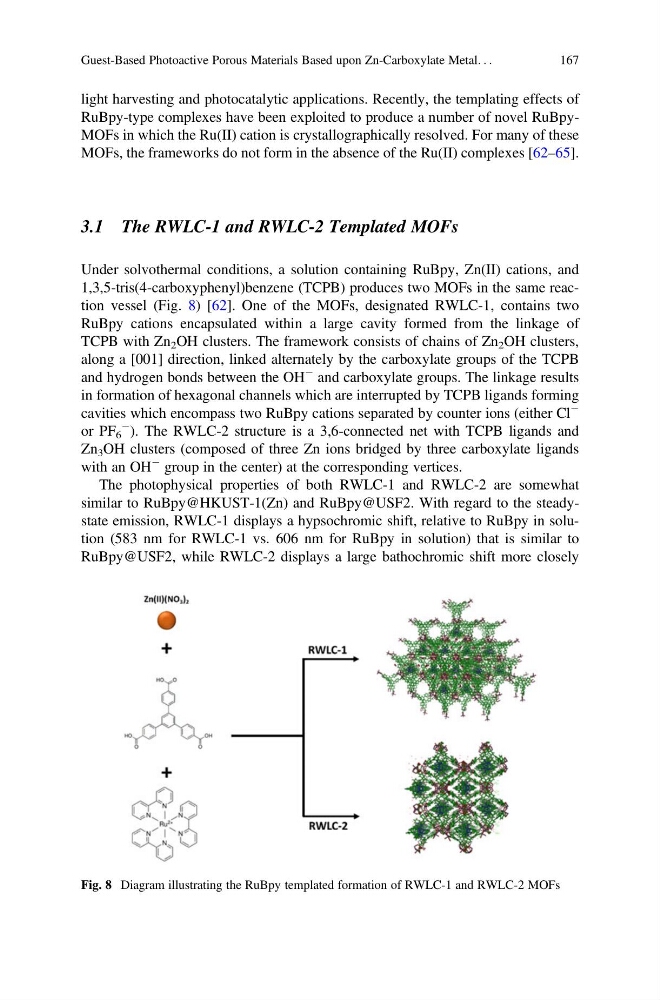
1,3,5-tris(4-carboxyphenyl)benzene (TCPB) produces two MOFs in the same reaction vessel (Fig. 8) [62]. One of the MOFs, designated RWLC-1, contains two
RuBpy cations encapsulated within a large cavity formed from the linkage of
TCPB with Zn 2 OH clusters. The framework consists of chains of Zn 2 OH clusters,
along a [001] direction, linked alternately by the carboxylate groups of the TCPB
and hydrogen bonds between the OH
À and carboxylate groups. The linkage results
in formation of hexagonal channels which are interrupted by TCPB ligands forming
cavities which encompass two RuBpy cations separated by counter ions (either Cl
À
or PF 6
À ). The RWLC-2 structure is a 3,6-connected net with TCPB ligands and
Zn 3 OH clusters (composed of three Zn ions bridged by three carboxylate ligands
with an OH
À group in the center) at the corresponding vertices.
The photophysical properties of both RWLC-1 and RWLC-2 are somewhat
similar to RuBpy@HKUST-1(Zn) and RuBpy@USF2. With regard to the steadystate emission, RWLC-1 displays a hypsochromic shift, relative to RuBpy in solution (583 nm for RWLC-1 vs. 606 nm for RuBpy in solution) that is similar to
RuBpy@USF2, while RWLC-2 displays a large bathochromic shift more closely
Fig. 8 Diagram illustrating the RuBpy templated formation of RWLC-1 and RWLC-2 MOFs
Guest-Based Photoactive Porous Materials Based upon Zn-Carboxylate Metal. . .
167
RuBpy-type complexes have been exploited to produce a number of novel RuBpyMOFs in which the Ru(II) cation is crystallographically resolved. For many of these
MOFs, the frameworks do not form in the absence of the Ru(II) complexes [62–65].
3.1 The RWLC-1 and RWLC-2 Templated MOFs
Under solvothermal conditions, a solution containing RuBpy, Zn(II) cations, and
1,3,5-tris(4-carboxyphenyl)benzene (TCPB) produces two MOFs in the same reaction vessel (Fig. 8) [62]. One of the MOFs, designated RWLC-1, contains two
RuBpy cations encapsulated within a large cavity formed from the linkage of
TCPB with Zn 2 OH clusters. The framework consists of chains of Zn 2 OH clusters,
along a [001] direction, linked alternately by the carboxylate groups of the TCPB
and hydrogen bonds between the OH
À and carboxylate groups. The linkage results
in formation of hexagonal channels which are interrupted by TCPB ligands forming
cavities which encompass two RuBpy cations separated by counter ions (either Cl
À
or PF 6
À ). The RWLC-2 structure is a 3,6-connected net with TCPB ligands and
Zn 3 OH clusters (composed of three Zn ions bridged by three carboxylate ligands
with an OH
À group in the center) at the corresponding vertices.
The photophysical properties of both RWLC-1 and RWLC-2 are somewhat
similar to RuBpy@HKUST-1(Zn) and RuBpy@USF2. With regard to the steadystate emission, RWLC-1 displays a hypsochromic shift, relative to RuBpy in solution (583 nm for RWLC-1 vs. 606 nm for RuBpy in solution) that is similar to
RuBpy@USF2, while RWLC-2 displays a large bathochromic shift more closely
Fig. 8 Diagram illustrating the RuBpy templated formation of RWLC-1 and RWLC-2 MOFs
Guest-Based Photoactive Porous Materials Based upon Zn-Carboxylate Metal. . .
167