

where Δν 1/2 is the full width at half maximum, n and m are the vibrational quantum
numbers for medium, and low-frequency acceptor vibrational modes, S M and S L are
the corresponding vibronic coupling factors (Huang-Rhys factors), and hω M and hω L
are the average vibrational frequencies of the acceptor modes [53]. In the case of
RuBpy complexes, the ground and lowest energy
3 MLCT states are coupled through
medium-frequency ν(Bpy) ring stretching modes, low- frequency ring torsional
modes, and lower frequency Ru-N stretching modes [53]. The data for the fits to
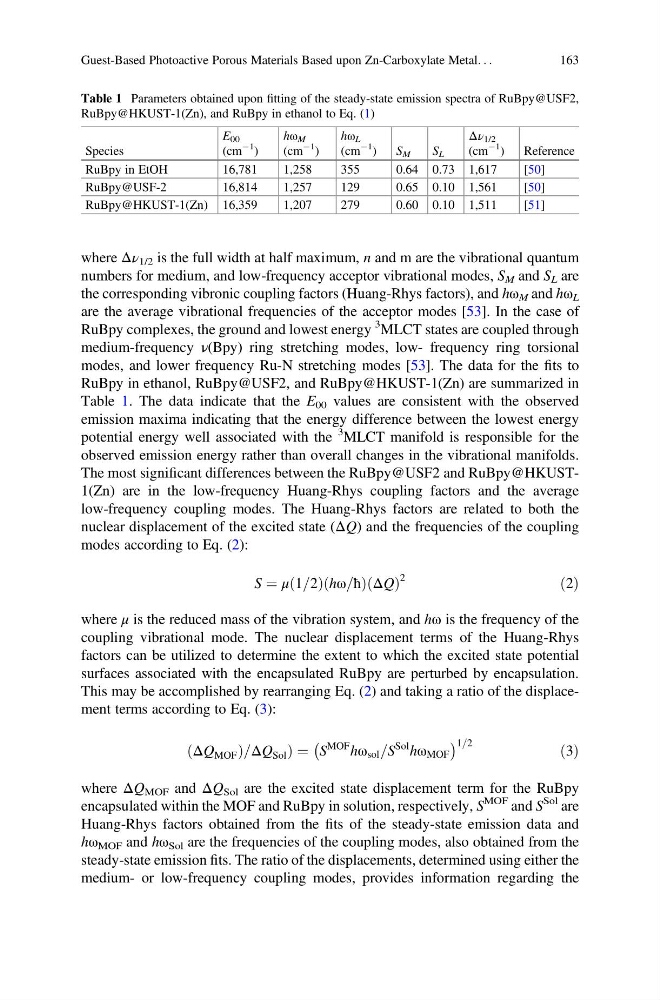
RuBpy in ethanol, RuBpy@USF2, and RuBpy@HKUST-1(Zn) are summarized in
Table 1. The data indicate that the E 00 values are consistent with the observed
emission maxima indicating that the energy difference between the lowest energy
potential energy well associated with the
3 MLCT manifold is responsible for the
observed emission energy rather than overall changes in the vibrational manifolds.
The most significant differences between the RuBpy@USF2 and RuBpy@HKUST1(Zn) are in the low-frequency Huang-Rhys coupling factors and the average
low-frequency coupling modes. The Huang-Rhys factors are related to both the
nuclear displacement of the excited state (ΔQ) and the frequencies of the coupling
modes according to Eq. (2):
S ¼ μ 1=2
ð
Þ hω=ħ
ð
Þ ΔQ
ð Þ
2
ð2Þ
where μ is the reduced mass of the vibration system, and hω is the frequency of the
coupling vibrational mode. The nuclear displacement terms of the Huang-Rhys
factors can be utilized to determine the extent to which the excited state potential
surfaces associated with the encapsulated RuBpy are perturbed by encapsulation.
This may be accomplished by rearranging Eq. (2) and taking a ratio of the displacement terms according to Eq. (3):
ΔQ MOF
ð
Þ=ΔQ Sol Þ ¼ S
MOF hω sol =S
Sol hω MOF
À
Á 1=2
ð3Þ
where ΔQ MOF and ΔQ Sol are the excited state displacement term for the RuBpy
encapsulated within the MOF and RuBpy in solution, respectively, S
MOF and S
Sol are
Huang-Rhys factors obtained from the fits of the steady-state emission data and
hω MOF and hω Sol are the frequencies of the coupling modes, also obtained from the
steady-state emission fits. The ratio of the displacements, determined using either the
medium- or low-frequency coupling modes, provides information regarding the
Table 1 Parameters obtained upon fitting of the steady-state emission spectra of RuBpy@USF2,
RuBpy@HKUST-1(Zn), and RuBpy in ethanol to Eq. (1)
Species
E 00
(cm
À1
)
hω M
(cm
À1
)
hω L
(cm
À1
)
S M
S L
Δν 1/2
(cm
À1
)
Reference
RuBpy in EtOH
16,781
1,258
355
0.64 0.73 1,617
[50]
RuBpy@USF-2
16,814
1,257
129
0.65 0.10 1,561
[50]
RuBpy@HKUST-1(Zn) 16,359
1,207
279
0.60 0.10 1,511
[51]
Guest-Based Photoactive Porous Materials Based upon Zn-Carboxylate Metal. . .
163
numbers for medium, and low-frequency acceptor vibrational modes, S M and S L are
the corresponding vibronic coupling factors (Huang-Rhys factors), and hω M and hω L
are the average vibrational frequencies of the acceptor modes [53]. In the case of
RuBpy complexes, the ground and lowest energy
3 MLCT states are coupled through
medium-frequency ν(Bpy) ring stretching modes, low- frequency ring torsional
modes, and lower frequency Ru-N stretching modes [53]. The data for the fits to
RuBpy in ethanol, RuBpy@USF2, and RuBpy@HKUST-1(Zn) are summarized in
Table 1. The data indicate that the E 00 values are consistent with the observed
emission maxima indicating that the energy difference between the lowest energy
potential energy well associated with the
3 MLCT manifold is responsible for the
observed emission energy rather than overall changes in the vibrational manifolds.
The most significant differences between the RuBpy@USF2 and RuBpy@HKUST1(Zn) are in the low-frequency Huang-Rhys coupling factors and the average
low-frequency coupling modes. The Huang-Rhys factors are related to both the
nuclear displacement of the excited state (ΔQ) and the frequencies of the coupling
modes according to Eq. (2):
S ¼ μ 1=2
ð
Þ hω=ħ
ð
Þ ΔQ
ð Þ
2
ð2Þ
where μ is the reduced mass of the vibration system, and hω is the frequency of the
coupling vibrational mode. The nuclear displacement terms of the Huang-Rhys
factors can be utilized to determine the extent to which the excited state potential
surfaces associated with the encapsulated RuBpy are perturbed by encapsulation.
This may be accomplished by rearranging Eq. (2) and taking a ratio of the displacement terms according to Eq. (3):
ΔQ MOF
ð
Þ=ΔQ Sol Þ ¼ S
MOF hω sol =S
Sol hω MOF
À
Á 1=2
ð3Þ
where ΔQ MOF and ΔQ Sol are the excited state displacement term for the RuBpy
encapsulated within the MOF and RuBpy in solution, respectively, S
MOF and S
Sol are
Huang-Rhys factors obtained from the fits of the steady-state emission data and
hω MOF and hω Sol are the frequencies of the coupling modes, also obtained from the
steady-state emission fits. The ratio of the displacements, determined using either the
medium- or low-frequency coupling modes, provides information regarding the
Table 1 Parameters obtained upon fitting of the steady-state emission spectra of RuBpy@USF2,
RuBpy@HKUST-1(Zn), and RuBpy in ethanol to Eq. (1)
Species
E 00
(cm
À1
)
hω M
(cm
À1
)
hω L
(cm
À1
)
S M
S L
Δν 1/2
(cm
À1
)
Reference
RuBpy in EtOH
16,781
1,258
355
0.64 0.73 1,617
[50]
RuBpy@USF-2
16,814
1,257
129
0.65 0.10 1,561
[50]
RuBpy@HKUST-1(Zn) 16,359
1,207
279
0.60 0.10 1,511
[51]
Guest-Based Photoactive Porous Materials Based upon Zn-Carboxylate Metal. . .
163