

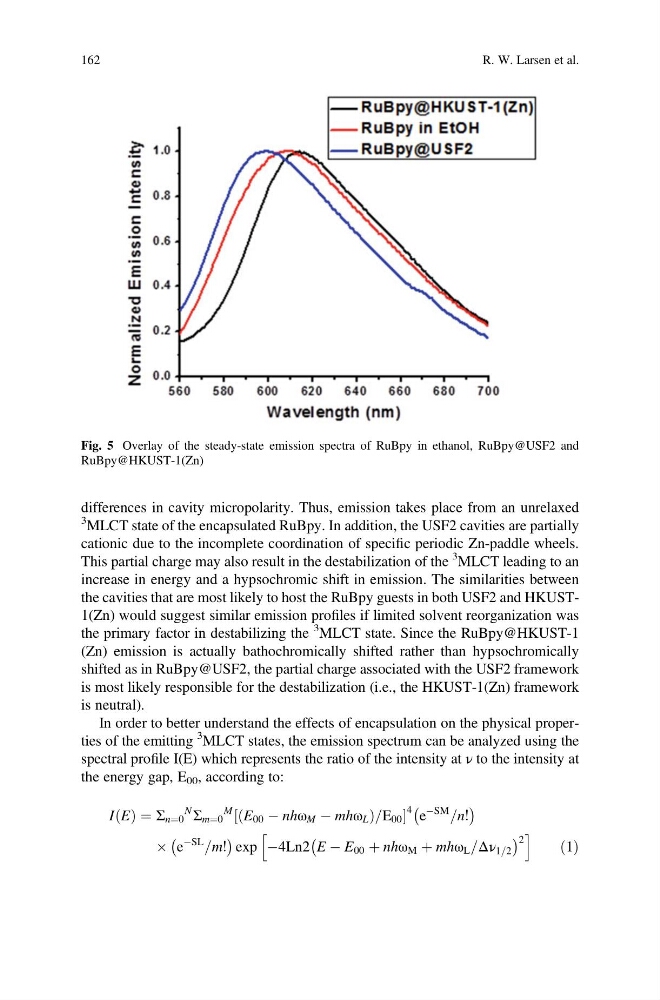
differences in cavity micropolarity. Thus, emission takes place from an unrelaxed
3 MLCT state of the encapsulated RuBpy. In addition, the USF2 cavities are partially
cationic due to the incomplete coordination of specific periodic Zn-paddle wheels.
This partial charge may also result in the destabilization of the
3 MLCT leading to an
increase in energy and a hypsochromic shift in emission. The similarities between
the cavities that are most likely to host the RuBpy guests in both USF2 and HKUST1(Zn) would suggest similar emission profiles if limited solvent reorganization was
the primary factor in destabilizing the
3 MLCT state. Since the RuBpy@HKUST-1
(Zn) emission is actually bathochromically shifted rather than hypsochromically
shifted as in RuBpy@USF2, the partial charge associated with the USF2 framework
is most likely responsible for the destabilization (i.e., the HKUST-1(Zn) framework
is neutral).
In order to better understand the effects of encapsulation on the physical properties of the emitting
3 MLCT states, the emission spectrum can be analyzed using the
spectral profile I(E) which represents the ratio of the intensity at ν to the intensity at
the energy gap, E 00 , according to:
I E
ð Þ ¼ Σ n¼0
N
Σ m¼0
M E 00 À nhω M À mhω L
ð
Þ =E 00
½
4 e
ÀSM
=n!
À
Á
 e
ÀSL
=m!
À
Á
exp À4Ln2 E À E 00 þ nhω M þ mhω L =Δν 1=2
À
Á 2
h
i
ð1Þ
Fig. 5 Overlay of the steady-state emission spectra of RuBpy in ethanol, RuBpy@USF2 and
RuBpy@HKUST-1(Zn)
162
R. W. Larsen et al.
3 MLCT state of the encapsulated RuBpy. In addition, the USF2 cavities are partially
cationic due to the incomplete coordination of specific periodic Zn-paddle wheels.
This partial charge may also result in the destabilization of the
3 MLCT leading to an
increase in energy and a hypsochromic shift in emission. The similarities between
the cavities that are most likely to host the RuBpy guests in both USF2 and HKUST1(Zn) would suggest similar emission profiles if limited solvent reorganization was
the primary factor in destabilizing the
3 MLCT state. Since the RuBpy@HKUST-1
(Zn) emission is actually bathochromically shifted rather than hypsochromically
shifted as in RuBpy@USF2, the partial charge associated with the USF2 framework
is most likely responsible for the destabilization (i.e., the HKUST-1(Zn) framework
is neutral).
In order to better understand the effects of encapsulation on the physical properties of the emitting
3 MLCT states, the emission spectrum can be analyzed using the
spectral profile I(E) which represents the ratio of the intensity at ν to the intensity at
the energy gap, E 00 , according to:
I E
ð Þ ¼ Σ n¼0
N
Σ m¼0
M E 00 À nhω M À mhω L
ð
Þ =E 00
½
4 e
ÀSM
=n!
À
Á
 e
ÀSL
=m!
À
Á
exp À4Ln2 E À E 00 þ nhω M þ mhω L =Δν 1=2
À
Á 2
h
i
ð1Þ
Fig. 5 Overlay of the steady-state emission spectra of RuBpy in ethanol, RuBpy@USF2 and
RuBpy@HKUST-1(Zn)
162
R. W. Larsen et al.