

2.2 Encapsulation of RuBpy Within USF2
and HKUST-1(Zn) (RuBpy@USF2
and RuBpy@HKUST-1(Zn))
One of the early examples of photoactive transition metal polyimine guest encapsulation within a MOF was RuBpy encapsulated within the Zn-carboxylate MOF
USF2 (RuBpy@USF2) [50]. These materials were prepared at room temperature
using a so-called crystallization inclusion technique in which the guest is present
during MOF synthesis. In the presence of RuBpy, the synthesis of USF2 produces
orange crystals with the same unit cell as the parent USF2. The RuBpy cations could
not be crystallographically resolved within the framework, but their presence within
the MOF framework is confirmed from the photophysical properties. The most
probable cavity for encapsulation is the cuboctahedron with a diameter of ~15 Å
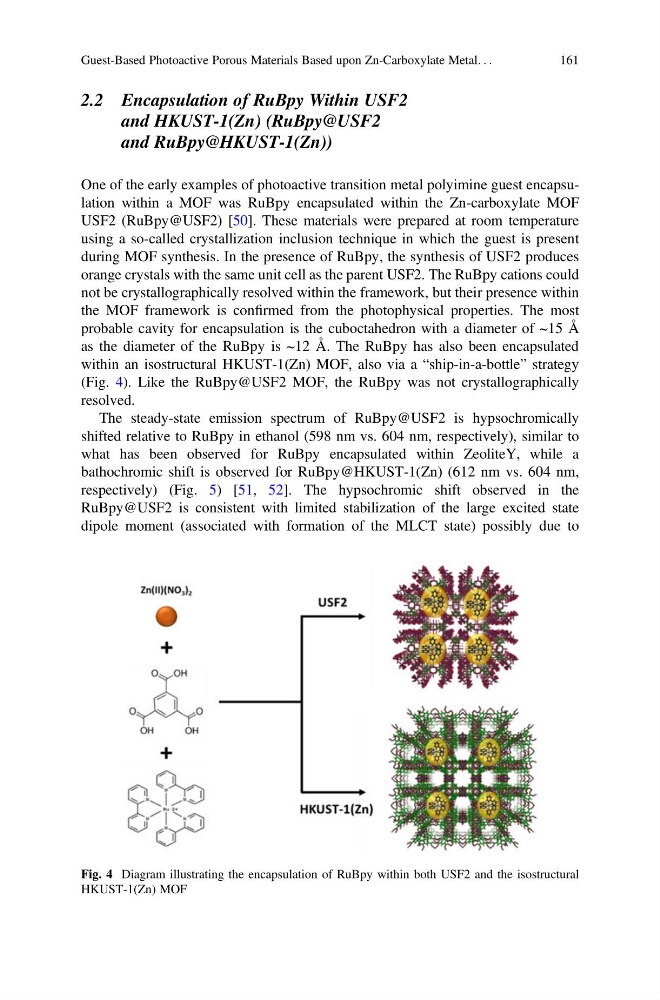
as the diameter of the RuBpy is ~12 Å. The RuBpy has also been encapsulated
within an isostructural HKUST-1(Zn) MOF, also via a “ship-in-a-bottle” strategy
(Fig. 4). Like the RuBpy@USF2 MOF, the RuBpy was not crystallographically
resolved.
The steady-state emission spectrum of RuBpy@USF2 is hypsochromically
shifted relative to RuBpy in ethanol (598 nm vs. 604 nm, respectively), similar to
what has been observed for RuBpy encapsulated within ZeoliteY, while a
bathochromic shift is observed for RuBpy@HKUST-1(Zn) (612 nm vs. 604 nm,
respectively) (Fig. 5) [51, 52]. The hypsochromic shift observed in the
RuBpy@USF2 is consistent with limited stabilization of the large excited state
dipole moment (associated with formation of the MLCT state) possibly due to
Fig. 4 Diagram illustrating the encapsulation of RuBpy within both USF2 and the isostructural
HKUST-1(Zn) MOF
Guest-Based Photoactive Porous Materials Based upon Zn-Carboxylate Metal. . .
161
and HKUST-1(Zn) (RuBpy@USF2
and RuBpy@HKUST-1(Zn))
One of the early examples of photoactive transition metal polyimine guest encapsulation within a MOF was RuBpy encapsulated within the Zn-carboxylate MOF
USF2 (RuBpy@USF2) [50]. These materials were prepared at room temperature
using a so-called crystallization inclusion technique in which the guest is present
during MOF synthesis. In the presence of RuBpy, the synthesis of USF2 produces
orange crystals with the same unit cell as the parent USF2. The RuBpy cations could
not be crystallographically resolved within the framework, but their presence within
the MOF framework is confirmed from the photophysical properties. The most
probable cavity for encapsulation is the cuboctahedron with a diameter of ~15 Å
as the diameter of the RuBpy is ~12 Å. The RuBpy has also been encapsulated
within an isostructural HKUST-1(Zn) MOF, also via a “ship-in-a-bottle” strategy
(Fig. 4). Like the RuBpy@USF2 MOF, the RuBpy was not crystallographically
resolved.
The steady-state emission spectrum of RuBpy@USF2 is hypsochromically
shifted relative to RuBpy in ethanol (598 nm vs. 604 nm, respectively), similar to
what has been observed for RuBpy encapsulated within ZeoliteY, while a
bathochromic shift is observed for RuBpy@HKUST-1(Zn) (612 nm vs. 604 nm,
respectively) (Fig. 5) [51, 52]. The hypsochromic shift observed in the
RuBpy@USF2 is consistent with limited stabilization of the large excited state
dipole moment (associated with formation of the MLCT state) possibly due to
Fig. 4 Diagram illustrating the encapsulation of RuBpy within both USF2 and the isostructural
HKUST-1(Zn) MOF
Guest-Based Photoactive Porous Materials Based upon Zn-Carboxylate Metal. . .
161